The 2026 move in enterprise AI is to point an assistant at everything the company has already written. Microsoft 365 Copilot indexes the SharePoint estate, the document-management vendors have all shipped a copilot of their own, and the demo always uses a clean document. Industrial document estates are not clean, and the specific way they are dirty is what defeats retrieval: a large part of any real bid package is superseded, duplicated, or cited but absent.
What is a ghost spec?
A ghost spec is a specification that a requisition, purchase order or contract calls out by number, but which is not in the package you were given. The reference is binding. The document is missing.
They are ordinary. A material requisition (MR) for a package of pumps lists the client's welding standard, painting standard, inspection and test plan requirements, packing and preservation standard, and site-specific electrical area classification, each by document number. The ones attached are the ones somebody remembered to attach. Specifications also reference other specifications, two or three levels deep, so a datasheet that says "external coating to CS-2201" is a dead end unless CS-2201 travelled with it.
The ghost spec has a quieter cousin: the silent supersession. Revision C of the client specification lands mid-tender as an attachment to a technical query answer. The project folder still holds Revision B, nobody renames anything, and both copies now look equally authoritative to anyone who opens the folder. Multiply that by a spec pile copied into department folders, a bidder's own extranet, and three sub-suppliers' inboxes, and the estate contains many near-identical documents with no shared account of which one governs.
Why doesn't the document management system already solve this?
Because the systems that enforce revision authority govern the documents your own company issues, and a bid package is mostly documents somebody else issued.
Look at the stack honestly. Project collaboration platforms (Oracle Aconex, Bentley ProjectWise) are strong at controlled transmittals and registers, and they lose authority the moment a file leaves through a portal download or an email attachment, which is how bidders and sub-suppliers normally receive it. Enterprise content systems (OpenText, Documentum) control the repository and not what recipients do with copies. PLM (Siemens Teamcenter, PTC Windchill) governs revision state rigorously for your own parts and drawings, which is exactly the data set that the client's specifications are not part of. And the honest incumbent across most bid teams remains a SharePoint folder tree beside a document register in Excel, where revision authority is a column maintained by a person under deadline.
None of this is a tooling failure so much as a boundary problem. The client's transmittal portal is authoritative for what the client uploaded. The technical query answers that supersede it arrive by mail. The sub-supplier quotes that reference the specs arrive somewhere else again. The bid package is the assembly of all three, and no system owns the assembly.
What does an AI layer inherit when it reads the pile?
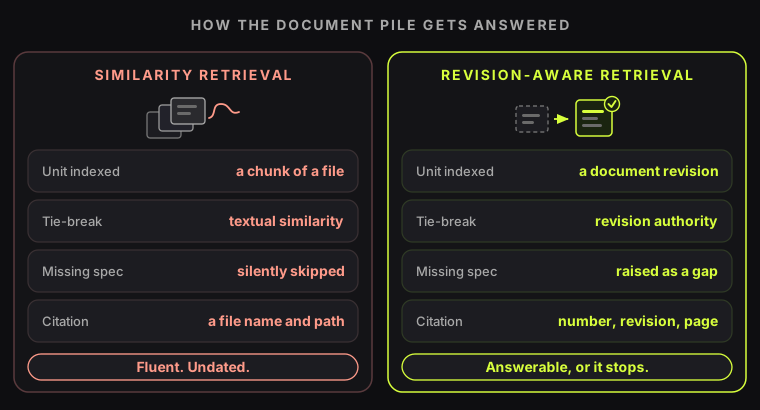
It inherits every unresolved reference and every undated copy, then converts them into fluent prose. Retrieval ranks passages by similarity, and none of the four failure modes below look dissimilar to a correct source.
- The ghost spec. The requirement exists and the document does not. Similarity search returns the nearest text that discusses coatings, and the answer reads complete rather than unanswerable.
- The superseded revision. Revisions B and C both sit in the index. The chunk from B wins on wording, and nothing in the ranking knows that C replaced it eleven days ago.
- The near-duplicate copy. One specification copied into a dozen folders competes with itself. Which copy surfaces is decided by phrasing and chunk boundaries, not by which copy is current.
- The unresolvable chain. The spec cites a sub-spec by number, which cites a client standard, which cites a clause in an ASME or EN code. Answering the top-level question honestly means resolving the chain, or declaring where it broke.
The failure here is not comprehension. It is that the corpus carries no notion of authority, so a system optimized to find the closest text has nothing with which to prefer the governing document over a plausible neighbour.
What does engineering document revision control for an AI layer require?
Revision identity has to be a property of the indexed object, not metadata that happens to live in a filename. Five things follow from that.
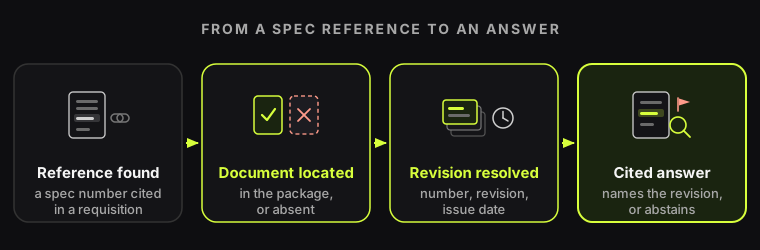
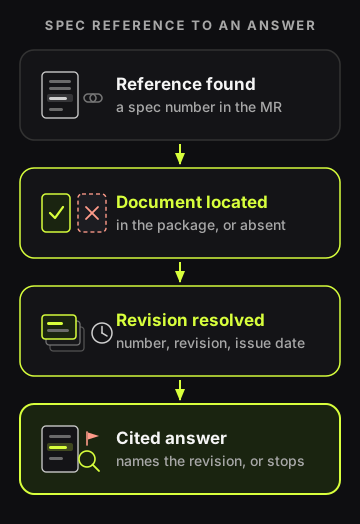
- Build the reference register before answering anything. Extract every document called out anywhere in the package (number, title, stated revision) and try to resolve each one against what was actually supplied. The most valuable column in that register is the list of references that resolved to nothing, because that is the ghost-spec inventory and today it is usually discovered late by an engineer.
- Key documents on number, revision and issue date.
Rev Candfinal_v2cannot both be authoritative. The identifier an engineer trusts is the document number plus its revision, so that pair, with the issue or transmittal date, has to be the primary key rather than a path. - Collapse duplicates into one object with known copies. Near-identical copies should never compete in retrieval. One canonical document, with each copy recorded as a location, removes an entire class of wrong answers and also tells you where the stale copies are.
- Model supersession explicitly, with effective dates. If "C supersedes B, effective 14 May" is a relation in the data, non-current revisions can be excluded from answers by default and produced deliberately when the question is historical, which it often is: what was in force at bid submission is a different question from what is in force now.
- Cite the revision, and abstain when authority is unknown. "Clause 4.3 of MS-1042 Rev C, page 61" is verifiable by opening the document. "Your specification requires" is not. A layer that reports it cannot resolve a reference is worth more than one that always produces something, because the first failure is visible and the second is not.
What do the standards already say about revision authority?
All five requirements above are already written into quality and configuration-management practice. An AI document layer is late to this, not ahead of it.
ISO 9001:2015 clause 7.5.3 requires documented information to be controlled: available and suitable for use where it is needed, and subject to change control, which the standard names as including version control. A folder tree holding both revisions satisfies neither condition. ISO 10007, the configuration-management guidance in the same family, is more specific still and names exactly the capability missing here: configuration identification, change control, and configuration status accounting, which is the recorded account of which revision is current and what it replaced. In drawing practice the point is settled: ASME Y14.35 exists because a drawing revision is a formal engineering object with rules for how it is raised and recorded, not a suffix on a file name.
That gives the AI question a clear shape. A retrieval system that ignores status accounting has not modernised document control, it has bypassed it, and the deployer inherits the consequences. In regulated production the consequences are audited: a pharmaceutical or nuclear quality regime expects you to show which approved revision governed a decision, and "the assistant found it in SharePoint" is not an answer.
See a spec pile with every reference resolved and every revision dated
Bring one material requisition and the specifications that came with it. See which references resolve, which are ghosts, and which revision each answer is drawn from.
Where is this going in 2026 and 2027?
Toward document layers judged on whether they can date an answer, not on whether they can produce one. Two forces are pushing in that direction at once.
The first is agentic document work. Assistants are moving from answering questions to drafting compliance matrices, deviation lists and technical queries straight from the package. Each additional automated step compounds a revision error rather than exposing it, because the human who would once have noticed that a clause looked out of date is now reviewing an output instead of the source.
The second is regulatory. The EU AI Act phases obligations across 2026 and 2027 with a heavy emphasis on logging, technical documentation and human oversight for consequential uses, and the practical effect for a deployer is that knowing what a system's answer was based on stops being a nice property. Meanwhile the market is converging from two directions: the EDMS and PLM vendors already hold revision state and are adding retrieval, while general-purpose assistants already have retrieval and hold no revision state at all. The gap between those two is where the useful products will be built. Ranger works in that category, cited comprehension of engineered inquiry and bid documents, on the view that a citation which cannot name a revision is not a citation.
Key Takeaways
- A ghost spec is a specification a requisition calls out by number that was never supplied with the package, and it makes an obligation binding while leaving no document to read.
- Silent supersessions are the same problem in reverse: a new revision arrives mid-tender by email while the old one stays in the folder, and nothing in the estate records which now governs.
- The document systems that do enforce revision authority govern documents your own company issues, so a bid package assembled from a client portal, mail threads and sub-supplier files falls outside all of them.
- Similarity-based retrieval cannot distinguish a superseded revision, a stale duplicate or a missing reference from a correct source, because none of the three look dissimilar to the text being matched.
- A workable document layer keys documents on number, revision and issue date, collapses duplicates to one canonical object, models supersession with effective dates, and reports unresolved references instead of answering around them.
- ISO 9001 clause 7.5.3, ISO 10007 configuration status accounting and ASME Y14.35 already define revision authority as a controlled engineering property, which is the discipline an AI layer has to inherit rather than reinvent.
A specification you cannot date is a specification you cannot price against, and the gap between those two states is where post-award arguments come from. For the identifier half of the same problem, see why industrial document AI stalls at the part number, and for what production parsing of these documents actually involves, see scalable document parsing for industrial PDFs. For how it lands on compliance-heavy project scope, see our infrastructure page.