Through 2025 and 2026 every major source-to-pay suite shipped AI scoring into its sourcing module. The evaluation that decides a multi-year industrial award still lands, in most OEM and EPC bid rooms, in a spreadsheet somebody rebuilt from the last tender. The gap between those two facts is not a software adoption problem. It is that the hard part of tender evaluation was never the scoring.
Why is a bid tabulation spreadsheet still the system of record?
Because the spreadsheet is the only place the whole comparison fits, and because nothing upstream produces bids that are comparable in the first place.
Put a package of process pumps out to twelve bidders and twelve different documents come back. One includes commissioning spares, one excludes them and says so on page 40 of a deviation list, one offers a duplex alternative to the specified material with a note that the specified grade carries a 22 week lead time. Payment terms differ. Escalation clauses differ. Two bidders quote DAP site and one quotes ex works. The line items do not line up, so the comparison gets built by hand, per tender, in a sheet that is structurally new every time.
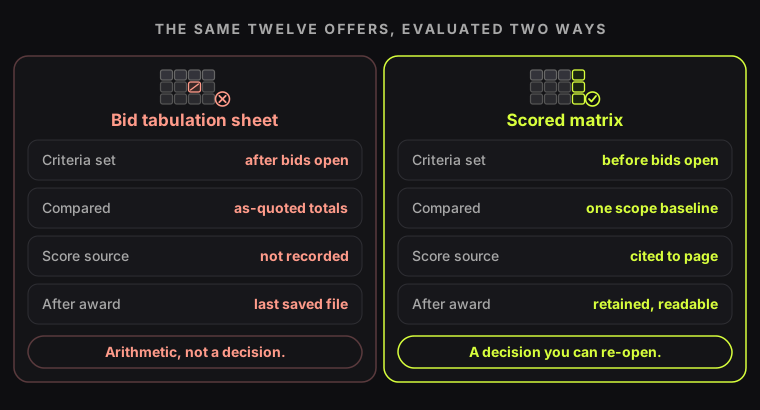
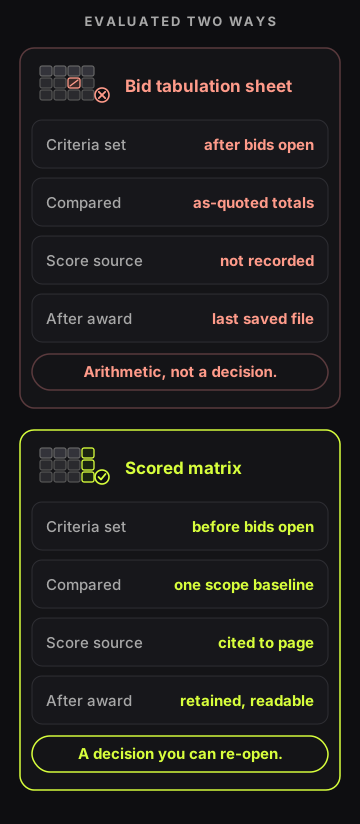
What that sheet retains is arithmetic. It holds the totals and the weighted average, and it does not hold why a criterion was weighted at 15 percent, which page of which offer a technical score came from, or what was added back to a bidder's price to cover the scope they excluded. Those decisions were made in the room and they left with the people in it. The award is defensible for as long as the people who made it are still available to explain it.
Why doesn't e-procurement software already score industrial tenders?
Because sourcing suites are built to run the event, and engineered evaluation is a reconciliation problem rather than an event problem.
Look at what the stack is actually good at. The source-to-pay platforms (SAP Ariba, Coupa, Jaggaer, Ivalua) are strong at the mechanics: supplier onboarding and qualification, sealed bidding, RFx distribution, audit of who submitted what and when, and scoring that works well when the bid response is a structured form with identical line items on every side. Public-sector evaluation tools formalize the panel: fixed criteria, independent scorers, consensus records. Sell-side configurators (Tacton, Configit, Intelliquip) generate the offer and sit on the other side of the transaction entirely. And the incumbent across most industrial bid rooms remains Excel beside a folder of PDFs.
The suites' assumption is the thing that breaks. Structured scoring requires a common response structure, and an engineered tender's substance arrives as unstructured attachments precisely because the scope is negotiable: datasheets, deviation lists, sub-supplier quotes, exception schedules, spares recommendations. A platform can enforce that bidders fill the form. It cannot make the form the offer. The commercially significant content is in the attachments, and the tab sheet exists because somebody has to read them.
What has to happen before a bid can be scored?
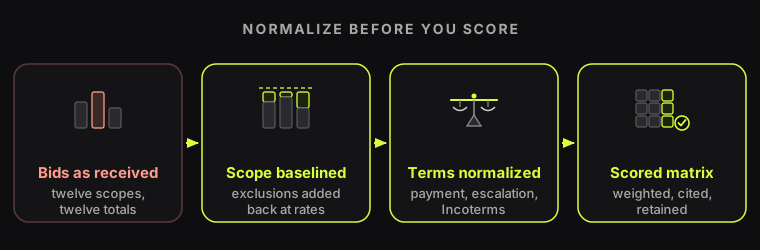
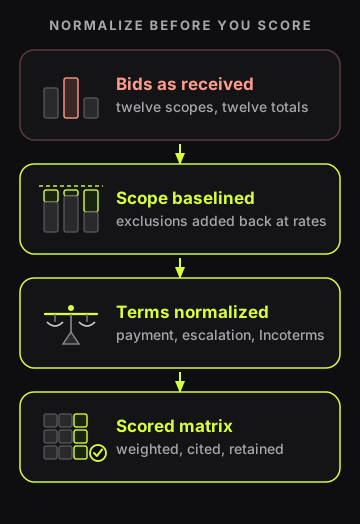
The offers have to be made comparable, and that normalization is most of the work. Five things have to be reconciled before a score means anything.
- Bring every offer to one scope baseline. Take the requisition as the reference and record, per bidder, what is included, what is excluded, and what is offered as an option. Exclusions get added back at that bidder's own rates where they quoted them, or at a stated allowance where they did not, and the allowance is written down as an assumption rather than absorbed into a total.
- Account for deviations as commercial items, not technical footnotes. A deviation list is a scope instrument. An alternative material, a reduced test scope, a shortened warranty, a proposed exception to the inspection and test plan: each one either has a price consequence, a risk consequence, or both, and each one is a thing the bidder has asked you to accept.
- Normalize the commercial terms. Payment milestones, price validity, escalation formula, currency, Incoterms and freight responsibility, delivery date against required on site date, liquidated damages exposure, warranty period and start trigger. Two prices quoted on different terms are not the same number.
- Extend to cost over the operating life where the scope justifies it. For rotating equipment, purchase price is a fraction of the cost. Power draw at duty point, service interval, and spares pricing and availability belong in the comparison when the asset runs for twenty years.
- Assess technical compliance clause by clause, and keep the trace. Compliance is a per requirement finding against the requisition and its referenced specifications, and it is only useful if you can point at the page that supports it.
What does a defensible scored matrix actually contain?
Criteria and weightings fixed before the bids were opened, a score per criterion that points at the page it came from, and every normalization adjustment recorded as a line with its basis. Five properties separate a scored matrix from a tab sheet with colours.
- Criteria and weightings, dated before opening. If the weighting can move after the prices are visible, the model is a justification tool rather than a decision tool. Fixing it early also forces the useful argument, which is what the organization is actually buying, to happen before there is a preferred bidder in the room.
- A defined scale with stated meanings. A five point scale where each level says what it means ("fully compliant", "compliant with a minor deviation, priced", "non compliant, requires waiver") produces scores two different engineers can reproduce. A bare one to ten does not.
- Every score traceable to its source. Document number, revision and page, so an award review a year later can be re-opened by reading rather than by remembering. This is also the only version of a score that survives the evaluator changing jobs.
- Adjustments shown, not folded in. Each add back, allowance and term adjustment stays a visible line with its basis. A normalized price that cannot be decomposed into the quoted price plus its adjustments is a number nobody can defend to the bidder who lost.
- A record that outlives the tender. Retained, re-readable, and comparable to the last tender for the same package, which is how an organization learns what its own criteria are worth.
What do the standards and the evidence say about evaluation records?
The requirement is already written down, and industrial buyers outside the public sector mostly meet it informally. ISO 9001:2015 clause 8.4.1 requires organizations to determine and apply criteria for the evaluation, selection and re-evaluation of external providers, and to retain documented information of the results of those evaluations. A tab sheet whose criteria were set after opening and whose scores cite nothing satisfies the letter thinly and the intent not at all.
Public procurement shows what the disciplined version looks like when it is compulsory. Under the EU public procurement directive (Directive 2014/24/EU, Article 67), contracting authorities must state award criteria and their relative weightings in the procurement documents in advance, and the principles of transparency and equal treatment prevent changing them once bids are in. Private industrial buyers carry no such obligation, which is precisely why the practice is worth borrowing: the discipline exists because the alternative was shown, repeatedly, to produce awards that could not be defended.
Then there is the tool itself. Spreadsheet error research is unusually consistent on this point: field audits of operational spreadsheets, reviewed across many studies by Raymond Panko at the University of Hawaii, found errors in the large majority of the sheets examined, and the European Spreadsheet Risks Interest Group has catalogued the consequences for two decades. A tender evaluation sheet is the high risk case in that literature: built once, under deadline, by one person, with hand-entered adjustments, reviewed by nobody who has the source documents open, and used to commit a capital sum.
See twelve offers normalized to one scope baseline
Bring one tender package and the bids that came back. See the exclusions, deviations and term differences surfaced per bidder, each one cited to the page it came from.
Where is industrial tender evaluation going in 2026 and 2027?
Toward evaluation tools judged on whether they can show their basis, not on whether they can produce a ranking. Two movements are arriving at the same time and pulling in opposite directions.
The first is agentic scoring. Autonomous bid analysis is being marketed into exactly the step that was never made auditable, which means the risk is not that an agent scores badly. It is that an unaccountable score produced in four seconds looks more authoritative than a defensible one produced in four days, and the organization loses the argument it used to have in the room.
The second is consolidation from both ends. The source-to-pay suites hold the event record and are adding comprehension of the attachments; document comprehension layers read the attachments and are moving toward the comparison. What nobody has standardized is the middle: the normalized, cited comparison the score is calculated from. That artifact is the real deliverable of tender evaluation, and today it is a spreadsheet nobody keeps. Ranger works in that category, cited comprehension of engineered inquiry and bid documents, on the view that a score which cannot name its source is not an evaluation.
Key Takeaways
- On engineered tenders the ranking is largely determined by how each bidder split the scope, so scoring offers as quoted measures that choice rather than the offers themselves.
- Normalization is most of the evaluation work: one scope baseline, deviations priced as commercial items, common commercial terms, and life cost where the duty cycle justifies it.
- Source-to-pay suites solved the sourcing event and structured scoring, both of which assume a common line item structure that engineered offers do not have, because the commercial substance sits in the attachments.
- A defensible scored matrix fixes criteria and weightings before opening, defines what each score level means, cites every score to a document, revision and page, and shows each adjustment as its own line.
- ISO 9001 clause 8.4.1 already requires applied evaluation criteria and retained documented information, and EU public procurement rules show the compulsory version: criteria and weightings published in advance and unchangeable once bids are in.
- Spreadsheet error research finds errors in the large majority of audited operational sheets, and a tender tab sheet is the high risk case in that literature: built once, under deadline, and used to commit capital.
A tender evaluation you cannot re-open is a decision the organization has to take on trust, and the bidder who lost is usually the one asking. For what issuers actually score behind the scenes, see inside the bid evaluation room, and for where autonomous scoring breaks on engineered tenders, see why bid analysis agents fail engineered tenders. For how this lands on complex assemblies and rotating equipment, see our precision manufacturing page.