"Bid analysis agent" is the phrase industrial procurement software reached for in 2026. The pitch is clean: point an autonomous agent at a folder of supplier responses, and it hands back a ranked score. Then sit in an actual bid evaluation room, where an EPC contractor or a pump OEM decides who wins a tender worth tens of millions, and the decision looks nothing like a leaderboard.
What does an industrial bid evaluation committee actually score?
A commercial bid evaluation is the structured process by which an issuer scores competing supplier proposals against a fixed rubric, not on price alone. In large industrial and public tenders that rubric follows a most economically advantageous tender (MEAT) logic, a standard written into EU public procurement rules, where technical merit, delivery, and risk are weighted alongside cost.
The room is cross-functional by design. Engineering checks technical compliance against the specification. Procurement normalizes commercial terms. Legal and quality review qualification, certifications, and liability. On an energy or infrastructure package, end-user operations sit in too. The weights for each axis are agreed before bids are opened, so the committee is not deciding what matters after seeing who is cheapest.
What the committee produces is not just a winner. It is an auditable record of why one bid beat the others, on each weighted axis, that can withstand a losing bidder's challenge and an internal audit months later.
Why do "bid analysis agents" fall short of the evaluation room?
Autonomous scoring agents fall short because they optimize for a confident-looking ranking, while a bid committee is accountable for a defensible one. Those are not the same output, and the gap is exactly where risk hides.
Look at the existing stack. Sourcing suites like SAP Ariba and Coupa run intake, workflow, and reverse auctions well, but they treat a supplier response as a form to be filled, not an engineered document to be comprehended. Contract-intelligence tools such as Icertis focus downstream, on clause risk after award. General-purpose LLM copilots and AutoRFP.ai-style assistants summarize quickly, but they hallucinate on engineered specifications, where a misread tolerance or a dropped unit changes the meaning entirely. And most scoring still happens in Excel, where the audit trail is whatever the evaluator remembered to paste into a cell.
An autonomous agent layered on top of that inherits the same weakness. It can rank. It cannot tell you, line by line, why. Weighting is a judgment call the committee owns. Materiality of a deviation is an engineering call. A number with no citation behind it is not evidence; it is an opinion with a decimal point.
What issuers actually look for, and what AI can automate
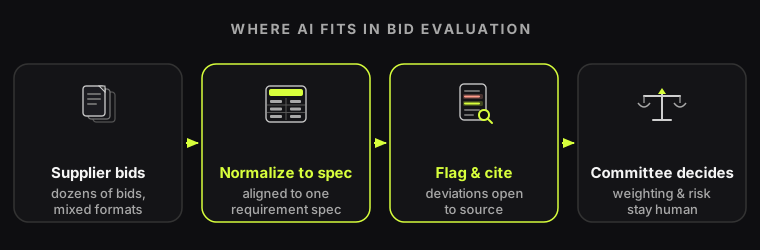
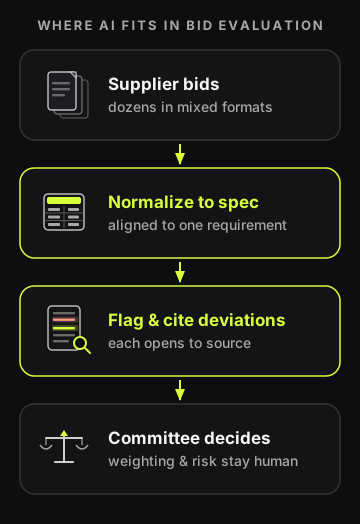
Issuers look for evidence, not opinions: proof that each bid meets the specification, priced on comparable terms, at an acceptable delivery and compliance risk. AI can automate the evidence preparation. It cannot own the judgment. The split runs cleanly along four axes.
- Technical compliance. Automatable: extract and align every response to the requirement, line by line, and flag missing or deviating items with a citation to the source paragraph. Judgment: whether a given deviation is material enough to disqualify or reprice.
- Commercial normalization. Automatable: reconcile pricing to a comparable basis across currency, scope inclusions, and payment terms. Judgment: negotiation leverage and strategic value of a given supplier.
- Delivery and schedule risk. Automatable: pull stated lead times and gather past-performance references into one view. Judgment: how credible those commitments are for this scope.
- Qualification and compliance. Automatable: confirm that certifications and due-diligence questionnaire (DDQ) answers are present, current, and cited to the document. Judgment: accepting or rejecting residual risk.
The pattern underneath all four is the same. The automatable half is comprehension and reconciliation at volume, with a citation attached to every claim. The human half is weighting, materiality, and risk appetite. A tool that respects that boundary speeds the committee. A tool that erases it just moves the risk somewhere the committee cannot see.
What does the trend data say about autonomous versus assisted evaluation?
Even the bullish forecasts put fully autonomous decisions in the minority. Gartner projects that a third of enterprise software will embed agentic AI by 2028, up from less than one percent in 2024, and that around 15 percent of day-to-day work decisions will be made autonomously by then, up from none today.
Read that carefully. The direction is real, but the destination is not "the software decides." A high-stakes engineered tender, where a losing bidder can file a protest and an auditor can reopen the file, is precisely the wrong place to spend that 15 percent of autonomy. The value shows up earlier in the process, in the evidence layer, not in the verdict.
See a cited bid evaluation, not a black-box score
Watch how a comprehension layer normalizes dozens of supplier bids to one spec and opens every flag to its source, so your committee decides with the evidence in front of it.
Where is bid evaluation software going?
The next phase of procurement AI is shifting from autonomous scoring toward verifiable, cited assistance, with a human still accountable for the decision. Gartner has already started describing "guardian agents" whose job is to check other agents' work, a tacit admission that unverified autonomous output is a liability, not a feature.

That direction lines up with what is happening to industrial tenders themselves. Re-shoring and energy-transition capital projects are pushing bid volumes up, so the reconciliation problem gets larger, not smaller. At the same time, audit and ESG scrutiny are raising the bar for how defensible an award has to be. Both trends reward the same thing: a comprehension layer that normalizes and cites every supplier response at volume, feeding a committee that still weighs and decides. Ranger builds in that category, cited bid-evaluation AI for industrial issuers, on the premise that the score is only worth as much as the source you can open behind it.
Key Takeaways
- A commercial bid evaluation scores competing proposals against a fixed, pre-agreed rubric spanning technical compliance, commercial terms, delivery risk, and qualification, not on price alone.
- The hard part of the supplier bid evaluation process is reconciling dozens of differently structured responses against one specification and defending every score, not reading speed.
- A "bid analysis agent" that returns a ranking without a citation behind each number automates the easy part and hides the risky part.
- AI can automate the evidence preparation (normalize to spec, flag and cite deviations); weighting, materiality, and risk appetite stay with the human committee.
- Even bullish forecasts (Gartner) keep fully autonomous decisions a minority through 2028, and engineered tenders are the wrong place to spend that autonomy.
- The winning direction is verifiable, cited assistance feeding a human decision, not a black-box score.
The issuers who win this decade will not be the ones who automate the verdict. They will be the ones who automate the evidence and keep the judgment, as we cover in how industrial buyers evaluate 40+ supplier bids and in what engineered supplier bids reveal about bid evaluation AI. See how this plays out in capital-intensive projects on our energy industry page.