Procurement software's 2026 pitch has moved from reading documents to watching them: agentic monitoring tools now promise a real-time alert the moment a supplier's risk profile changes. Set that against how vendor qualification actually works at most industrial buyers, and the contrast is uncomfortable. Ask a category manager which qualified suppliers on the approved vendor list hold certifications that expire this quarter, and most cannot answer without opening a shared drive. That gap, between a monitoring ambition and a filing-cabinet reality, is exactly where vendor qualification AI earns its keep.
What is vendor qualification at industrial scale?
Vendor qualification is the process by which an industrial buyer verifies that a supplier is fit to bid and fit to deliver: technically capable, financially sound, properly certified, and compliant with the buyer's legal and ethical requirements. The output is usually an approved vendor list (AVL), the register that decides who is even allowed to receive an RFQ.
At industrial scale, that verification is a document problem before it is anything else. An EPC contractor or an energy operator qualifying a vendor base of hundreds or thousands of suppliers is holding ISO 9001 certificates, ASME stamps, welding procedure qualifications, insurance certificates, financial statements, due-diligence questionnaire (DDQ) responses, and sanctions screening results, most of them PDFs, all of them dated. Every one of those documents was true on the day it was filed.
The regulatory direction makes that dating problem sharper. The EU's Corporate Sustainability Due Diligence Directive, adopted in 2024, and Germany's Supply Chain Due Diligence Act, in force since 2023, both frame supplier due diligence as a continuing obligation, not a one-time onboarding check. The phase-in timelines have shifted, but the direction has not: regulators increasingly expect buyers to know their supplier base as it is now, not as it was at the last audit.
Why do existing vendor qualification tools fall short?
Most qualification stacks fall short because they were built to collect documents, not to comprehend them or keep them current. Each layer of the existing stack does one part of the job well and leaves the same gap.
Supplier lifecycle modules in the big sourcing suites, SAP Ariba and Coupa among them, run registration and approval workflow cleanly. But they treat a supplier submission as a set of form fields. The engineered substance, what a certificate actually covers, what scope a welding qualification is limited to, lives in the attached PDFs, and the workflow does not read attachments. Prequalification networks like Avetta, ISNetworld, and Achilles standardize collection across a trade or a region, which genuinely reduces duplicate effort, yet the questionnaires are generic by design and the review is periodic by design. Risk data feeds, Dun & Bradstreet financials and sanctions screening services, supply a live external signal, but that signal arrives disconnected from the buyer's own document trail, so someone still has to reconcile the alert against the file. And underneath all of it sits the real system of record at most industrial buyers: an AVL spreadsheet whose audit trail is whoever edited it last.
What does vendor qualification AI actually need to do?
A vendor qualification AI is only useful if it turns qualification from a date stamp into a live, verifiable state. That breaks into five concrete requirements.
- Read the documents themselves. Certificates, DDQ responses, financial statements, and qualification records arrive in whatever format the supplier produced. The system has to comprehend them as engineered documents, not index them as attachments.
- Cite every extracted fact. An expiry date, a certification scope, or a DDQ answer is only usable in a compliance file if it carries a citation back to the exact page and clause it came from, so a reviewer can open the source and verify it.
- Track validity as state, not as a checkbox. Qualified-until, limited-to-scope, conditional-on-insurance: these are living attributes with dates attached, and the system should know which ones lapse next quarter without being asked.
- Reconcile external signals against the internal record. A sanctions list update or a registry change matters when it touches a supplier you rely on. The system's job is to connect the external alert to the internal file and raise a dated, cited exception.
- Leave risk acceptance with the human. Whether an expired certificate disqualifies a supplier from an active tender is a judgment call the buyer owns. The AI prepares the evidence; the category manager and the compliance officer decide.
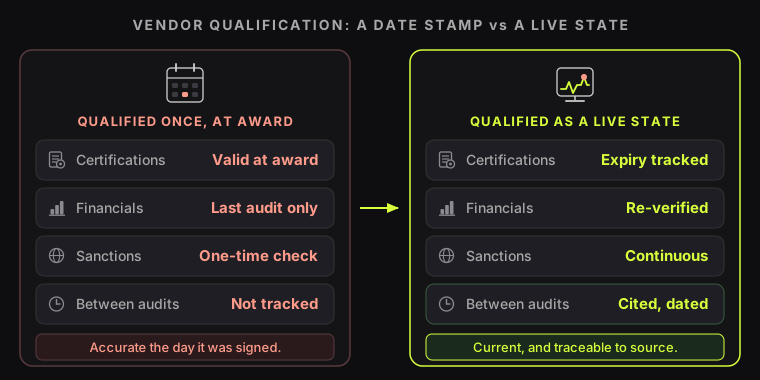
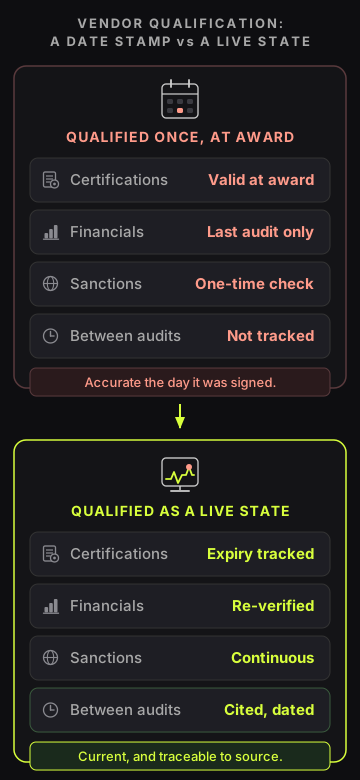
The through-line is the same one that runs through bid evaluation: comprehension plus citation at volume is automatable, and judgment is not. A tool that respects that boundary makes the compliance file stronger. A tool that hides it just moves the risk into a dashboard.
What do the market signals say about continuous monitoring?
The market is converging on monitoring, but not on autonomy. Gartner projects that a third of enterprise software will embed agentic AI by 2028, and has begun describing "guardian agents" whose role is to verify other agents' output, which is a plain admission that an unverified autonomous signal is a liability in a compliance context. The value of an agentic alert depends entirely on whether a human can trace it to a source when an auditor asks.

Meanwhile the workload is growing from both ends. Re-shoring and energy-transition capital projects are widening industrial vendor bases, and due-diligence legislation is deepening what a buyer must know about each vendor on the list. More suppliers, more documents per supplier, and a higher bar for how current that knowledge has to be: that is a scaling problem, and it lands on qualification teams that are not getting bigger.
See vendor qualification as a live, cited record
Watch how a comprehension layer reads certificates, DDQs, and qualification documents at vendor-base scale, and raises exceptions your compliance team can trace to the page.
Where is vendor qualification going?
Vendor qualification is becoming a continuous, evidence-backed discipline instead of a periodic paperwork exercise. The direction of travel is set by the same forces on both sides of the market: regulators are writing continuing due diligence into law, and agentic tooling is making continuous monitoring technically plausible. What separates a defensible implementation from a risky one is the evidence layer underneath the alerts. A monitoring agent that cannot show its source is one more unverified feed for the compliance team to chase; a comprehension layer that reads the vendor base's actual documents and cites every extracted fact turns the same alert into a file that survives an audit. Ranger builds in that category, cited comprehension of supplier and vendor documents at industrial scale, on the premise that a qualification record is only worth what you can trace it back to.
Key Takeaways
- Vendor qualification verifies that a supplier is fit to bid and deliver: technically capable, financially sound, certified, and compliant, recorded on an approved vendor list.
- The compliance gap is not the audit but the time between audits, when certificates lapse and sanctions lists change while the AVL stays frozen.
- Existing tools collect documents well but do not comprehend them: workflow suites read form fields, prequalification networks review periodically, and risk feeds arrive disconnected from the document trail.
- Vendor qualification AI has to read the actual documents, cite every extracted fact to its source, track validity as a dated state, and reconcile external signals against the internal record.
- Due-diligence laws like the EU CSDDD and Germany's supply chain act frame supplier knowledge as a continuing obligation, raising the bar for how current a qualification record must be.
- Risk acceptance stays human: AI prepares the cited evidence, and the buyer decides what disqualifies.
Qualification decides who gets to bid; evaluation decides who wins. The buyers who get both right will run them on the same evidence discipline, as we cover in what issuers actually score inside the bid evaluation room and in the two-sided marketplace inside every industrial OEM. See how this plays out on capital projects on our energy industry page.