Procurement software spent the past eighteen months rebranding around agents, and the pitch for a bid analysis agent is consistent across vendors: point it at every supplier response, come back to a ranked shortlist. Gartner has predicted that more than 40 percent of agentic AI projects will be scrapped before the end of 2027, mostly on cost and unclear value rather than model quality. On engineered tenders the reason is more specific, and worth naming precisely: autonomous scoring produces a number over inputs that were never comparable, then throws away the only thing that would let anyone check it.
Why are two engineered bids not comparable until someone normalizes them?
Because each bidder answered a slightly different question, and the differences are priced. A ranking computed before those differences are reconciled is arithmetic on incompatible units.
Put ten responses to the same material requisition side by side and the divergence starts at the scope boundary. One bidder includes commissioning supervision, another quotes it as an option. One prices two years of recommended spares into the line item, another lists them separately, a third omits them in a covering letter. Witnessed hydrostatic testing and a performance test at the works do not cost what a factory acceptance certificate costs.
The commercial layer then moves the number again. Delivery terms follow the ICC Incoterms 2020 rules, and an FCA price is not a DDP price, because freight, insurance, duty, and risk transfer sit with different parties. Escalation clauses shift the figure across a project built over two or three years, and payment terms carry a financing cost that never appears as a line item. Liquidated damages caps, warranty duration, and the liability ceiling all trade against price: a bidder who accepted uncapped LD exposure quoted a different commercial product than one who capped it at five percent.
Why do bid analysis agents output the wrong artifact?
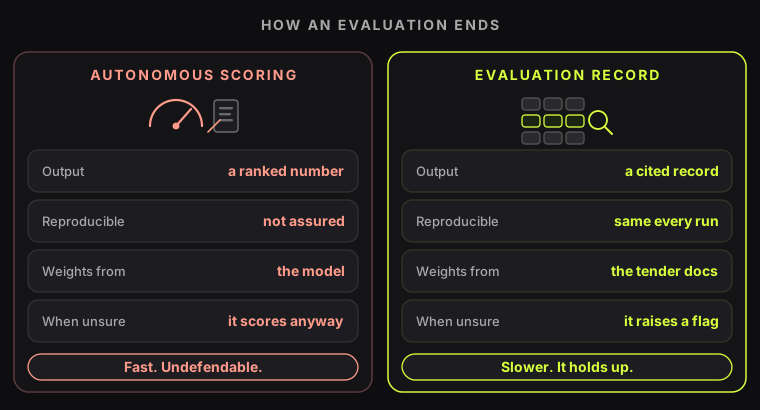
Because an award decision has to be reproducible and traceable, and a score is neither. The output contract, not the model, is what fails.
Two categories of tool sit in this space. The e-procurement suites (SAP Ariba, Coupa, Jaggaer) digitized the transaction, and their data model assumes the thing being evaluated arrived as fields in a form, so an engineered bid lands as an attachment and the reading stays manual. The newer agentic layer does read the documents and returns a compliance percentage or a ranked shortlist. That number is unusable for three reasons, none of which are about model quality.
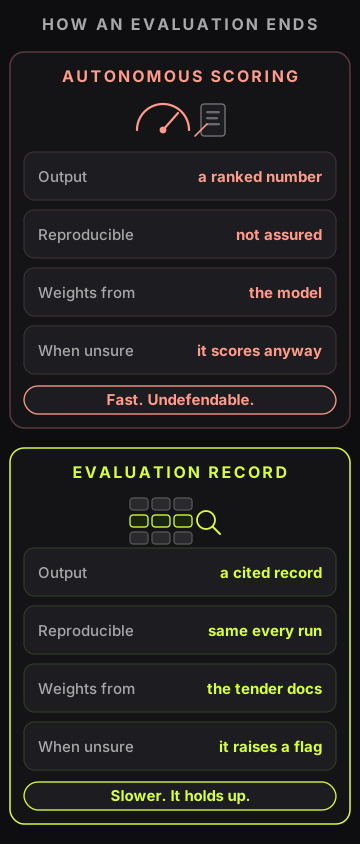
The first is reproducibility. A scoring step that runs through a sampled language model is not guaranteed to return the same answer twice, so the same bid package can put two bidders in a different order on Monday and on Friday. In a workflow whose output is a contract award, a value that moves between runs is a defect rather than a variance, and prompt tuning does not remove it, because it is a property of how the answer is produced.
The second is weighting authority. The criteria and their relative weights are a governance artifact that exists before any bid arrives. Under the EU public procurement regime, Directive 2014/24/EU requires a contracting authority to state the award criteria and their relative weighting in the procurement documents (Article 67), and to give an unsuccessful tenderer the characteristics and relative advantages of the winning tender on request (Article 55). Private buyers are not bound by that directive, though their internal delegation of authority usually imposes a similar discipline. A weight the model inferred is not a weight the buyer published, and that gap is exactly where a losing bidder's debrief request lands.
The third is provenance. A cell that says "partially compliant" and cannot open to the paragraph that made it partial is a claim without evidence, so the evaluator re-reads the document to verify the tool. That is the work the tool was bought to remove.
Where should the determinism boundary sit in an evaluation pipeline?
The model reads and locates. Code computes. Humans decide. Every arithmetic step that feeds an award belongs on the deterministic side of that line, and drawing the line explicitly is what separates a system you can defend from a system you have to trust.
- Let the model find the number, never compute with it. Extracting "test pressure 1.5 x design, per clause 7.4.2" from an annex is comprehension work, and a language model is good at it. Converting units, escalating a currency, and summing a weighted score are arithmetic, and arithmetic belongs in code with an audit log. This one boundary removes most of the surprising results.
- Normalize scope before comparing price. Define the comparison basis as data: a single Incoterm, a single currency and conversion date, an explicit scope boundary, and a fixed rule for whether spares, commissioning, and testing sit inside the compared figure. Record every adjustment as its own line with a reason, so a reviewer sees what was added to whom and why.
- Apply the published weights in code, from the tender documents. Read the weights once from the criteria the buyer issued, store them as a versioned object, and apply them mechanically. If the committee changes them mid-evaluation, that is a new version with a timestamp, not an edited prompt.
- Make "unresolved" a first-class output. A line the system cannot resolve should stop and queue, not receive a low confidence score. Unresolved is a state a human can act on. A 0.61 confidence is not.
- Cite every populated cell to page and clause. Each cell opens to the source paragraph in the bidder's own document, so the evaluator verifies rather than trusts. Citation is the unit of output for the whole pipeline, not a feature layered on afterwards.
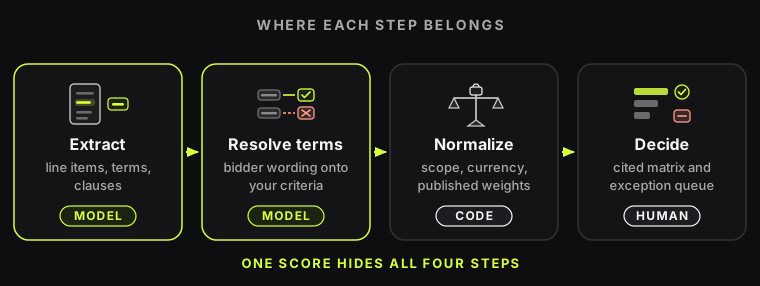
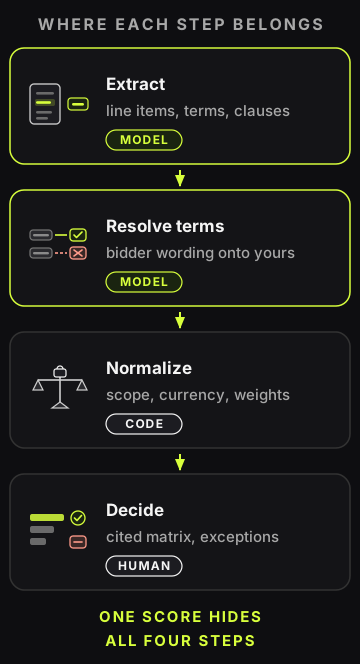
Nothing in that list reduces the evaluator's authority. It moves the weeks of transcribing forty inconsistent responses into one comparable shape off the committee's desk, and leaves the judgment where it sat.
How do you test an AI bid scoring tool before you trust it?
Test reproducibility and recall of known defects, not a vendor's accuracy percentage. Accuracy on a curated demo set predicts almost nothing about behaviour on a real tender. Four tests you can run during an evaluation predict quite a lot.
Run the same package repeatedly. Put one bid pack through the tool five times and diff the output. Every cell that feeds a comparison should be identical across runs. Cells that drift tell you which parts of the pipeline are sampled rather than computed, which is the map you need before deciding what to rely on.
Plant defects you already know about. Take a tender your team evaluated by hand last year and inject the failure modes that actually cost money: a certificate that expired between bid and award, a guarantee narrowed by a footnote, a deviation buried in an annex, a unit switched from bar to psi. Recall on buried defects is the capability worth buying.
Audit the citations, not the summary. Sample thirty populated cells and open every link. Does it land on the clause it claims, in the right revision of the right document? A citation rate is meaningless if the citations point at approximately the right page.
Back-test against closed tenders. Re-run awards that are already decided and compare the normalized basis against what the committee actually built. Where the two differ, the useful question is whether the difference is explainable. An unexplainable difference on a decided tender previews an unexplainable award on a live one.
Report the unresolved rate as the headline number, not accuracy. A tool that resolves 70 percent of lines and clearly marks the rest beats one that resolves 95 percent silently, because the second hides where it guessed. ISO/IEC 42001 and the NIST AI Risk Management Framework both give a structure for recording what was tested and what risk is left.
Put an evaluation pipeline through the reproducibility test
Bring one issued specification and a handful of supplier responses. See the normalized comparison, every cell cited to its source clause, and the same result on every run.
Where is AI bid scoring going in 2026 and 2027?
Toward tools that produce evidence rather than verdicts, because that is the only version of this that survives contact with an award decision.
Agents are arriving on both sides of the table. Bidders draft with AI and buyers read with it, which raises the volume of plausible text on every tender and makes verifiable provenance more valuable, not less. Regulation moves the same way: the EU's AI Act phases its obligations in across 2026 and 2027, and whatever the final classification of any particular procurement tool, the direction of travel is toward documented risk management, logging, and human oversight for AI in consequential decisions. Meanwhile the reasoned-decision duty in public procurement has not moved at all, so the debrief question stays the same however the shortlist was produced.
What holds up in that environment is not the fastest scorer. It is the layer that reads every response the way an evaluator reads it, normalizes forty offers onto one basis in code you can inspect, and opens every cell to the clause behind it. Ranger builds in that category, cited comprehension of engineered bid and inquiry documents, on the view that in industrial evaluation an answer is worth exactly what you can trace it back to.
Key Takeaways
- Engineered bids are not comparable until scope, Incoterms, currency, payment terms, and liability caps sit on one basis, so a score computed before that step is arithmetic on incompatible units.
- Autonomous scoring fails on the output contract, not on model quality: an award has to be reproducible and traceable, and a single number is neither.
- A scoring step that samples from a language model can rank the same bid package differently on two runs, which is a defect when the output is a contract award.
- Award criteria and weights are a governance artifact set before bids arrive, and in EU public procurement they must be published in the tender documents and defensible to unsuccessful bidders.
- The determinism boundary belongs between reading and computing: let the model locate and cite values, and keep unit conversion, normalization, and weighting in auditable code.
- Evaluate a bid scoring tool on reproducibility, recall of planted defects, citation accuracy, and its unresolved rate, not on a vendor accuracy percentage.
An evaluation you cannot reproduce is not an evaluation, it is a preference with a decimal point. For what a committee actually weighs before any of this reaches software, see inside the bid evaluation room, and for the pattern-recognition layer underneath it, see what engineered supplier bids reveal about bid evaluation AI. For how this lands on EPC and capital project tenders, see our infrastructure page.