Every answer Ranger returns carries a document name, a clause number, and a page. That is not an interface nicety. It is the difference between an industrial AI a bid team can put in front of an auditor and one they quietly abandon by week three. As of 2026, with the EU AI Act's record-keeping and human-oversight obligations for high-risk systems due to apply from December 2027, industrial AI citation has shifted from a trust feature to a procurement requirement. "The model said so" is no longer a defensible answer when a fabricator, a client's QA lead, or a regulator asks where a compliance decision came from.
Why does an uncited answer fail in industrial procurement?
In SaaS, a wrong AI answer costs a rewrite. In industrial procurement, a wrong answer about an ASME flange class or an API 610 NPSH margin propagates into a fabricated part, a contractual liability, and a project the error follows for years. The people reviewing 200-page vendor submissions and 400-page EPC specifications know this. They are not asking whether an AI can produce a fluent answer. They are asking whether they can stake a tender on it.
That question has a precise technical form: can this answer be traced back to the exact place in the exact document it came from? An answer that cannot be traced is not a faster answer. It is an unverifiable claim that a human now has to re-derive from scratch, which is slower than not using the tool at all.
In industrial bid review, the expensive step is not generating an answer. It is verifying one. A tool that produces answers 10× faster but forces a manual re-check of each one has not removed the bottleneck. It has moved it downstream and added a layer of false confidence on top.
Why do most "AI for RFP" tools cite nothing you can verify?
The current generation of procurement AI tools handle citation in three broken ways, and the failure mode matters more than the marketing.
ChatGPT and Microsoft Copilot generate from a blend of training data and retrieved snippets, then attach a citation as a post-hoc gesture. The cited passage often does not actually contain the claim. A 2023 Stanford audit of generative search engines, Microsoft's Bing Chat among them, found that on average only 74.5% of citations supported the sentence they were attached to. This is worse than no citation: it looks auditable and is not. A reviewer who spot-checks one citation, finds it plausible, and stops checking has been lulled, not protected.
AutoRFP.ai and Inventive AI were built for SaaS security questionnaires, where answers are reused from a prior-response library. Their "source" is usually a previous answer, not the governing technical standard. For a security DDQ that works. For a clause-level technical compliance question against a client's project specification, the chain of custody breaks immediately.
Excel is honest about its limits. It cites nothing because it parses nothing. The link between a cell and the source document lives entirely in the analyst's head, which is exactly the tribal knowledge that walks out the door when a senior estimator retires.
How does Ranger cite every answer back to source?
Citation in Ranger is not a display layer bolted onto a language model. It is enforced at the point of retrieval, before any answer is generated. Four design decisions make that work in production.
1. Answers are grounded, not recalled. Ranger does not answer from a general corpus. It grounds on the documents your team uploads: client specifications, licensed standards, vendor data sheets, your historical proposals. An answer about NACE MR0175/ISO 15156 comes from your copy of NACE MR0175, at the revision you uploaded, not from a model's training memory that may have ingested a superseded edition.
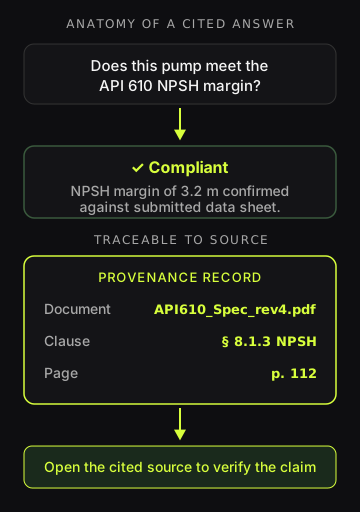
2. The provenance record is generated with the answer, not after it. When Ranger returns a compliance finding, it carries the source document, the clause or section, and the page as structured data, captured during retrieval. The citation and the answer are the same object. You cannot get one without the other.
3. "Not found in your documents" is a first-class response. When the answer is not present in the grounded set, Ranger says so rather than interpolating a plausible one. Industrial IT leads consistently tell us this single behavior is the strongest driver of trust during rollout. A system that admits the gap is one a reviewer can rely on for the answers it does give.
4. Every citation opens to the source. The reviewer does not take the provenance on faith. They click the clause reference to open the exact source passage the answer was drawn from, and check it against the original. Verification becomes a glance, not a re-derivation. That is the entire economic argument: cited answers are cheap to check.
What does industrial AI citation look like under audit?
The test of a citation layer is not the demo. It is the moment a client's quality lead or an internal auditor asks a bid team to defend a technical compliance decision made six months earlier. With Ranger, that decision is already reconstructable: every answer references its source document, clause, and page, and each citation can be opened to the original passage it was drawn from. The audit trail is a byproduct of how the work was done, not a report someone has to assemble after the fact.
This is also where the EU AI Act intersects with the actual work. High-risk AI obligations call for record-keeping, traceability, and meaningful human oversight. A grounded, cited answer a reviewer can verify against the source satisfies those requirements as a matter of architecture, not compliance theater. Teams adopting industrial AI citation now are not just moving faster. They are building the evidentiary trail that procurement governance in 2026 increasingly demands.

See how Ranger traces every answer to its source clause
Book a technical walkthrough with our engineering team. Bring a real specification and watch it get cited.
Where is industrial AI trust heading in 2026 and beyond?
The market is moving from "can AI read my documents" to "can I prove what the AI told me." That shift is being forced from two directions at once. Regulation is one: the EU AI Act's high-risk provisions, and the procurement governance frameworks that will follow them, make traceability a baseline expectation rather than a differentiator. The agentic AI shift is the other: as systems take more autonomous steps inside the inquiry-to-order workflow, the value of a verifiable record of what each step concluded, and why, compounds.
The vendors that survive this transition will not be the ones with the largest base model. They will be the ones whose architecture treats provenance as the product. For industrial IT leads running an evaluation, the test is simple and unforgiving: ask the tool a clause-level question against your own specification, then click the citation. If it does not land you on the exact page, the tool is not built for technical review. It is built for a demo.
Key Takeaways
- Industrial AI citation is the trust mechanism, not a cosmetic feature: an answer that cannot be traced to its source clause is an unverifiable claim a human must re-derive
- Most procurement AI tools attach citations after generating an answer, so the cited passage often does not contain the claim, which is more dangerous than no citation at all
- Ranger generates the provenance record (document, clause, page) at retrieval, before the answer exists, so the citation and the answer are inseparable
- The "not found in your documents" response is a feature: a system that admits a gap is one reviewers can trust for the answers it does give
- A grounded, cited answer a reviewer can verify against the source satisfies EU AI Act record-keeping and oversight obligations as a matter of architecture, not added paperwork
- In any vendor evaluation, ask a clause-level question against your own spec and click the citation: it should land you on the exact page, or the tool is not built for technical review
Ranger is the industrial document intelligence layer for EPC firms, pump and valve OEMs, and energy operators. For the deeper engineering reason general-purpose models get specs wrong, read why general-purpose AI hallucinates industrial specs. To see citation in your own environment, explore what Ranger looks like for compliance-heavy projects.