Procurement and sales teams spent the last year wiring "agentic" RFP assistants into their proposal stack, and most of them advertise a Trust Score: a single number that says how confident the model is in each drafted answer. That number reads well on a capabilities question. It falls apart the moment the document is a security questionnaire, because a confidence percentage is not what a security reviewer is asking for. They are asking which control covers the answer, and where the proof lives.
What is a security questionnaire, and why does it break RFP automation?
A security questionnaire is the due-diligence document a buyer's security team sends before a deal closes, asking a vendor to attest, in detail, to how it protects data and infrastructure. Standardized formats include the Shared Assessments SIG (Standardized Information Gathering), the Cloud Security Alliance's CAIQ (Consensus Assessments Initiative Questionnaire), and the bespoke DDQ (due diligence questionnaire) a buyer's risk team writes itself. It breaks RFP automation because every answer has to be backed by a specific control and a piece of evidence, not phrased persuasively.
That used to be a software-vendor problem. It is now an industrial one. When a pump OEM connects to an operator's network for remote monitoring, when an EPC firm handles a client's plant design files, or when a contract manufacturer touches regulated pharma data, the buyer runs the same vendor security review it runs on a SaaS company. The industrial supplier that has never seen a SIG before now has to answer one to close the order.
Why do "Trust Score" RFP tools fall short on security questions?
They fall short because they output confidence, not provenance. Three categories of tool claim this work, and each optimizes the wrong variable for a security review. RFP response platforms recycle the closest past answer from a content library, which is fast but inherits whatever was stale or wrong in that answer. Generic LLM copilots draft fluent prose that reads compliant whether or not a control exists behind it. The newer AutoRFP.ai-style agents attach a Trust Score, a confidence figure that tells you how sure the model is and nothing about which policy it is standing on.
Meanwhile the systems that actually hold the evidence, the GRC platforms where a vendor's controls and attestations already live, are not built to draft a bespoke questionnaire answer in the buyer's format. The gap nobody fills is the one that matters: mapping each question to the control that answers it, and citing the evidence behind that control.
What does reliable AI security questionnaire automation require?
It requires treating every answer as a claim that must cite a control and its evidence, the same discipline a SOC 2 audit applies to a vendor's own systems. Five things have to be true for that to hold up in front of a buyer's security team.
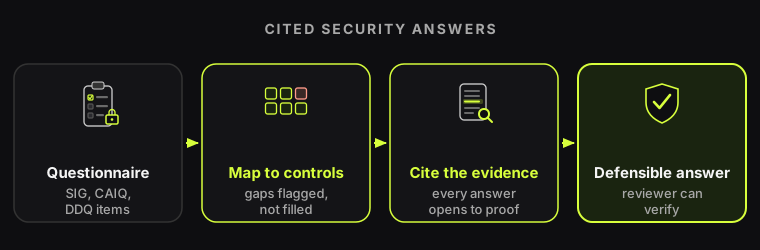
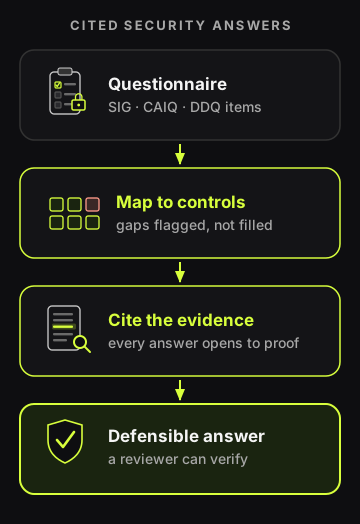
- Map each question to a control, not a keyword. The answer to "describe your encryption at rest" is the relevant clause of your control set (ISO/IEC 27001 Annex A, the SOC 2 Trust Services Criteria, or NIST 800-53), not the nearest-matching paragraph from last year's RFP.
- Cite the evidence behind every answer. Each response links to the policy, configuration record, or attestation that backs it, and opens to that source so a reviewer can verify it rather than trust it.
- Flag the gaps instead of filling them. Where no control or evidence exists, the system surfaces the gap. A model that confabulates a compliant-sounding answer for a control you do not have is worse than a blank, because it fails the moment evidence is requested.
- Keep version and date on every answer. Controls drift. An answer that was accurate last quarter can be stale today, so each cited answer carries the date and version of the evidence it rests on.
- Keep the security owner as the approver. The system assembles, maps, and cites. A person attests. That division is what makes the submission defensible, because someone signed it and can point to the proof.
What does the evidence show about questionnaire scale?
Security questionnaires are long, standardized, and control-anchored by design, which is exactly why fluency-first automation struggles with them. The Cloud Security Alliance's CAIQ v4 runs to 261 questions across 17 control domains. ISO/IEC 27001:2022 reorganized its Annex A into 93 controls. The AICPA's SOC 2 framework is built on 5 Trust Services Criteria. None of these reward a well-phrased paragraph. They reward an answer that points to a named control and the evidence that satisfies it.
Layer a buyer's bespoke DDQ on top of one of these standard forms and a single vendor review can run to several hundred questions, each expecting a control reference. At that scale, the work is not writing prose. It is reconciling every question against a control set and proving each answer, which is the part a Trust Score skips.

Put your next security questionnaire to the citation test
Bring a SIG or CAIQ your team is partway through. We will show you each answer mapped to a control and cited to the evidence behind it, on top of the systems you already run.
Where is AI security questionnaire automation going?
The agentic procurement wave is not going to reverse, but security questionnaires are where it gets sorted into tools that automate writing and tools that automate accountability. Two forces are tightening the screw through 2026 and 2027. Vendor security reviews are spreading from software into industrial supply chains as operational technology connects to corporate networks, so more industrial suppliers face a SIG for the first time. And regulatory pressure, from the phased rollout of the EU AI Act to rising buyer expectations for SOC 2 and ISO 27001, is pushing provenance from a nice-to-have to a gate. The questionnaire that used to be a formality is becoming a deal-blocker.
The tools that win this category will not be the ones with the most confident Trust Score. They will be the ones that treat a security answer the way an auditor does: as a claim that has to cite a control and open to its evidence. That is the same cited comprehension problem Ranger works on across industrial documents, applied to the one document where an undefendable answer costs you the deal.
Key Takeaways
- A security questionnaire grades an answer on the control and evidence behind it, not on how well it is written, which is why fluency-first RFP automation fails it.
- A Trust Score reports model confidence; a security reviewer is asking which control covers the answer and where the proof lives, which are different questions.
- RFP libraries recycle stale answers, LLM copilots draft unbacked prose, and GRC platforms hold evidence but do not draft the answer, so the question-to-control-to-evidence mapping goes unfilled.
- Reliable automation maps each question to a control, cites the evidence, flags gaps instead of filling them, dates every answer, and keeps a human as the approver.
- Standard forms like the CAIQ (261 questions), ISO 27001 Annex A (93 controls), and SOC 2 (5 criteria) are control-anchored by design, and bespoke DDQs push a single review to several hundred questions.
- As OT connects to IT and the EU AI Act phases in, security reviews are becoming deal-gates, and provenance, not confidence, is what passes them.
The next security review your team faces will not be won by the most confident answer. It will be won by the answer you can trace to a control and a piece of evidence. That is the same trust mechanism behind citing every industrial AI answer to source, it is where the gap between AI RFP marketing and what actually ships a proposal shows up most sharply, and it is what regulated buyers in pharma and other compliance-heavy industries now require before a contract is signed.