Every industrial OEM has a revenue number. Almost none of them know how it actually gets made. Your CRM tells you how many deals are in pipeline and how many closed. It will not tell you what your revenue team actually did yesterday: which inquiry sat in someone's inbox for three days, which bid got killed because engineering couldn't clear a spec question, which customer went quiet because your quote came back ten days late. That gap, between what gets measured and what actually moves money, is Inquiry-to-Order.
Where does industrial revenue actually get made?
Inquiry-to-Order (ITO) is the commercial and operational process that begins when a customer sends you a technical inquiry and ends when they confirm a purchase order. In an industrial environment, this is rarely a sales conversation. It is a multi-department, multi-week workflow: sales captures the inquiry, engineering interprets the specifications, estimating prices it, compliance validates the regulatory angle, legal touches the terms, and everyone has to cross-check against a specific customer's tolerances that somebody in the room has seen before. Operations management research calls the same process customer enquiry management: multi-stage, cross-departmental, and of strategic importance in engineer-to-order firms.
In software land, this would be called a sales cycle. In industrial OEMs (pump manufacturers, valve suppliers, motor OEMs, EPC firms) it is the revenue engine. Every dollar that enters the business enters through ITO. And it sits almost entirely outside the CRM.
Most industrial OEMs cannot tell you, with confidence, how long it takes to go from inquiry to quote for their own products. The number lives in tribal memory, not in a dashboard. The number that does live in the dashboard, pipeline, is a derivative of a workflow nobody owns.
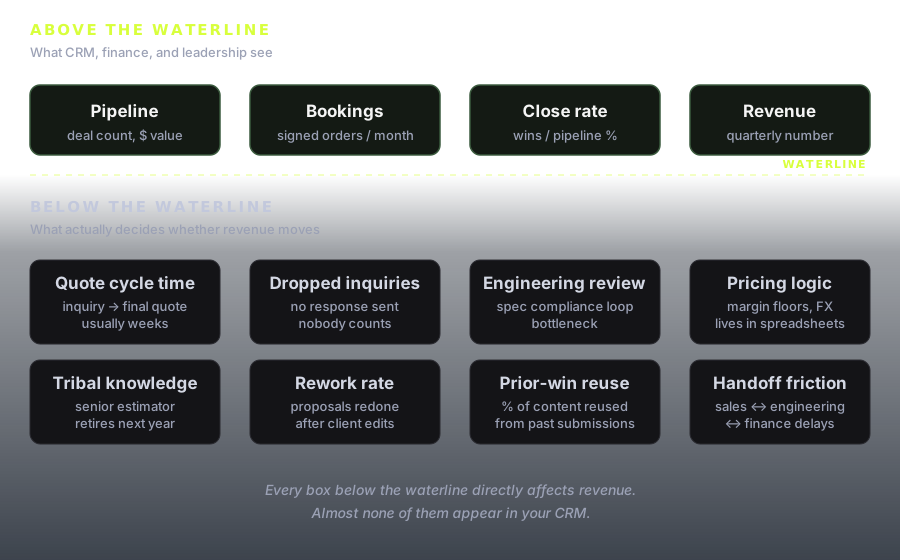
If you ask a VP of Sales at an industrial OEM "how is revenue?", they will quote you pipeline, bookings, close rate. If you ask them "how long is our quote cycle this month?", you will get a shrug, an estimate, or a number somebody made up for the board deck. That asymmetry is the story.
Why is CRM the wrong tool for this job?
CRMs were built for SaaS sales motions: lead → qualification → demo → close. Industrial revenue does not look like that. Industrial revenue looks like: inquiry arrives with a 47-page technical spec → engineering spends weeks figuring out whether you can meet it → estimating builds a quote from a pricing spreadsheet that lives on someone's laptop → the customer asks three clarifying questions → you redo everything → months later the PO lands.
Forcing that workflow into a CRM pipeline stage is like tracking a construction project with a to-do app. The mechanics of the work (the back-and-forth, the engineering validation loops, the pricing tribal logic) don't fit the abstraction.
What you end up with is a CRM that correctly reports your pipeline number and gives you zero visibility into whether your revenue team will hit it. When the number misses, nobody knows why, because nobody was measuring the workflow that produced it.

Which four numbers should every industrial OEM actually track?
If you want to understand and eventually improve your industrial revenue engine, these are the numbers that matter. None of them live in your CRM today.
- Quote cycle time. Median hours from inquiry received to quote sent. Not "close rate": cycle time. In most industrial OEMs this number is weeks. When it's days, you win deals you used to lose on speed alone.
- Drop rate. Inquiries received that never got a response. Every industrial OEM has them. Most teams underestimate this number by a wide margin. These are not "lost deals" in the CRM. They never entered the CRM.
- Engineering review hours per quote. How much senior engineering time every outbound quote consumes. This is your most expensive, most bottlenecked resource. If the number is big, it's a scaling ceiling you can't grow through by hiring salespeople.
- Prior-win reuse rate. Percentage of content in a new quote that was reused from past winning proposals. High reuse means you're capturing institutional knowledge. Low reuse means every quote is starting from scratch, and every retirement is costing you capacity.
If you can't answer these four questions for your business, you have an ITO problem. Not a CRM gap. An operational measurement gap. And you can't improve what you can't see.
What happens when ITO becomes an operating layer?
The industrial OEMs that have moved ITO out of spreadsheets and CRM notes into a real operational system report the same pattern. Revenue capacity goes up, not because they hired more salespeople, but because the existing team can process more inquiries at higher accuracy. Senior engineering time goes down, because most of the initial spec interpretation is automated. Drop rate falls, because no inquiry disappears into an inbox.
None of that comes from a better salesperson or more pipeline. It comes from a quote cycle that is finally fast enough to matter.
Not sure where your quote cycle is bleeding time?
We'll walk through your ITO workflow on a 30-minute call and flag the two or three places an operating layer would pay back in under a quarter.
Where is industrial revenue operations heading?
Industrial procurement and industrial sales are converging on the same infrastructure problem. On the bidder side (the ITO motion) we need an operating layer that turns inquiries into quotes faster and more accurately. On the buyer side (commercial bid evaluation) the mirror problem exists: evaluating dozens of supplier proposals against technical specs at scale. The same parsing, scoring, and compliance primitives show up on both sides.
The industrial OEMs that will win the next decade are the ones that treat ITO as a system to be instrumented and improved, not a black box to be optimized around with more salespeople. CRM will stay. But alongside it, a real ITO layer that knows what your engineers reviewed, what your estimators priced, and what your closers actually sent will become the revenue infrastructure for anyone selling configured industrial products.
The question leaders should be asking is not "how is pipeline." It is "how long does it take us to turn an inquiry into revenue, and what would it take to cut that number in half?"
Key Takeaways
- Industrial OEMs track pipeline and bookings in CRM, but not the workflow between inquiry and order: the operational engine that actually produces revenue.
- Inquiry-to-Order is a multi-department, multi-week process involving sales, engineering, estimating, compliance, and legal, none of which fit cleanly into a CRM pipeline stage.
- The four numbers that matter (quote cycle time, drop rate, engineering review hours per quote, prior-win reuse rate) aren't measured in most industrial organizations today.
- When ITO becomes an instrumented operating layer, capacity goes up without hiring because the same team processes more inquiries faster and more accurately.
- The leaders winning the next decade will treat ITO as a system to be measured and improved, not a black box to be worked around.
Ranger is the operating layer for industrial revenue, from inquiry to order on the bidder side and commercial bid evaluation on the issuer side. See how it looks in precision manufacturing or energy.