Ask an industrial pump OEM's commercial team a simple question, of the bids you lost last quarter, how many were lost on price versus lost on delay, and most cannot answer it with data. When they run the post-mortem, the result is consistent: the majority of lost bids never made it back to the buyer on time. The pricing was never the issue. The losses happened inside Inquiry-to-Order (ITO), the workflow between a customer inquiry and a confirmed purchase order, and nobody had been measuring there.
Why don't lost quotes show up in the CRM?
Inquiry-to-Order (ITO) is the operational layer of industrial revenue. It is where every dollar is actually built, and it is the part of the funnel that almost no CRM is instrumented to see. After deploying Ranger across more than 1,000 industrial bid cycles, the same pattern shows up in pump OEMs, EPC bid teams, offshore operators, and process equipment manufacturers: the lost quotes that hurt most are not the ones where the buyer chose a competitor on price. They are the ones where the buyer chose a competitor because your team did not submit on time, or submitted with gaps that disqualified you in the technical review.
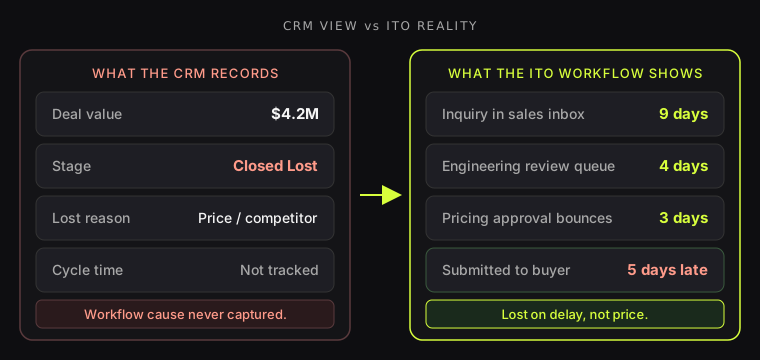
The CRM closes those out as "lost." The pipeline dashboard moves on. The board deck shows a win rate. None of those artifacts capture the operational truth: a 280-page specification sat in an estimator's inbox for nine days, a clause question waited four days for engineering to clear, a pricing approval bounced three times because the right person was at a trade show. By the time the proposal went out, the buyer was already in commercial conversations with two other vendors.
Most industrial OEMs lose a material share of their addressable bid revenue inside ITO before pricing is ever discussed. The losses are operational, not commercial. The board sees a competitive market; the workflow shows a queue management problem.
Why can’t CRMs, CPQs, and proposal tools catch the loss?
For a CRO trying to explain volatile win rate to a board, the available tools each see only a slice of the picture.
Salesforce, HubSpot, and other CRMs track deal stages, pipeline value, and forecast. They have no native concept of an inquiry that needs technical interpretation, a clause that needs engineering review, or a quote that has been queued behind seven other quotes. CRM users force-fit those workflows into custom stages and tasks, but the data captured is the salesperson's narrative, not the operational reality.
Salesforce CPQ, Tacton, Configit, and Intelliquip/FPX were built to produce structured price quotes from rules engines. They are excellent at validating that a configured pump can be ordered with a compatible motor. They are not built to read a 300-page EPC inquiry, route the technical clauses to engineering, manage compliance evidence, and rebuild a deviation log every time the buyer revises the specification. SteelBrick-era CPQ assumes the configurable product is the bottleneck. In industrial ITO, the document workflow is the bottleneck.
AutoRFP.ai, Loopio, Responsive, and Inventive AI are content-library systems built for software RFPs. They retrieve approved answers from a library and pattern-match them onto new questions. That architecture does not work when the answer has to be constructed from the buyer's own engineering document, not retrieved from a library of past responses.
The result, predictable across every industrial OEM we have deployed with, is that the CRM logs the loss, no system owns the cause, and the post-mortem stops at "competitor was cheaper." The actual cause was that your team's ITO cycle took weeks when the market is now operating on a much shorter clock.
What is the industrial ITO playbook?
Across pump OEMs, valve manufacturers, EPC firms, and offshore operators, the teams that are reliably winning in 2026 are running five operational moves the rest of the market is still catching up to.
1. Measure cycle time, not just close rate. Every inquiry has a clock. The most useful metric for an industrial revenue team is not pipeline value; it is median days from inquiry receipt to first compliant proposal sent. Until that number is on a board deck, the workflow underneath it stays invisible.
2. Separate technical interpretation from sales follow-up. The first hour after an inquiry arrives is when the specification must be parsed: which clauses apply, which standards are referenced (API 610, ASME B73.1, NACE MR0175/ISO 15156), which vendor data is needed, what the deviation surface looks like. In most industrial OEMs, this hour does not happen for days because the inquiry sits in the salesperson's inbox waiting for "review." That hour has to happen at intake, not after triage.
3. Make engineering review queues visible. The single most common failure mode in industrial ITO is a clause question sitting in an engineer's queue for days because nobody at the commercial level can see it is blocked. A revenue operations leader who cannot see engineering review queue depth is flying blind on every deal in the bid pipeline.
4. Build a compliance matrix from the buyer's clauses, not from a template. Every EPC client structures their requirements differently. Industrial OEMs that pre-built a generic compliance template are re-doing the work on every bid. The matrix has to be constructed from the inquiry itself at intake, with each clause mapped to a vendor response and a supporting document.
5. Capture tribal knowledge inside the workflow, not in post-mortems. When an industrial OEM wins, the reasoning lives in the senior estimator's head: which clause they negotiated, which vendor exception they sourced, which standard they substituted. That knowledge has to be captured inside the workflow that produced it, not in a slide deck after the fact. The next bid that resembles this one needs to inherit that reasoning automatically.
What does the playbook deliver when it runs end-to-end?
The industrial OEMs running this playbook with Ranger see the same shape of result, regardless of vertical.
The mechanism is consistent. Once an industrial revenue team sees ITO cycle time on the same dashboard as pipeline value, the workflow optimizes against the right number. Once technical interpretation happens at intake, the engineering queue stops being the bottleneck. Once compliance matrices are built from the buyer's actual document, the bid team stops re-doing the same work on every inquiry.
Stop losing bids inside your own workflow.
See how industrial OEMs are measuring and closing the ITO gap that CRMs and CPQs cannot see.

Where is industrial revenue operations going in 2026 and 2027?
Three movements are reshaping what industrial CROs are accountable for over the next 18 months, and they all reinforce the same conclusion: ITO is becoming the layer where industrial revenue is operated, not the layer that is invisible to operations.
First, the next Gartner CPQ Magic Quadrant is expected to formalize a category split between rules-engine CPQ (configure-price-quote for catalog products) and document-driven ITO platforms (inquiry-to-order for industrial bid teams). Boards will start asking why ITO is not a tracked workflow if the analyst frame validates it. The CROs who already have ITO instrumented will answer the question with data.
Second, the Salesforce CPQ End-of-Sale is prompting Salesforce CPQ customers to evaluate their quote-to-cash stack in 2026 and 2027. The question is not just "what replaces SteelBrick." It is "what should the next decade of quote workflow look like for our category." Industrial OEMs that pretend SteelBrick was solving ITO will replace it with something that also does not solve ITO. The teams that look at the workflow honestly will pick differently.
Third, agentic AI is moving from demo to production. The 2027 generation of revenue operations tooling will be expected to read inquiries, route technical questions, escalate to engineering, propose deviations, and own a bid end-to-end under human supervision. The trust architecture for that, citation, audit trail, reviewability, has to come first. Industrial buyers will not accept agency without it.
Key Takeaways
- The bids that hurt industrial OEMs most are not lost on price; they are lost on delay inside ITO before the price is ever discussed.
- CRMs, CPQs, and content-library RFP tools each see a slice of the workflow; none see the operational reality of an industrial inquiry-to-order cycle.
- The cause of lost quotes is fixable in weeks once cycle time, engineering queue depth, and compliance matrix construction are made visible.
- Industrial revenue operations ITO is becoming a measurable, instrumented workflow in 2026, not a tribal one.
- Three movements (Gartner CPQ Magic Quadrant, Salesforce CPQ End-of-Sale, agentic AI) are pushing the category in the same direction.
- The industrial OEMs that win in 2026 to 2027 will be the ones that treat ITO as a revenue operations system, not a sales narrative.
Those lost bids that trace back to ITO cycle delays rather than price are not unusual; they are the pattern. See the full thesis on why this workflow is the most underweighted lever in industrial revenue in our writeup on inquiry-to-order as the hidden revenue problem, or read how this lands in complex-assembly environments on our precision manufacturing page.