Run an industrial RFP through the AI tools marketed at proposal teams in 2026 and a pattern shows up fast. The pitch is identical from every vendor: 70% faster proposals, automated compliance, agentic bid response. Put one on a 300-page EPC inquiry and the demo unravels. The tool produces fluent answers, but a human still has to redo every technical compliance response before the bid can leave the building. The conclusion industrial bid teams keep reaching is the one nobody in marketing will say out loud: most AI RFP automation in 2026 was not built for industrial RFPs.
Why Don't Industrial RFPs Look Like Software RFPs?
The current generation of AI RFP automation, AutoRFP.ai, Inventive AI, Loopio, Responsive (formerly RFPIO), Olive, was built for software and SaaS procurement. Those RFPs have a predictable shape: 60 to 400 prose questions, a security questionnaire annex, vendor onboarding, pricing. Answers are reusable across deals. A "content library" of approved responses, paired with semantic search, gets a SaaS vendor 70% of the way to a complete bid.
Industrial RFPs do not have that shape. An EPC inquiry to a centrifugal pump manufacturer arrives as a 280-page technical specification, a separate commercial annex, a vendor data requirements list (VDRL), a project-specific deviation log, and a quality plan with referenced industry standards (API 610, ASME B73.1, NACE MR0175). The questions are not freeform prose. They are clauses, tables, compliance matrices, and drawings. The required answers are technical positions backed by submitted documentation, not boilerplate paragraphs from a library.
The industrial proposal team's real bottleneck is not "how fast can we type." It is "how confident are we that every technical clause has been correctly addressed, with the supporting document referenced, before this bid leaves the building." Speed without that confidence is a liability multiplier, not an efficiency gain.
Why Do Generic AI RFP Tools Fail on Industrial Bids?
Here is what is actually happening when an industrial OEM tries to run a 300-page EPC RFP through a tool built for SaaS procurement.
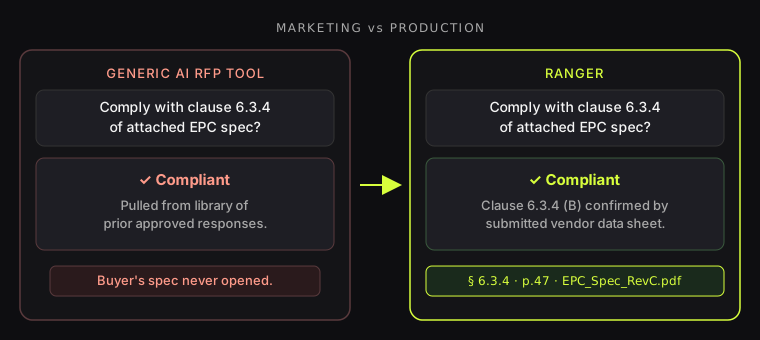
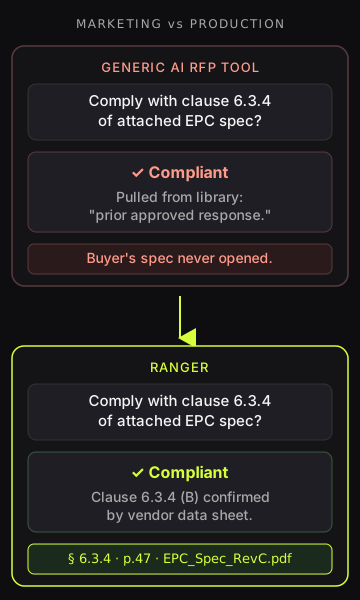
AutoRFP.ai and Inventive AI are template-and-library systems. They pattern-match new RFP questions against a knowledge base of previous answers. This works when 80% of your questions are variations of "describe your data residency policy." It breaks when the question is "Confirm compliance with Section 6.3.4, Clause B, of the attached technical specification, with reference to the deviations recorded in Appendix C." There is no library answer. The answer has to be constructed from the buyer's own document, not your past responses.
Loopio and Responsive (formerly RFPIO) are mature content management systems for proposal teams. They are excellent at organizing reusable answers and routing questions to subject matter experts. They were not designed to parse engineering drawings, cross-reference vendor data sheets against ASME or API standards, or detect when a clause is incompatible with another clause buried 180 pages away. The proposal manager still does that work manually.
Salesforce CPQ, Tacton, Configit, Intelliquip/FPX are configure-price-quote engines. They produce structured quotes from rules engines, not narrative responses to a 400-page RFP. They are the wrong tool for inquiry-to-order RFP response. Industrial teams that try to bend a CPQ into doing RFP work hit the same wall every time: the CPQ does not read documents.
Microsoft Copilot and ChatGPT Enterprise are general-purpose. We covered the specific failure mode in our post on why general-purpose AI hallucinates industrial specs. The short version: these tools sound authoritative on industrial standards because the standards exist in their training data, but they cannot tell you what the vendor's submitted document actually says, and they do not flag when they are guessing.
What Does AI RFP Automation Actually Have to Do for Industrial Buyers?
After deploying Ranger across pump OEMs, EPC firms, and offshore operators, five capabilities separate AI RFP automation that ships a real industrial proposal from AI RFP automation that produces a demo:
1. Ingest the buyer's document as it actually arrived. Scanned PDFs, AutoCAD exports, multi-tab Excel VDRLs, ten years of revisions stitched into one specification. The system has to parse this at ingestion, not require the bid team to pre-clean documents. Pre-cleaning is the work.
2. Build the compliance matrix from the buyer's clauses, not from a template. Every EPC client structures their requirements differently. Hardcoded compliance templates break the moment a new client's spec lands. Ranger constructs the matrix from the document, then maps each clause against the vendor response.
3. Cite every technical answer back to a source document and clause. This is the trust floor. If an AI tool cannot show the reviewer "this answer is supported by section 6.3.4 on page 47 of the vendor data sheet," the answer is unusable for industrial procurement.
4. Flag deviations and gaps, not just compliances. The high-value output of an industrial RFP review is the list of clauses where the vendor is non-compliant, partially compliant, or silent. Most AI RFP tools surface positive matches and bury gaps. That is the inverse of what an industrial reviewer needs.
5. Hand off to a human cleanly. No industrial bid team is shipping an AI-generated proposal unreviewed in 2026. The reviewer must be able to step into the document, see exactly what the AI produced, see the citations, and edit with full audit trail. Black-box generation is incompatible with bid governance.
See AI RFP automation built for industrial bids, not SaaS deals.
Ranger reads your buyer's specification, your vendor data, and your historical proposals together, and only returns answers it can cite to source.

Where Is AI RFP Automation Going in 2026 and 2027?
Three shifts are reshaping this category over the next 18 months, and they all push toward the same answer: industrial buyers will not tolerate untraceable AI in their bid workflow much longer.
First, regulatory pressure on AI-generated technical documents is rising in regulated industries (pharma tenders, offshore certification, defense procurement). EPC and operator quality teams are starting to require an audit trail showing which clauses an AI answered and how. Tools without source-level citation will be procurement-blocked, not because the AI is bad but because the output is not defensible.
Second, the Gartner CPQ Magic Quadrant publication in late 2026 will accelerate consolidation in quoting and proposal software. Generic AI RFP tools are likely to get re-packaged into CPQ suites; industrial-specific platforms are likely to deepen their position as the configurable layer for inquiry-to-order revenue. The lesson from the industrial inquiry-to-order workflow is that the proposal step does not live alone; it lives inside a longer revenue cycle that needs to be operated coherently.
Third, agentic AI will reshape what "RFP automation" means. The 2026 generation of these tools answers questions. The 2027 generation will be expected to negotiate clauses, propose deviations, escalate to engineering, and own a bid end-to-end under human supervision. Industrial buyers will only accept that if every action the agent takes is cited, reversible, and reviewable. The trust architecture has to come first; the agency comes second.
Key Takeaways
- AI RFP automation tools built for SaaS procurement do not generalize to 300-page industrial EPC inquiries.
- Template-and-library architectures break the moment the question is "comply with clause 6.3.4 of the buyer's specification," not "describe your security posture."
- Industrial bid teams need citation, deviation flagging, and reviewable audit trail more than they need faster autocomplete.
- The high-value output is the list of gaps and deviations, not the list of confident "yes" answers.
- Regulatory pressure and agentic AI are both pushing toward the same answer in 2026 to 2027: untraceable AI is not procurement-safe.
- Industrial RFP automation belongs inside the broader inquiry-to-order workflow, not as a standalone autocomplete tool.
That conclusion, that most AI RFP automation in 2026 was not built for industrial RFPs, is not a reason to give up on the category. It is a reason to be specific about what the category has to do. See where this work fits in the larger picture in our writeup on why inquiry-to-order is the hidden industrial revenue problem, or look at how this lands in regulated and complex-assembly environments on our precision manufacturing page.