Procurement vendors spent the last year rebranding their roadmaps around "agentic AI." The pitch is a Bid Analysis Agent that ingests every supplier response and hands you a ranked shortlist while you sleep, and the forecasts being circulated say procurement AI adoption will cross 80 percent this year. Look closely at how engineered supplier bids actually behave, though, and you can see exactly where that promise of bid evaluation automation holds and where it quietly breaks.
Why is autonomous bid scoring the wrong frame for engineered tenders?
The agentic pitch assumes the hard part of evaluation is reading speed. For catalog spend, maybe it is. For engineered procurement, the hard part is judgment under a specification, and that is a different problem entirely. When an EPC firm or a pump OEM issues a tender, a supplier response is not a quote with a price and a lead time. It is a 400-page technical package: datasheets, compliance matrices, hydrostatic test certificates, welding procedure specifications, deviation lists, and a pricing structure that no two bidders format the same way.
An agent that summarizes that package produces something that reads like an answer and cannot be defended in a steering committee. The recurring pattern across engineered bids is that the expensive mistakes are never the ones a summary catches. They live in a deviation buried on page 240, in a footnote that narrows a guarantee, in a certificate that has technically expired.
Why do summarization agents and e-procurement suites fall short?
Two categories of tool claim this space, and both stop short for the same structural reason. SAP Ariba, Coupa, and Jaggaer digitized the transaction: sourcing events, supplier masters, purchase orders. Their data model assumes the thing being evaluated arrived as fields in a form. An engineered bid does not, so the suite stores the PDF as an attachment and leaves the reading to a human. The newer wave, the AutoRFP.ai-style agents and "Bid Analysis Agents," do read the document, but they output confidence, not provenance. A score that says a vendor is "92 percent compliant" with no link to the clause it is judging is a number a buyer cannot stand behind.
Look across enough engineered bids and the same lesson repeats: the value is not in the verdict, it is in the trail to the verdict.
What does bid evaluation automation actually require?
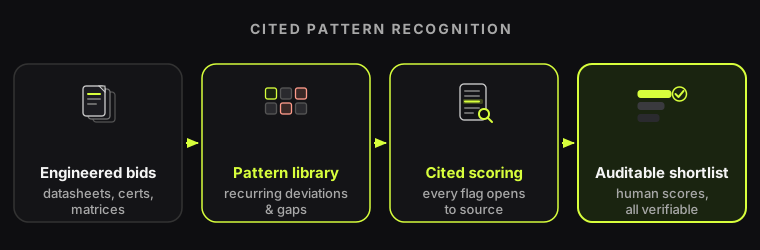
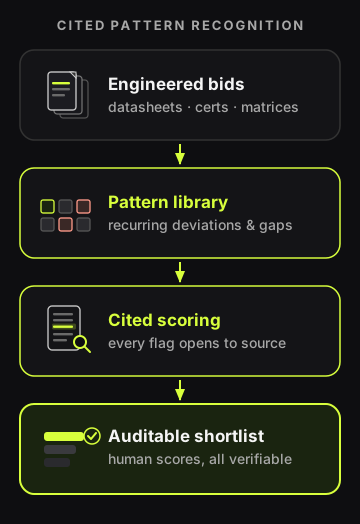
The pattern that holds up, bid after bid, is not autonomy. It is cited pattern recognition: a system reads everything, recognizes the recurring failure modes, and routes the evaluator straight to the source. Four things have to be true for that to hold at industrial scale.
- Evaluate against a requirement spine, not a prompt. The issuer's specification is parsed once into a structured set of requirements, each with a clause reference and an acceptance criterion. Every vendor response is matched line by line against that spine. The spine is the spec, not a keyword list.
- Recognize the patterns that recur across tenders. The same deviation types, the same hedged guarantees, and the same certificate gaps show up bid after bid. A system that has learned those recurring shapes flags what a first-time reviewer misses, and surfaces them as comparable rows across all bidders rather than as isolated summaries.
- Cite every flag to source. Compliant, partially compliant, or non-compliant, with a link that opens to the exact paragraph in the vendor PDF so the evaluator can verify it against the original. Citation is the unit of output, not a feature bolted on top.
- Keep the human as the scorer. The system normalizes, compares, and routes. The engineer decides. That division is what makes the output defensible in front of legal and audit, because a person signed the judgment and can point to the page.
What changes when the comprehension layer does the reading?
The shift is not that AI scores the bids. The buyer still scores the bids. The shift is that evaluators stop spending the bulk of a tender cycle on data normalization, the mechanical work of getting forty inconsistent responses into one comparable shape, and start spending it on engineering judgment. That is where the cycle compresses and the quality of the recommendation goes up.

Run your next tender through cited evaluation
Bring one issued specification and ten supplier responses. We will show you the normalized, cited evaluation matrix in under an hour, on top of the e-procurement system you already run.
Where is bid evaluation automation for industrial teams going?
The agentic procurement wave is real, and it is not going to reverse. But the market is about to separate the tools that automate reading from the tools that automate accountability. As the 2026 Gartner CPQ Magic Quadrant and the broader consolidation in quoting and evaluation software push buyers to re-examine their full quote-and-evaluate stack, the question issuers will ask is not "can your agent rank these bids." It is "can your agent prove the ranking." Re-shoring and the surge in capex-heavy industrial projects are pushing the number of responses per tender from a handful to dozens, sometimes more than a hundred, which makes the proof problem worse, not better. The winners will treat evaluation as a cited comprehension problem layered onto the e-procurement system of record, not as a black-box agent they wait for an incumbent to ship.
Key Takeaways
- The hard part of industrial bid evaluation is judgment under a specification, not reading speed, so "autonomous scoring" solves the wrong problem.
- E-procurement suites store the bid as an attachment; summarization agents read it but output confidence instead of provenance.
- What works across engineered bids is cited pattern recognition: read everything, recognize recurring failure modes, route the evaluator to source.
- Evaluation has to run against a clause-referenced requirement spine, with every flag linked to the exact paragraph in the vendor PDF.
- The human stays the scorer; the system normalizes and routes, which is what keeps the decision defensible in audit.
- Agentic procurement and the 2026 Gartner CPQ MQ are separating tools that automate reading from tools that automate accountability.
The next wave of industrial procurement runs on a comprehension layer that reads every bid, recognizes the failure modes that recur across engineered tenders, and cites every flag to source. See the architecture behind it in bid evaluation beyond e-procurement, how buyers run it in practice in how industrial buyers evaluate 40+ supplier bids in 2026, or where it fits in industrial infrastructure and EPC workflows.