A single offshore tender at an EPC firm now draws dozens of supplier bids, sometimes more than a hundred. That volume has grown sharply in recent years, driven by re-shoring, US CHIPS and IRA-funded projects, and a wider supplier pool that finally has the digital tooling to respond. Most procurement teams are still scoring those bids in Excel.
Why did bid evaluation become 2026's procurement bottleneck?
Industrial buyers, the EPC firms, the operators, the large pump and compressor OEMs running their own multi-tier supply chains, are sitting in front of more bids than they have ever processed. A pharmaceutical capex project routinely runs 30 to 50 vendor proposals across mechanical, electrical, instrumentation, and validation packages. An offshore production tender at a firm like SBM Offshore can pull 80 to 100 supplier responses on a single FPSO program. A large EPC bid for a refinery turnaround is regularly 40+ vendors per package, and a project has many packages.
Volume alone is not the problem. The problem is the work each bid demands: line-by-line technical compliance against the client specification, normalization of pricing across very different commercial terms, vendor qualification against safety and quality records, and risk scoring that has to be defensible to legal and audit. CPOs and Heads of Procurement have to deliver a recommendation that holds up in a steering committee, and they have to do it in weeks, not months, because the project schedule moves.
Why do existing tools break under industrial bid volume?
The procurement stack most industrial buyers run was built for indirect spend, not engineered tenders. SAP Ariba and Coupa are excellent at sourcing events, supplier onboarding, and PO automation. They are not built to read a 600-page mechanical bid response and tell you whether the vendor's pump curve actually meets the duty point in clause 4.3.2 of your specification. Jaggaer and GEP layer better RFx workflow on top, but the technical compliance scoring still happens in side files. Excel is where the real evaluation lives, and Excel does not know what an API 610 hydrostatic test certificate is.
The result is a handoff problem. Procurement runs the event. Engineering scores the technical sections. Risk and legal review the commercial terms. Each function works in its own document, and the consolidator, often a senior buyer, spends two weeks merging spreadsheets and chasing down clarifications. By the time the matrix is ready for the steering committee, the cheapest bid has expired.
How do industrial buyers actually evaluate 40+ bids in 2026?
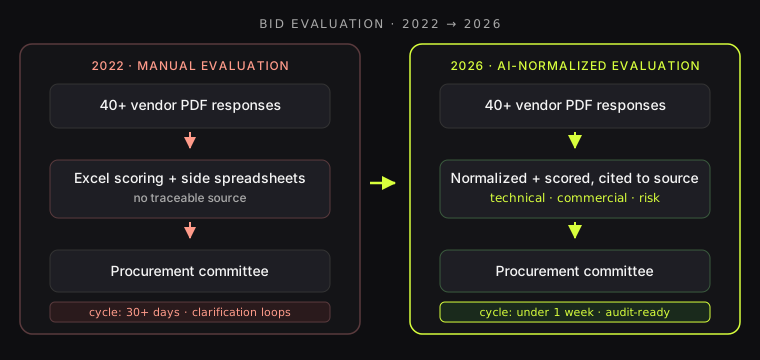
The buyers who are getting through 40+ bids on schedule are not running faster spreadsheets. They are running a different workflow. Five things change:
- Specification ingestion is mechanical, not manual. The client specification (the issuer's own RFQ) is parsed once into a structured set of requirements. Every requirement has a clause reference and an acceptance criterion. This becomes the spine of evaluation.
- Vendor responses are normalized against the spec, not summarized. Each bid is read line by line and matched to the requirement spine. Compliant, partially compliant, or non-compliant, with the source paragraph cited every time. No more "the vendor confirms compliance" with no traceability.
- Commercial terms are extracted into a comparable shape. Pricing, payment milestones, warranty, liquidated damages, performance guarantees. Different vendors structure these differently; the evaluation only works if they are normalized.
- Vendor qualification runs in parallel. Safety record, ISO certifications, financial standing, prior project performance. Not as a separate workstream that finishes after technical scoring, but as a parallel signal that contributes to the recommendation.
- The audit trail is the deliverable, not the byproduct. Every score traces back to a paragraph in a vendor PDF. The steering committee, legal, and post-award audit can all see why bid 17 was rated 4 of 5 on technical compliance.
This is what commercial bid evaluation software is supposed to do, and it is what the Ariba-class tools were never built for. It is also what makes Ranger credible on the seller side of the marketplace: the system already reads engineered documents on the bidder side, and the same comprehension layer applies in reverse for the issuer.

What changes when AI does the comprehension work?
The shift is not that AI scores bids. AI does not score bids; the buyer does. The shift is that the buyer's evaluators stop spending the bulk of their time on data normalization and start spending it on judgment. That is where the cycle compresses and the quality of the recommendation goes up.
See commercial bid evaluation in your own workflow
Bring a real tender, your specification, and ten supplier responses. We'll show you the normalized evaluation matrix in under an hour.
Where is commercial bid evaluation going in 2026 and 2027?
Three forces are pulling this market forward fast. First, the Salesforce CPQ End-of-Sale window, announced in early 2025, has every industrial buyer looking at their quote-and-evaluation stack with fresh eyes. Even buyers who never ran SteelBrick are using the moment to consolidate. Second, Gartner's first dedicated CPQ Magic Quadrant publication this year is forcing a public taxonomy on a category that has been muddled for a decade, and it is dragging bid evaluation into the conversation alongside it. Third, the agentic AI shift is moving procurement away from "summarize this PDF" point tools toward platforms that can run an end-to-end evaluation, cite every answer back to source, and stay reliable across vendor environments.
The buyers who win in this window are the ones who treat bid evaluation as a structured comprehension problem, not a sourcing problem. The ones who keep treating it as a spreadsheet exercise will keep losing 30 days per project to clarification cycles, and they will keep getting beaten to award by competitors who decide faster.
Key Takeaways
- Industrial buyers now process dozens of supplier bids per major tender, well above the volumes of a few years ago.
- The bottleneck is comprehension, not sourcing; existing tools (Ariba, Coupa, Jaggaer, Excel) were built for sourcing, not for engineered bid scoring.
- The buyers getting through on schedule normalize specs and vendor responses against a structured requirement spine, with citations.
- Commercial bid evaluation software in 2026 means parallel workstreams (technical, commercial, qualification) consolidated into one auditable matrix.
- The 2025 Salesforce CPQ End-of-Sale and the 2026 Gartner CPQ MQ are accelerating procurement consolidation.
- The deliverable is the audit trail, not a summary.
The next wave of industrial procurement runs on commercial bid evaluation that is structured, cited, and fast enough to beat the project schedule. If you operate the bidder side and the buyer side, as most industrial OEMs do, see how Ranger sits across both in the two-sided marketplace inside every industrial OEM, or read how the same comprehension layer reshapes industrial infrastructure and EPC workflows.