Every major e-procurement suite shipped an "AI" feature in the last twelve months. Coupa, SAP Ariba, Jaggaer, GEP, all of them now promise intelligent sourcing. None of them can read a 600-page mechanical bid response and tell you whether the vendor's pump curve meets the duty point in clause 4.3.2 of your specification. That gap is where supplier vendor evaluation AI actually lives, and it is not the gap e-procurement was built to close.
What does e-procurement actually solve, and what does it leave open?
E-procurement digitized the transaction. Supplier onboarding, RFx event management, purchase order automation, three-way matching, spend analytics: these are solved problems, and the incumbents solve them well. If your job is to run a sourcing event for indirect spend or to keep a supplier master clean, Ariba and Coupa are mature, defensible systems of record. Nobody should rip them out.
The problem is that engineered procurement is not indirect spend. When an EPC firm or a pump OEM issues a tender, the supplier responses are not catalog line items. They are technical documents: datasheets, compliance matrices, hydrostatic test certificates, welding procedure specifications, deviation lists, and pricing structured a dozen different ways. The e-procurement layer collects those PDFs and attaches them to a sourcing event. It does not read them.
Why do e-procurement suites stop short of evaluation?
The architecture explains it. Ariba, Coupa, and Jaggaer were built around structured transactional data: line items, prices, quantities, supplier IDs. Their data model assumes the thing being evaluated already arrived as fields in a form. An engineered bid does not. The compliance answer lives in prose, in a table buried on page 240, in a P&ID, in a certificate appendix. Reaching it requires document comprehension, not workflow.
So the suites bolt comprehension on as a thin wrapper: a summarization feature, a "chat with your document" panel, a keyword extractor. These help a buyer skim, but they do not produce a defensible score. A summary that says "the vendor confirms compliance" with no traceable source paragraph is worse than useless in a steering committee, because legal cannot stand behind it and audit will reject it.
What does supplier vendor evaluation AI require architecturally?
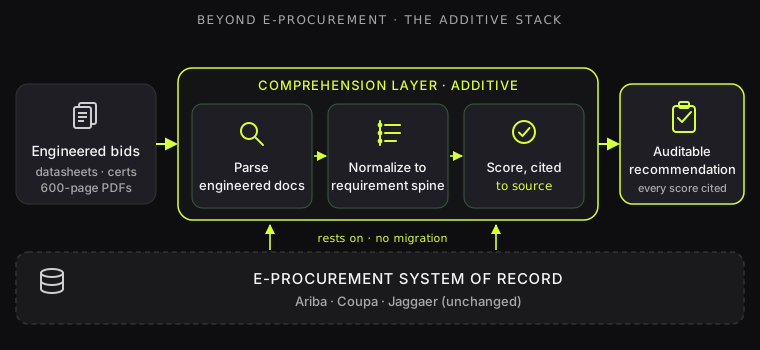
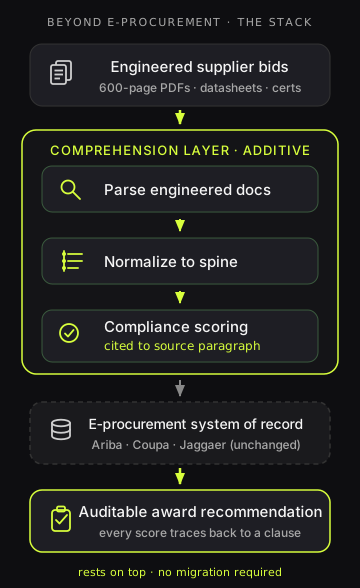
Building evaluation that holds up at industrial scale is a comprehension problem, not a workflow problem. Five things have to be true at the architecture level:
- Parsing has to survive engineered documents. Multi-column datasheets, rotated tables, scanned certificates, embedded drawings. A parser tuned for invoices fails on a 600-page mechanical response. The system has to extract structure from documents that were never designed to be machine-read.
- Evaluation runs against a requirement spine, not a prompt. The issuer's own specification is parsed once into a structured set of requirements, each with a clause reference and an acceptance criterion. Every vendor response is then matched line by line against that spine. The spine is the spec, not a list of keywords.
- Every score is cited to source. Compliant, partially compliant, or non-compliant, with a link that opens to the exact paragraph in the vendor PDF so an evaluator can verify it. Citation is not a feature on top; it is the unit of output. A score without a source is not a score.
- Vendor qualification runs in parallel, not after. ISO and API certifications, safety record, financial standing, prior performance. These are signals the comprehension layer reads from the submission and supporting documents in the same pass, not a separate workstream that finishes two weeks later.
- The e-procurement system of record stays the system of record. The comprehension layer reads what the suite stores and writes the structured evaluation back. Nobody migrates off Ariba or Coupa. The architecture is additive by design.
This is what makes Ranger credible on the seller side of the marketplace. The same comprehension engine that reads engineered documents on the bidder side runs in reverse for the issuer evaluating supplier bids.
What changes when the comprehension layer does the reading?
The shift is not that AI scores bids. The buyer scores bids. The shift is that evaluators stop spending the majority of their time on data normalization and start spending it on engineering judgment. That is where the cycle compresses and the quality of the recommendation goes up.
Evaluate a real tender against your specification
Bring one issued specification and ten supplier responses. We will show you the normalized, cited evaluation matrix in under an hour, on top of the e-procurement system you already run.
Where is e-procurement evaluation going in 2026 and 2027?
Three forces are pulling this forward. First, the agentic AI shift is moving procurement past "summarize this PDF" point tools toward systems that run an end-to-end evaluation, cite every answer to source, and stay reliable across vendor environments. The e-procurement incumbents will keep announcing AI features, but a summarization wrapper on a transactional data model has a ceiling, and engineered bid evaluation sits above it.
Second, re-shoring and IRA and CHIPS-funded capex have sharply increased the number of supplier bids per major tender in recent years. An offshore production tender can now pull dozens of responses, sometimes more than a hundred. Evaluation that was a manageable manual exercise at a handful of bids becomes the critical-path bottleneck at that scale.
Third, the 2026 Gartner CPQ Magic Quadrant and the broader consolidation in quoting and evaluation software are forcing buyers to look at their full quote-and-evaluate stack with fresh eyes. The ones who win treat bid evaluation as a structured comprehension problem layered onto their existing e-procurement of record, not as a feature they wait for Coupa to ship.
Key Takeaways
- E-procurement suites solve the transaction (sourcing, PO, supplier master) but were never built to read and score engineered supplier bids.
- The data model is the reason: Ariba, Coupa, and Jaggaer assume structured fields; engineered compliance lives in prose, tables, and certificates.
- Supplier vendor evaluation AI is a comprehension layer that parses engineered documents, scores against a clause-referenced requirement spine, and cites every result to source.
- The comprehension layer is additive. It sits above the e-procurement system of record, which stays the system of record.
- Citation is the unit of output, not a feature; a score without a traceable source paragraph fails in a steering committee and in audit.
- Re-shoring, agentic AI, and the 2026 Gartner CPQ MQ are accelerating the move beyond e-procurement.
The next wave of industrial procurement runs on a comprehension layer that scores engineered bids, cites every answer to source, and leaves your e-procurement of record exactly where it is. See how the same engine reads bids from both sides in the two-sided marketplace inside every industrial OEM, how buyers run the evaluation in practice in how industrial buyers evaluate 40+ supplier bids in 2026, or where this fits in industrial infrastructure and EPC workflows.