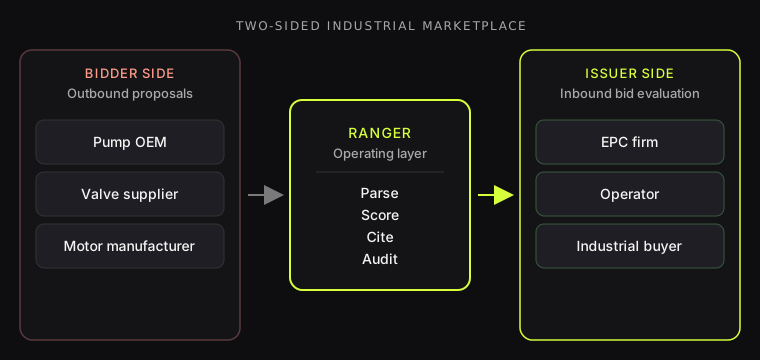
Walk into any industrial OEM (a pump manufacturer, a valve supplier, an offshore equipment maker) and the same company is running two completely different commercial motions at once. One side writes proposals. The other side reads them. In most organizations these two motions do not share data, do not share tooling, and often do not even share an executive. That gap is the largest unmeasured revenue lever in industrial procurement bid evaluation right now, and the category is about to make it visible.
What makes an industrial OEM a two-sided marketplace?
The bidder motion is the one every CRO recognizes. When a customer sends an inquiry, sales and engineering stitch a proposal together from tribal knowledge, prior submissions, and whatever the senior estimator remembers about that buyer's tolerances. We have written about this motion as Inquiry-to-Order: the revenue engine of industrial commerce.
The second motion is less obvious and equally consequential. Every industrial OEM is also a buyer. They procure sub-assemblies, castings, instrumentation, specialty services. When they do, they receive dozens, sometimes hundreds, of supplier bids. Somebody has to evaluate those bids: technical compliance against the spec, pricing bands, lead times, vendor qualification, risk exposure. That work, today, is almost entirely manual.
The same industrial OEM that spends six weeks responding to an EPC RFP will also spend four weeks evaluating supplier bids it receives, with the same spreadsheet, the same tribal knowledge, the same lack of audit trail. Two sides of the same broken workflow, paid for twice.
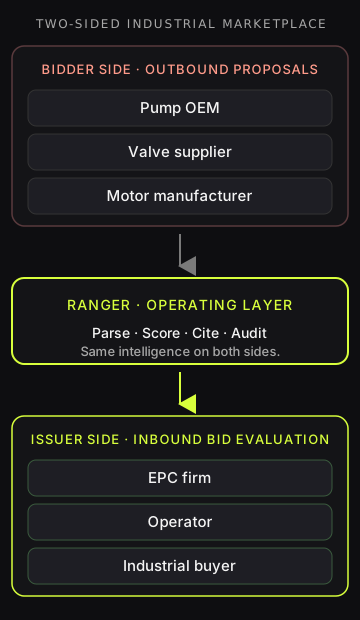
The interesting move is not picking a side. The interesting move is recognizing that the same operating layer serves both, and that running both through it is where the compounding starts.
Why do existing tools fail on the issuer side?
The bidder side has at least a handful of imperfect tools: RFP automation platforms, proposal generators, CPQ engines. The issuer side has almost nothing built for industrial complexity. What most procurement teams use today:
- Shared spreadsheets. One master scoring sheet, owned by three to five evaluators, usually stored in a folder nobody can find six months later.
- Email threads. Bids arrive as attachments in conversations that branch and die.
- E-procurement platforms (Ariba, Coupa, Jaggaer). Built for purchase orders, supplier onboarding, and catalog buying. Not built for reading a 200-page technical submission and judging whether the vendor meets clause 6.4.3 of your specification with the right ASME or API reference.
- The committee meeting. Because the software does not do the work, four or five experts gather in a room and argue about what each bid actually says.
The result, predictable across every industrial buyer we have deployed with, is that the issuer-side cycle is slower than the bidder-side cycle inside the same building. The OEM has invested in tooling to send proposals out, and almost nothing to score the proposals coming in.
What does an issuer-side operating layer actually do?
We have been building this motion with SBM Offshore, and four patterns are non-obvious until you are inside the workflow.
1. Inbound is the dirty part. Supplier bids arrive in every format imaginable: PDFs with embedded Excel, zipped CAD bundles, emails with inline tables, occasionally a physical binder. A real evaluation system treats inbound as a parsing problem, not a form-submission problem. You meet the bid where it lives, not where the e-procurement portal wants it.
2. Scoring needs to be cited, not just calculated. A number next to a supplier name is worth less than a number with a citation behind it. Every score the system produces should link back to the exact clause in the exact bid that drove it. This matters because procurement decisions get audited, sometimes years later by regulators or quality teams. Black-box scoring is incompatible with industrial governance.
3. The committee meeting becomes a review, not a workshop. When scoring is already done with evidence linked, the human conversation moves from "let's figure out what this bid says" to "do we trust this pattern across the cohort." The committee still matters. It just stops being a data-entry exercise.
4. Cycle time compresses, but decision quality is the bigger lever. The more interesting shift is not "evaluate in five days instead of four weeks." It is that when a procurement team can examine all 40 bids at the same level of depth, instead of just the top five they had time for, they make different decisions, and those decisions hold up under audit.
Why do the two sides compound into a flywheel?
Single-sided tools will never reach the move that matters most: the insights compound across the marketplace. When the same operating layer sits on both sides of industrial commerce, every bidder-side win teaches the issuer side what "good" looks like in the wild, and every issuer-side evaluation teaches the bidder side what actually gets disqualified and why.
This is not a matchmaking play. We are not building a B2B network. The value is that each side of the workflow, running through the same intelligence layer, produces pattern recognition that neither side could produce alone. Over enough turns of the wheel, the system knows things about industrial procurement bid evaluation that the buyers and the suppliers on their own do not have the data to know.
Running bid evaluation through spreadsheets?
Ranger is live on both sides of the industrial marketplace with SBM and a growing cohort of operators. See what it looks like with your own workflow.

Where is industrial procurement bid evaluation going in 2026 and 2027?
Three movements over the next 18 months point at the same answer: industrial procurement bid evaluation becomes its own category, and the operating layer that runs both sides of the marketplace is the one that compounds.
First, the Gartner CPQ Magic Quadrant publication in late 2026 is expected to formalize a category split between rules-engine CPQ (configure-price-quote for catalog products) and document-driven workflows for industrial bid teams. The downstream effect on the issuer side is that procurement leaders will begin asking why their own evaluation workflow is still spreadsheet-based when the analyst frame validates that the work is software-shaped. Once the category exists, the budgets follow.
Second, the Salesforce CPQ End-of-Sale migration window is forcing every Salesforce CPQ customer to rethink their quote-to-cash stack in 2026 and 2027. The smarter industrial CPOs are using that window to ask the harder adjacent question: if we are rebuilding our outbound proposal stack, why are we not also rebuilding our inbound supplier bid evaluation stack at the same time. Both sides will be replaced in this decade. The teams that replace both with the same operating layer get the flywheel.
Third, agentic AI is moving from demo to production. The 2027 generation of procurement tooling will be expected to ingest supplier bids, build the scoring matrix, propose risk-weighted recommendations, and escalate to a human reviewer with full audit trail. Industrial buyers will only accept that if every action is cited, reversible, and reviewable. Trust architecture has to come first; agency comes second. The OEMs that operate the same trust architecture on both sides of their marketplace will be the ones who let agentic procurement reach production.
The takeaway for an industrial CRO or CPO reading this in 2026: every dollar of revenue your OEM books outbound has a mirror on the inbound side, where you are spending the same kind of money on supplier components and the same kind of time evaluating who gets paid. Tooling one side and ignoring the other leaves the largest unbuilt operating lever in industrial procurement sitting on the table.
Key Takeaways
- Every industrial OEM operates on both sides of a marketplace: they sell proposals (ITO) and they evaluate supplier bids (CBE), but the second motion has almost no purpose-built tooling today.
- E-procurement platforms (Ariba, Coupa, Jaggaer) were built for transactional buying, not for reading 200-page industrial bids against engineering standards.
- A real issuer-side operating layer treats inbound as a parsing problem, scores every clause with a citation, and turns committee meetings into reviews instead of data-entry workshops.
- Cycle time compresses from weeks to days, but the larger lever is decision quality when every bid is evaluated at full depth and the scoring is auditable.
- Running both sides of the marketplace through the same intelligence layer creates a flywheel: bidder wins teach the issuer side what good looks like, issuer evaluations sharpen what bidders submit.
- Three 2026 to 2027 movements (Gartner CPQ MQ, Salesforce CPQ End-of-Sale, agentic AI) all point at the same outcome: an industrial procurement bid evaluation category, with the bilateral operating layer as the durable winner.
The two motions inside an industrial OEM are not separate businesses. They are the same marketplace seen from different desks. For the tactical view of how issuer-side teams are scoring 40-plus bids today, see how industrial buyers evaluate supplier bids in 2026. For how Ranger lands in the offshore and energy environments where this workflow runs at the highest stakes, see our energy industries page.