An industrial bid can now be drafted faster than it can be checked. Proposal tooling has turned the narrative sections, the company history, the quality approach, the project references, into an afternoon's work. The schedule of deviations, the one document that decides what the bidder is actually liable to deliver, is still assembled by hand at the end, usually by whoever is still awake the night before submission. The cheap part of the bid got cheaper, and the expensive part did not move.
What is a scope of supply deviation list?
It is the bidder's written record of every point where its offer departs from the enquiry documents. Depending on the house style it is called a schedule of exceptions and deviations, a clarifications and exceptions list, or a deviation register, and whatever it is called, it is the boundary of the price.
Picture a pump OEM bidding to an EPC contractor. The enquiry arrives as a datasheet, a piping material specification, an inspection and test plan, a set of project-specific amendments to a standard, and a commercial terms sheet. The offer that comes back is compliant in most respects and not compliant in perhaps fifteen. The casing material is one class below what the datasheet calls for, because the specified class carries a sixteen-week lead time. Two of the witnessed tests in the ITP are offered as non-witnessed. The warranty runs twenty-four months from delivery rather than from commissioning. The liquidated damages cap is accepted at a lower percentage than the terms sheet states.
Every one of those is a priced decision. The deviation list is where they become visible to the buyer, and the only place the bidder gets to say, in writing and before award, what it is not promising.
Why do deviation lists fail to protect scope?
Because they are written last, by the fewest people, and checked least. The list is supposed to be derived from the technical and commercial offer, but in practice the offer and the list are assembled in parallel by different people and reconciled only if someone remembers to.
Look at what the surrounding tooling actually covers. Configurators and quoting systems (Salesforce CPQ, Tacton, Configit) model what a company can build and what it costs. They are built to express a valid configuration, not to express a refusal, so a decision to not meet a clause has no natural home in them. Proposal and response platforms (Loopio, Responsive, AutoRFP.ai) are strong on prose assembly and content reuse, which is exactly the half of the bid that was already getting cheaper, and they treat a deviation as another text field rather than as a pointer at a specific clause. PLM and document management hold the specification revisions and have no concept of an outbound exception against them. So the real incumbent is an Excel tab, filled in from memory near the deadline.
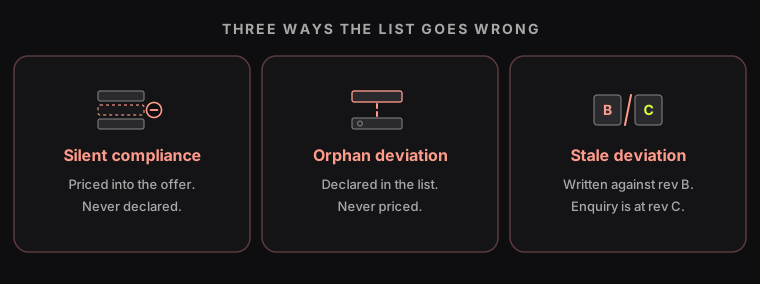
That produces three failure modes, and none of them are visible from reading the deviation list by itself. Silent compliance is a departure that was priced into the offer and never declared, which is the expensive one: the bidder has quoted non-compliant work and contracted to deliver compliant work. Orphan deviation is the reverse, a deviation declared but never reflected in the price, so the bidder gives away a concession it already paid for. Stale deviation is one written against revision B of a specification when the buyer issued revision C during the clarification rounds, which makes it an exception to a document that no longer exists.
What does a deviation list have to do to hold up?
Four things, none of which are about the document's formatting.
- Bind each deviation to the clause it departs from. Not "deviation on testing" but the document number, the revision, and the clause: specification 4512-PS-001 rev C, clause 7.3.2. A deviation that does not name what it deviates from cannot be checked by the evaluator or defended later by the bidder.
- Carry the consequence, not just the statement. Each entry needs its technical effect and its commercial effect. A reduced test scope is not simply a reduced test scope; it is a change in what evidence will exist at handover.
- Come from the same record as the price. When the decision to deviate and the decision to price are one event rather than two documents reconciled later, silent compliance and orphan deviations stop being possible. This is the structural fix, and the other three are hygiene.
- Survive revision. When the enquiry is reissued, every open deviation has to be re-tested against the new text rather than carried forward. A deviation is a statement about a specific revision, and it expires when that revision does.
What do the standards actually require?
More than most bid teams assume, and the requirement sits on the bidder rather than the buyer.
ISO 9001:2015 clause 8.2.3 requires an organisation to review the requirements for a product or service before committing to supply it, to ensure that requirements are defined, that it has the ability to meet them, and specifically that any differences between the contract or order requirements and those previously expressed are resolved. The results of that review have to be retained as documented information. A deviation schedule is not an optional courtesy to the buyer. It is the visible output of a review the quality system already obliges the bidder to perform.
In regulated public procurement the position is harder still. Under Directive 2014/24/EU Article 45, a contracting authority must state in the contract notice whether variants are authorised at all, and variants are not authorised without that indication. Where they are permitted, the authority states the minimum requirements a variant must meet, and only variants meeting those minimum requirements are taken into consideration. An unauthorised deviation in that setting is not an opening negotiating position. It is a reason the tender is not assessed.
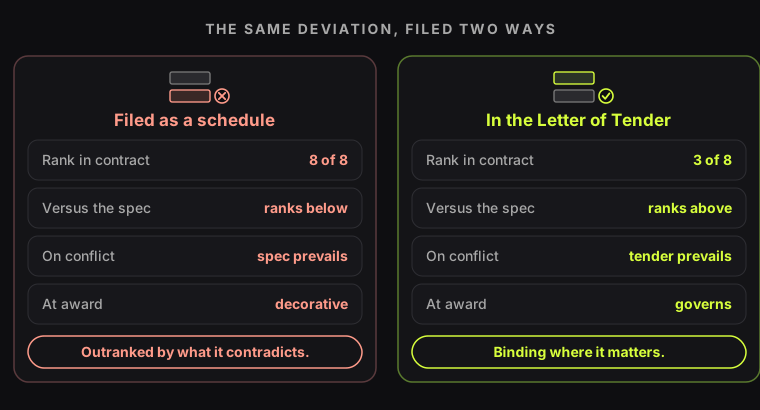
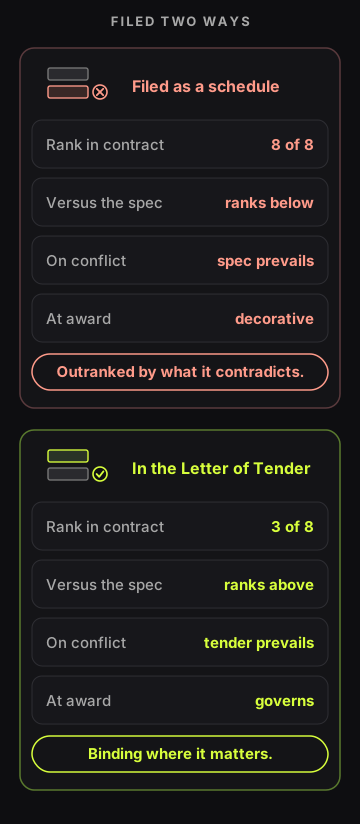
Then there is the question of where the deviation physically sits, which decides whether it binds at all. Standard-form contracts rank their constituent documents in a priority order so that conflicts resolve predictably. In the widely used FIDIC Red Book sequence, the Letter of Tender ranks third, above the Particular Conditions, the General Conditions and the Specification, while Schedules rank last, below the Specification. The consequence is uncomfortable and almost never discussed in the bid room: identical wording either overrides the specification or is overridden by it, depending only on which document the bid team pasted it into.
Deviations that trace back to the clause they depart from
See how cited, clause-level comprehension changes what a bid team can check before submission.
Where this is going
Both sides of the tender are automating at once, and they are converging on the same requirement. Bidders are generating more offer content faster, which raises the number of statements that need to be reconciled against a specification. Evaluators, as we have written about in how issuers score bids, are moving from reading submissions to normalising them, and a free-text deviation list is the hardest thing in a submission to normalise.
The predictable result is that compliance matrices stop being a courtesy attachment and start being a submission format. When an issuer can machine-read a deviation schedule, it will require one that is machine-readable, which means clause references rather than prose. Bid teams that already hold deviations as structured records against document, revision and clause will be able to emit whatever format an issuer asks for. Teams holding them in a spreadsheet tab will be re-typing them per tender, which is where the stale and orphan entries come from in the first place.
How should you choose a tool for scope and deviation management?
Judge candidates on traceability, not on template libraries. Six questions separate tools that manage deviations from tools that merely store them:
- Can a deviation bind to a document, a revision and a clause number, or only to free text?
- When the enquiry is reissued at a new revision, does every open deviation get re-tested against the new text, or silently carried forward?
- Do the priced scope and the declared deviation come from one record, or from two documents reconciled by a person?
- For any line in the final offer, can the system show the source clause it answers?
- Can the deviation schedule be exported into a specific contract document, so the bid team controls where it lands in the priority of documents?
- Can an evaluator open each deviation back to the source clause without asking the bidder for help?
A tool that answers the first and last of those well will usually answer the rest. A tool that answers none of them is a formatting aid, which is a reasonable thing to buy as long as nobody mistakes it for scope protection.
Key Takeaways
- A deviation list is the boundary of the quoted price, not an administrative appendix to the technical offer.
- Three failure modes recur: a departure priced but never declared, a deviation declared but never priced, and a deviation written against a superseded specification revision.
- ISO 9001:2015 clause 8.2.3 already obliges a supplier to resolve differences between contract requirements and those previously expressed before committing to supply.
- Under EU Directive 2014/24/EU Article 45, variants are only considered when the authority authorised them and they meet the stated minimum requirements.
- Where a deviation is recorded decides whether it binds, because standard-form contracts rank the Letter of Tender above the Specification and Schedules below it.
- The structural fix is making the decision to deviate and the decision to price one event rather than two documents reconciled later.
Scope protection is a document control problem wearing a commercial hat, which is why it resists being solved by better templates. For how the same traceability requirement shows up on the evaluation side of the same tender, see modernising industrial tender evaluation, or read how Ranger approaches this class of work in precision manufacturing.