An EPC tender for a process plant or a pipeline routinely arrives as a single package running past 400 pages: instructions to bidders, a technical specification, equipment datasheets, a compliance matrix, and a contract form with performance guarantees attached. Buyers increasingly expect a qualified response in days, and a wave of RFP automation tools now advertises exactly that, drafting a proposal in a fraction of the old cycle time. The catch is that an EPC bid is not a capabilities questionnaire. A single mis-stated pressure rating or a missed deviation is not a typo, it is a priced liability, and speed that breaks technical accuracy costs more than the delay it saves.
What makes an EPC RFP different from a standard proposal?
An EPC RFP is an engineered, contractually binding document, not a marketing questionnaire. EPC stands for Engineering, Procurement, and Construction: the bidder commits to design the asset, buy the equipment, and build it, usually under a fixed price and a fixed completion date. The proposal a bidder returns is not a pitch, it is the priced technical scope that carries into the contract.
That changes what the document contains and how it is graded. Alongside the instructions to bidders (ITB) sit a technical specification, equipment datasheets, project schedules, and two artifacts that decide most EPC awards: a compliance matrix, where the bidder must mark each requirement comply, partially comply, or deviate, and a schedule of guaranteed values, where numbers like flow rate, efficiency, or noise level become contractual commitments. Under the FIDIC Silver Book, the standard turnkey EPC contract form, the contractor also owns responsibility for the correctness of that tender. Every clause is a place where an answer has to be technically correct, internally consistent, and traceable to the spec that governs this project, not the last one.
Why do speed-first RFP automation tools break on EPC bids?
They break because they optimize for drafting speed, and an EPC response is bottlenecked by verification, not writing. Producing fluent proposal prose was never the hard part. Confirming that every number in that prose traces to the governing spec, and stays consistent across hundreds of pages, is.
Four categories of tool claim this work, and each optimizes the wrong variable. Generic LLM copilots draft fluent, confident answers whether or not a real spec value sits behind them, which is exactly the failure mode you cannot afford on a guaranteed number. RFP content libraries recycle the closest past answer, inheriting whatever datasheet figure was true on a different project. The newer speed-first RFP agents advertise cycle-time cuts and a confidence score, optimizing the half of the job that was already fast. And the hand-kept Excel compliance matrix, still the default at many bid desks, is accurate the moment it is written and then desyncs from the proposal narrative the first time a number changes. None of them close the requirement that every technical answer open to its source for this tender.
How do you respond to a 400-page EPC RFP without losing technical accuracy?
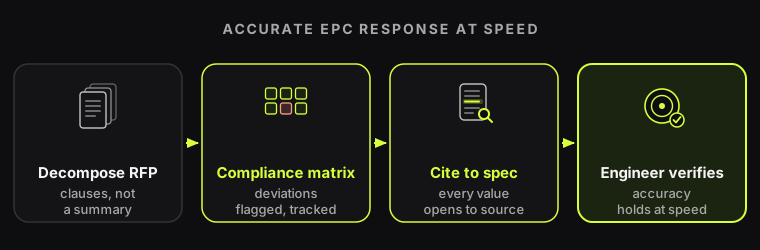
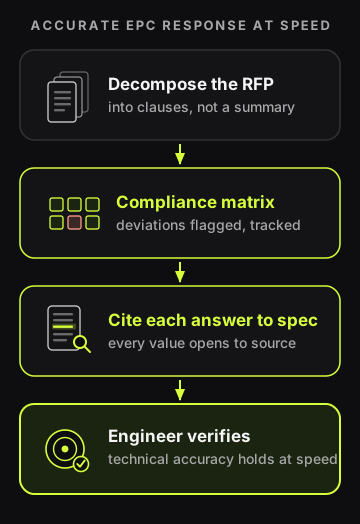
You decompose the tender into a traceable requirement set, answer each item against its governing source, and keep an engineer as the approver. The speed comes from removing the manual reconciliation, not from drafting faster. Five things have to hold for a fast response to survive technical evaluation.
- Decompose the RFP into a structured requirement set. Parse the ITB, specification, datasheets, and compliance matrix into discrete, addressable clauses, so nothing is answered from memory or from a summary of the document.
- Trace every technical answer to its governing source. Each guaranteed value and code-compliance statement points to the datasheet, standard, or prior engineered submittal it came from, for this project, and opens to that source so a reviewer can verify it rather than trust it.
- Flag deviations instead of papering over them. Where the design cannot fully comply, surface it as an explicit deviation. An EPC evaluator scores an honest deviation higher than a false "comply" that unravels during clarifications.
- Enforce consistency across the whole document. A guaranteed flow rate in the schedule of values has to match the datasheet and the narrative section that references it. Automation's real value here is holding that consistency across hundreds of pages, which is where manual assembly quietly fails.
- Keep the lead engineer as the approver. The system decomposes, traces, and checks consistency. A qualified engineer signs. That division is what lets a team move fast without owning an answer it cannot defend.
What does the evidence show about EPC tender complexity?
EPC tenders are standardized around contract forms that make technical accuracy enforceable, which is exactly why an unverifiable fast answer is a poor trade. The FIDIC Silver Book, the Conditions of Contract for EPC/Turnkey Projects published by the International Federation of Consulting Engineers (FIDIC), is the reference form for turnkey work, and it places responsibility for the design and for the correctness of the tender on the contractor. Under that model, the compliance matrix and the schedule of guaranteed values are not paperwork around the bid. They are the priced scope.
That is what makes a wrong number expensive rather than embarrassing. A guaranteed value entered incorrectly is a value the contractor is contractually bound to deliver, and EPC contracts routinely tie performance guarantees to liquidated damages if the built asset misses them. A speed-first tool that drafts a plausible figure it cannot trace has not saved the bid team time. It has moved the real work, verifying that figure against the spec, downstream to where it is most costly to catch.

Run your next EPC tender through the citation test
Bring a live EPC RFP your team is scoping. We will show each requirement traced to the spec that governs it and every deviation flagged, on top of the systems you already run.
Where is EPC RFP response automation going?
It is splitting into tools that automate drafting and tools that automate verification, and EPC is where the difference gets decided. Two forces are tightening the window through 2026 and 2027. The industrial capital wave, energy transition projects, LNG, grid buildout, and reshored manufacturing capacity, is raising the volume of EPC tenders while buyers compress the time they allow for a response. At the same time, agentic procurement and RFP tools are proliferating, most of them pitched on speed and a confidence number rather than on provenance.
The tools that win this category will not be the ones with the fastest first draft. They will be the ones that treat every technical answer the way an evaluator does: as a commitment that has to trace to a spec and open to its source. That is the same cited comprehension problem Ranger works on across industrial documents, applied to the tender where an unverifiable answer is not a bad sentence but a priced liability.
Key Takeaways
- An EPC RFP is an engineered, contractually binding document; EPC stands for Engineering, Procurement, and Construction, and every guaranteed value in the bid carries into the contract.
- Speed-first RFP automation optimizes drafting, but an EPC response is bottlenecked by verifying that each technical answer traces to the spec governing this project, not by writing prose.
- Generic LLM copilots produce unbacked figures, content libraries recycle stale numbers from other projects, and a hand-kept Excel compliance matrix desyncs from the proposal, so each fails the traceability test.
- Responding fast without losing accuracy means decomposing the tender into a traceable requirement set, sourcing every answer, flagging deviations, enforcing document-wide consistency, and keeping an engineer as the approver.
- Under the FIDIC Silver Book, the contractor owns the correctness of the tender, so a wrong guaranteed value is a priced liability tied to liquidated damages, not a typo.
- As industrial capex raises EPC tender volume and shrinks response windows, the winning tools will make every answer traceable to source, not draft the fastest.
The next 400-page EPC tender your team faces will not be won by the fastest first draft. It will be won by the response where every guaranteed value opens to the spec that backs it. That is the same cited comprehension discipline behind why general-purpose AI hallucinates industrial specs, it is where the gap between AI RFP marketing and what actually ships a proposal is widest, and it is what compliance-heavy EPC and infrastructure buyers require before they award the work.