This scene plays out across the pump and valve OEMs we work with. A VP of Commercial Operations opens her Salesforce pipeline review and sees a healthy forecast: dozens of active bids, weighted to a strong number. Then the board asks the question the dashboard cannot answer: that $6M offshore package, where is it right now, and will we make the deadline? The CRM knows the account, the contact, and the deal stage. It does not know that the technical specification has been sitting unparsed for over a week, or that two clause questions are stuck in the engineering review queue. The relationship is in the CRM. The revenue is somewhere the CRM cannot see.
What does a CRM actually know about an industrial bid?
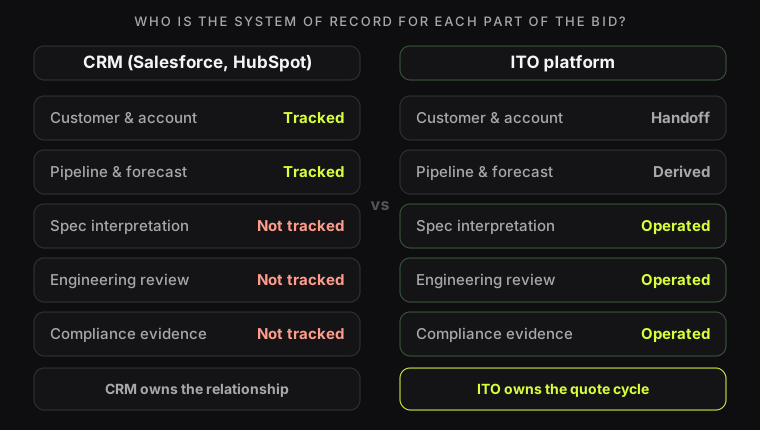
A CRM is a system of record for the customer relationship. Salesforce, HubSpot, and Microsoft Dynamics are very good at what they were built for: contacts, accounts, activity history, pipeline stages, and a weighted forecast. For a software company selling seats, that is most of the revenue motion, so the CRM feels like the system of record for revenue itself.
Industrial revenue does not work that way. For a pump OEM, an EPC bid team, or a process equipment manufacturer, the deal is not won in conversations logged against an account. It is won or lost inside the Inquiry-to-Order (ITO) workflow: the work between a customer inquiry and a confirmed purchase order. That workflow is document-driven and engineering-gated. A 280-page specification has to be parsed, clauses routed to engineering, deviations logged, compliance evidence assembled, and a compliant proposal returned before a competitor does the same. None of that has a native home in a CRM.
A CRM can tell you a bid is in the "proposal" stage for three weeks. It cannot tell you that two of those weeks were spent waiting on an engineering clause review nobody could see. The stage field moves on a clock the workflow does not control.
Why Salesforce and CPQ both miss where the revenue is built
The instinct, when a CRM cannot see the quote workflow, is to bolt on a CPQ. That is exactly the decision many industrial manufacturers are being forced to revisit right now: the Salesforce CPQ End-of-Sale has put every CPQ customer on notice that their quoting stack needs a deliberate answer over the next two years, not a default renewal.
Here is the trap. Salesforce CPQ, Tacton, Configit, and Intelliquip/FPX are rules engines. They were built to configure a catalog product and produce a structured price: validate that this pump pairs with that motor, apply the price book, generate the quote document. That is genuine, useful work. It is also not the work that loses industrial bids. The SteelBrick-era assumption is that the configurable product is the bottleneck. In industrial ITO, the bottleneck is the document: reading the buyer's inquiry, interpreting which standards apply (API 610, ASME B73.1, NACE MR0175), and constructing a compliance matrix from clauses that change every time the buyer revises the spec.
So replacing one CPQ with another CPQ answers the wrong question. The honest question the End-of-Sale moment surfaces is not "what replaces SteelBrick." It is "what is the system of record for the part of our revenue that neither the CRM nor the CPQ has ever owned."
What an ITO system of record actually operates
ITO is not a replacement for the CRM, and it is not a CPQ. It is the operational layer underneath both, where the bid is actually built. An ITO platform like Ranger is the system of record for the work the CRM hands off and the CPQ never touches.
1. Spec interpretation at intake. The moment an inquiry arrives, the specification is parsed: which clauses apply, which standards are referenced, what the deviation surface looks like. This happens in the first hour, not after the inquiry sits in a salesperson's inbox for a week.
2. Engineering review as a visible queue. Clause questions that need engineering input are tracked as a queue with depth and age, not as an invisible email thread. A commercial leader can see what is blocked and for how long.
3. A compliance matrix built from the buyer's document. Every EPC client structures requirements differently. The matrix is constructed from the inquiry itself, each clause mapped to a response and a supporting document, not force-fit from a generic template.
4. Every answer cited back to source. The interpretation of a clause, the standard applied, the deviation proposed: each traces to the exact page of the buyer's document or your own engineering record, so the bid survives technical review.
5. Forecast and account data flow back to the CRM. ITO does not fight Salesforce for the relationship. Cycle status and probability derived from real workflow state flow back, so the pipeline the CRM shows is finally grounded in operational reality.
What changes when the right system owns the quote
Industrial manufacturers that put an ITO system of record under their CRM see the same shape of result, regardless of vertical.
The mechanism is not magic. When spec interpretation happens at intake, the eight-day inbox delay disappears. When the engineering queue is visible, blocked clauses get unblocked in hours instead of days. When the forecast is derived from workflow state rather than salesperson optimism, the number the board sees is one the commercial team can actually defend.
See where your industrial revenue actually lives.
We will map your inquiry-to-order workflow against what your CRM and CPQ can and cannot see.

Where the industrial revenue stack is going
The next two years will force a stack decision on most industrial manufacturers, and the ones who treat it as a system-of-record question rather than a tool-swap will come out ahead.
First, the Salesforce CPQ End-of-Sale migration window is the forcing function. Every CPQ customer has to decide what their quoting stack looks like for the next decade. The teams that look honestly at their lost bids will notice the losses came from the ITO layer, not the configurator, and will architect for that instead of buying another rules engine.
Second, the Gartner CPQ Magic Quadrant is expected to formalize a split between rules-engine CPQ for catalog products and document-driven ITO for industrial bid teams. Once the analyst frame names the category, boards will start asking why ITO is not an instrumented workflow.
Third, agentic AI is moving from demo to production. The next generation of revenue tooling will read inquiries, route technical questions, and propose deviations under human supervision. That only works on top of a system of record built for the quote workflow, with citation and an audit trail underneath it. A CRM was never going to be that foundation, and it does not need to be.
Key Takeaways
- A CRM is the system of record for the customer relationship; for industrial manufacturers it was never the system of record for the quote.
- Bolting on a CPQ answers the wrong question: rules engines configure catalog products, they do not operate the document-driven ITO workflow where industrial bids are lost.
- Inquiry-to-Order is the operational layer underneath the CRM and CPQ, where spec interpretation, engineering review, and compliance evidence actually happen.
- ITO does not replace Salesforce; forecast and account data flow back to the CRM, grounded in real workflow state.
- The Salesforce CPQ End-of-Sale window is a system-of-record decision, not a tool swap.
- The manufacturers who win in 2026 and 2027 will instrument ITO as a measurable workflow rather than inferring revenue from a pipeline stage.
The VP in that scene does not have a CRM problem; she has a missing layer underneath it. For the broader thesis on why this workflow is the most underweighted lever in industrial revenue, read why inquiry-to-order is the revenue problem nobody is measuring and the industrial ITO playbook on what lost quotes teach us, or see how this lands in complex-assembly environments on our precision manufacturing page.