The European Commission put the first draft GMP rules for artificial intelligence out for consultation in July 2025, and the text still is not adopted. Meanwhile the work that actually consumes a pharma bid team is older and duller than anything in that draft: taking a buyer's user requirements specification, several hundred numbered lines of it, and establishing line by line what the offered equipment does and which document proves it. That is compliance mapping, and it is where a pharma tender is won, lost, and later audited.
What is compliance mapping on a pharma tender?
Compliance mapping is the line-by-line reconciliation of a buyer's requirement document against a supplier's offer and the evidence behind it. In a pharmaceutical tender that requirement document is normally a user requirements specification (URS): a numbered list of what a system, utility or piece of equipment has to do, written by the buyer's engineering and quality functions, and treated under Annex 15 of the EU GMP guide as the reference point for the qualification life cycle that follows.
The response is not a proposal in the ordinary sense. It is a matrix. Every URS line gets a status (comply, comply with comment, deviation, not applicable), a short written response, and a pointer to evidence: a weld map, a material certificate to EN 10204 3.1, a surface finish record in Ra, a software classification under GAMP 5, a factory acceptance test protocol, a statement of conformity to ASME BPE.
The pointer is the whole job. A pharma buyer is not purchasing the claim, it is purchasing a claim that will survive its own inspection, because the supplier's matrix gets absorbed into the buyer's design qualification and read years later by someone who was not in the room. An answer with no traceable record behind it is worse than a declared deviation, because a deviation is a negotiation and an unprovable claim is a finding.
Why do general-purpose RFP tools fail pharma tenders?
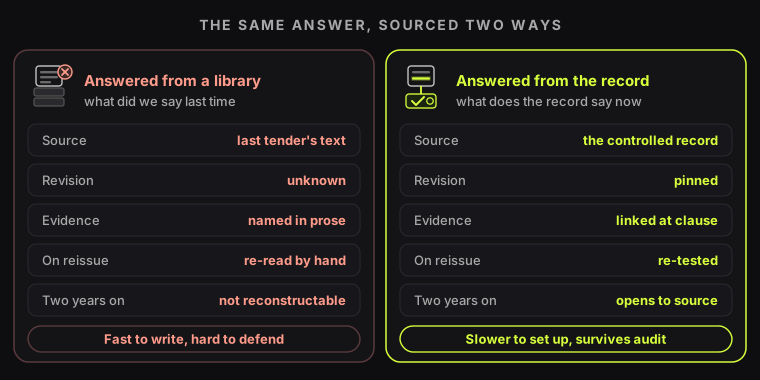
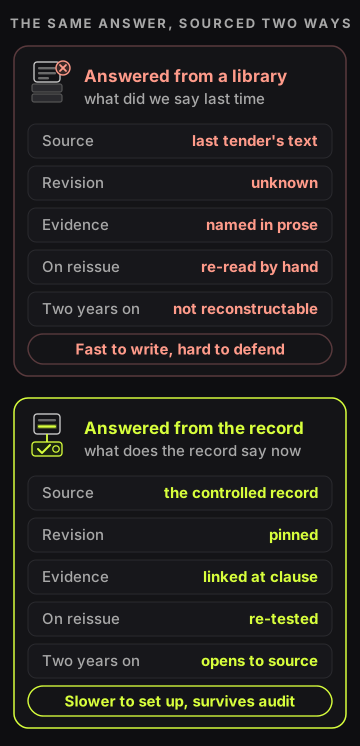
Because they are built to reuse language, and a pharma tender asks a question about current evidence. Response platforms (Loopio, Responsive, AutoRFP.ai) hold a library of previously approved answers and match new questions against it by similarity. That is the right architecture for a capability statement or a security questionnaire, where last year's correct answer is still this year's correct answer. It is the wrong default for a URS line that turns on which revision of a cleaning validation protocol applies, because the library's answer is a fossil of whichever revision was current when someone last pasted it.
The quality systems hold the real evidence and have no outbound concept at all. Veeva Vault, MasterControl and TrackWise exist so that documents are controlled, approved and retrievable inside the organisation. None of them know a tender exists. PLM holds the engineering specification. The configurator, where there is one, prices the build.
So the connective tissue, the part that decides whether an answer is defensible, lives in a spreadsheet maintained by the one or two people who know where everything is filed. That is not a tooling gap anyone chose. It is the residue of three systems each doing their own job correctly.
Where does AI actually change the work?
It changes the mapping, not the judgment. Whether an offer complies with a clause is an engineering and quality decision that ends in a named person's signature, and nothing in the current or draft rules moves that. What can be taken off the team is the retrieval and reconciliation underneath it, which is where the hours actually go. Four things in particular:
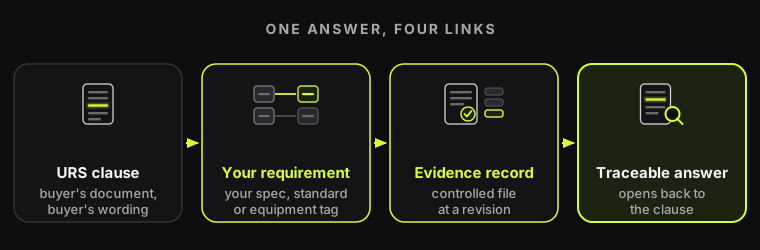
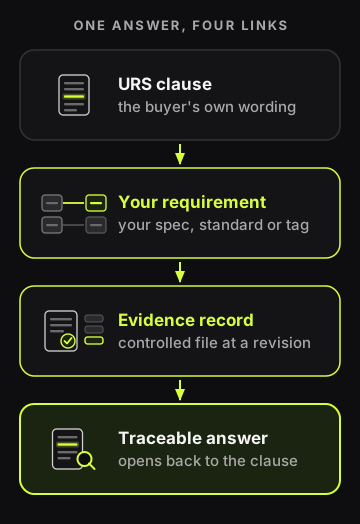
- Resolving the buyer's wording to your identifiers. Every buyer writes its URS in its own vocabulary, while the supplier's evidence is filed under internal document numbers, equipment tags and part codes. The hard part of industrial document work is rarely reading the text, it is matching an external reference to an internal identifier, and a URS response is that problem several hundred times over.
- Revision-aware retrieval. The useful request is not "find the cleaning validation protocol" but "find the approved revision current today, and tell me whether it has moved since the last tender cited it". A retrieval layer that ranks purely by similarity will cheerfully return a superseded document that happens to read better.
- Consistency across the response. The same requirement surfaces in the URS, the quality annex and the commercial terms, usually worded differently each time. Teams answer each in isolation and contradict themselves. Comparing the answers against each other catches that before the buyer does.
- Emitting the traceability matrix as a by-product. When an answer is a link to a document, a revision and a clause rather than a paragraph of text, the requirements traceability matrix stops being a separate deliverable someone assembles under deadline at the end.
None of that decides compliance. The honest model is that this class of tooling narrows what a reviewer has to look at and shows its working. It does not shorten the signature.
What do the regulators actually say about AI here?
Less than the headlines imply, and what they do say is about evidence rather than permission.
In the EU, the Commission and PIC/S published a joint draft package on 7 July 2025 covering a revision of Chapter 4 (documentation), a revision of Annex 11 (computerised systems), and a wholly new Annex 22 on artificial intelligence. That consultation closed in October 2025 and Annex 22 has not been adopted. The draft excluded generative models from critical GMP applications, and the EMA has since indicated that consultation responses showed appetite for allowing them, so that boundary is still moving. A bid team reading the draft looking for permission will not find it. What it will find is the shape of the expectation: AI use in a GMP context is declared, risk-assessed and documented rather than invisible.
The FDA arrived first, with a January 2025 draft guidance on using artificial intelligence to support regulatory decision-making for drug and biological products. Its central idea travels well beyond the submissions it addresses: credibility is assessed against a specific context of use, not in the abstract. There is no such thing as a validated model, only a model shown to be adequate for the particular question being asked of it.
Both of those concern AI inside the regulated process. Writing a tender response is not, in itself, a GxP activity, and treating it as one is how bid teams talk themselves out of useful tooling for a decade. The real constraint is narrower and sharper. The supplier's compliance matrix becomes a controlled record the moment the buyer folds it into design qualification. So the governing question is not whether the drafting tool is validated. It is whether every answer can be reconstructed from the underlying records without the tool, by a person who has never used it.
Answers that trace to the record, not to last year's response
See how cited, revision-aware comprehension changes what a bid team can prove before submission.
Where this is going
Three things are converging on the same point. The URS is gaining weight rather than losing it: the EMA's concept paper for a revision of Annex 15, consulted on in early 2026, proposes extending user requirement and acceptance testing concepts and tying them more formally to the qualification stages that follow. Annex 22 will land in some form, and whatever generative AI's final status inside it turns out to be, the declare-and-risk-assess posture is not going to be reversed. And buyers have started asking suppliers to state how AI was used in a response, a question that first appeared in IT security questionnaires and is now migrating into quality annexes.
The practical consequence for a supplier is that the compliance matrix becomes a structured artefact rather than a document. A response already held as requirement, status, evidence document, revision and clause can be emitted into whatever template a given buyer demands, including the machine-readable ones that are coming. A response held as a spreadsheet of prose has to be retyped per tender, which is exactly where stale revisions enter the record in the first place.
How should you choose a tool for pharma tender responses?
Judge candidates on whether an answer traces to a controlled record, not on how quickly they produce a first draft. Five questions separate the two:
- Does an answer point at a document number, a revision and a clause, or at a block of previously approved text?
- When a referenced record moves to a new revision, does the system flag every answer that cited the old one?
- Can a reviewer open any generated answer back to its source record in one step, without searching for it?
- Is the full set of requirement, status, evidence and revision exportable as a traceability matrix in the buyer's format, not only the vendor's?
- Could your quality function reconstruct any answer from the underlying records if the tool were switched off tomorrow?
The last question is the one that matters most and the one vendors are asked least. A tool whose output cannot be reproduced without it has not reduced your audit exposure. It has concentrated it.
Key Takeaways
- Compliance mapping, not writing, is the work in a pharma tender: every URS line needs a status, a response, and a pointer to a controlled record.
- Under Annex 15 of the EU GMP guide the user requirements specification is the reference point for the qualification life cycle, so a supplier's matrix ends up inside the buyer's design qualification.
- Content-library response tools reuse last year's language, which is the wrong default when the correct answer depends on the current revision of a record.
- The EU's draft Annex 22 on artificial intelligence, published for consultation on 7 July 2025, has not been adopted, and its treatment of generative models is still unsettled.
- The FDA's January 2025 draft guidance assesses credibility against a specific context of use rather than certifying a model in the abstract, a test that travels well beyond regulatory submissions.
- The practical bar for a bid team is reconstruction: any answer must be defensible from the underlying records without the tool that produced it.
Compliance mapping is a document control problem that happens to be priced, which is why pharma tender AI automation aimed only at drafting speed leaves the expensive half untouched. For how the same traceability requirement behaves on the questionnaire side of the same supplier relationship, see the compliance load on industrial vendors, or read how Ranger approaches regulated work in pharma.