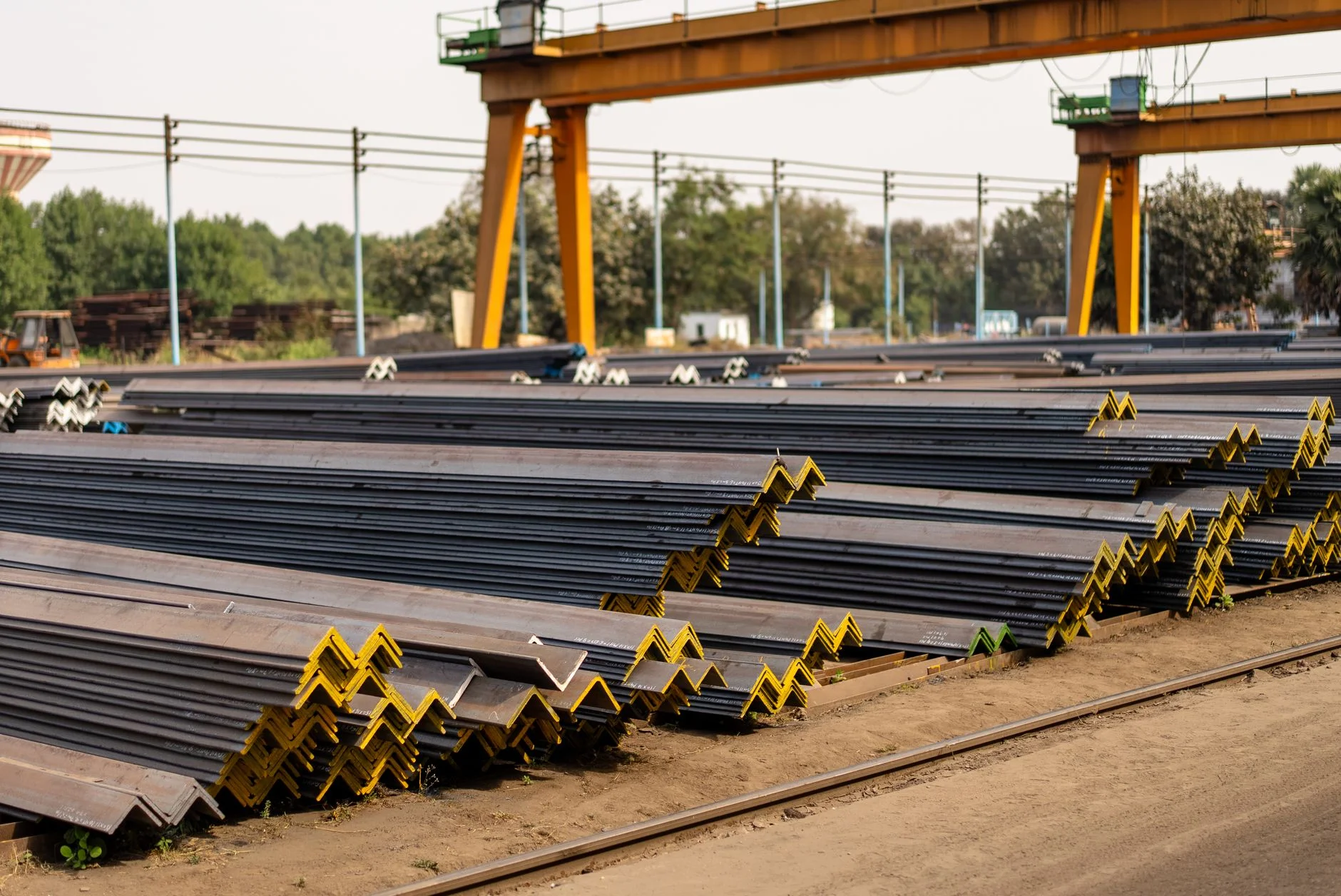
On 1 January 2026 the EU's Carbon Border Adjustment Mechanism left its reporting-only phase and became a financial obligation attached to imported steel, aluminium, cement, fertilisers, hydrogen and electricity. The consequence lands one tier down the chain: suppliers of those goods are now fielding requests for installation-level embedded emissions data nobody asked them for before, on top of the quality packs, substance declarations and sustainability assessments already there. That is how a thing once called questionnaire season became a standing queue.
Why does supplier questionnaire volume keep rising for industrial vendors?
Because nearly every new supply chain regulation places its duty on the buyer, and the buyer discharges that duty by asking the supplier. Each new rule creates one obligation upstream and hundreds of questionnaires downstream.
Count the streams that now converge on a mid-sized pump, valve or fabrication business. Qualification and onboarding packs to get onto an approved vendor list at all. Quality system evidence: ISO 9001 certificates with the right scope wording, IATF 16949 for anything automotive, PPAP submissions, first article inspection reports, welder qualifications, material test certificates traced to heat numbers. Product compliance: REACH substance declarations, RoHS statements, conflict minerals templates, safety and technical data sheets. Sustainability: customer-specific ESG questionnaires plus third-party scorecards such as EcoVadis, which a growing number of OEMs now write into supply agreements as a contractual threshold. Financial and insurance standing. Information security, which is its own discipline.
None of these replaced anything. They accumulated. The part that matters commercially is where they sit in the revenue cycle: these are gates, not paperwork. A questionnaire returned late, or returned with an answer that fails a scoring threshold, removes a vendor before a single technical or commercial page of its bid is read. That makes questionnaire handling part of inquiry-to-order rather than back-office administration, and it is usually resourced as though it were the opposite.
Why doesn't answer-library automation fix supplier questionnaires?
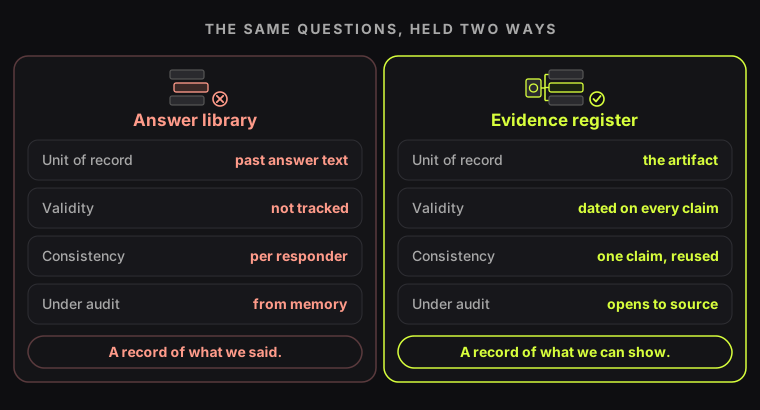
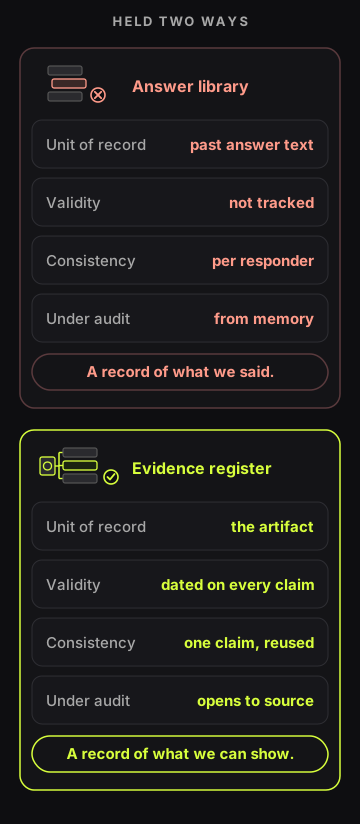
Because it optimises the wrong unit. An answer library stores what a company said last time. A questionnaire asks what is true now, and those two things drift apart quietly.
Look at what each part of the current stack actually does. RFP-response and answer-library tools (Loopio, Responsive, AutoRFP.ai and the agentic entrants) are genuinely strong on prose-heavy questionnaires: a curated response bank, ownership and review cycles, fast assembly of a long narrative document. They break where an industrial answer is not prose but a number or a status bound to an artifact that expires: a certificate valid until a date, a test report at a revision, a declaration that was true against last year's candidate list.
Material compliance platforms (Assent, Sphera, and similar) do the substance rollup properly: full material disclosure from sub-tiers, exemptions tracked, declarations regenerated at bill-of-materials level. Their scope is the substance question, so the commercial, quality and labour sections of the same pack go somewhere else. ERP and PLM hold much of the underlying master data and have no concept of an outbound attestation, or of which customer was told what.
So the real incumbent is a shared folder of last year's completed questionnaires plus whoever filled one in last time. Its limit is that it has no memory of why an answer was true. When the same question returns in different wording eight months later, the fastest move is to copy the previous answer, and nothing asks whether the certificate behind it is still in force, or whether its scope still covers the parts being quoted.
What does supplier questionnaire automation actually require?
An evidence register rather than an answer library. The distinction is not a matter of vocabulary: it changes what gets stored, and therefore what can be checked before a declaration is signed.
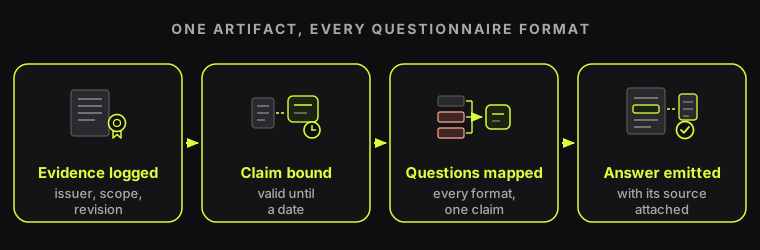
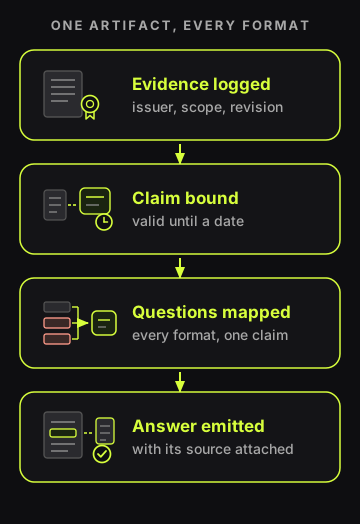
- Register the evidence, not the answer. The unit of record is the artifact: a certificate, an audit report, a test result, a policy, a mill certificate, each with its issuer, scope wording, revision and validity date. An answer is a rendering of an artifact for one customer's format, and storing renderings while discarding the artifact is how the record of what is true gets lost.
- Bind every claim to the artifact that supports it. A claim such as "this plant is certified to ISO 9001 for machining of pressure-retaining components" should not be assertable without pointing at a currently valid certificate whose scope contains that wording. Most scope failures are not dishonesty, they are a certificate that covers a neighbouring activity.
- Give every claim an expiry. Certificates lapse, insurance renews, substance lists update twice a year, audit findings close. A claim without a valid-until date decays silently and keeps being reused. Expiry is the one field that turns a static library into something that can warn you.
- Map the question, not the wording. The same underlying question arrives as free text in one customer's Word pack, a template row in another, and a yes/no in a portal. Normalising incoming questions onto the claim they interrogate lets one maintained claim serve every format, and it is the only version of this that scales past a few key accounts.
- Keep the outbound record. Who was told what, when, against which artifact revision. This is the part almost nobody holds, and it is the part that matters when a certificate lapses or a substance moves onto the candidate list: the useful question then is which customers are currently holding a signed statement that is no longer accurate.
Point five is where the commercial exposure sits. Many of these documents are signed declarations incorporated into supply agreements by reference, so two answers to the same question that do not agree is not untidy filing. It is a contractual problem sitting in two customers' records.
What do the 2026 rules actually require of suppliers?
Directly, very little. Almost every instrument in this space regulates the buyer or the importer, and reaches the supplier only through a contract. That asymmetry explains why the formats never converge.
The Carbon Border Adjustment Mechanism is the clearest case. Its transitional period ran from October 2023 to the end of 2025 and required reporting only. From 1 January 2026 the definitive regime applies and embedded emissions in covered imports carry a financial obligation. The declarant is the EU importer, but the data exists only at the producing installation, so a rule aimed at importers lands as a data request on every steel and aluminium supplier selling into the EU, in whatever format the importer chose.
The Corporate Sustainability Due Diligence Directive works the same way and shows the second-order effect. An amending directive in 2025, widely known as "stop the clock" (Directive (EU) 2025/794), postponed transposition and pushed the first wave of application back. The questionnaires did not stop. Large customers are standing up due diligence programmes against the requirement they expect to face, on their own timetables and in their own templates, and a supplier cannot point at a delayed directive to decline, because the ask is contractual.
Product rules add the long-lived obligations. Under REACH Article 33, a supplier of an article containing a candidate list substance above 0.1% by weight must pass information down to recipients, and since January 2021 the same data must be notified to ECHA's SCIP database. The candidate list is updated roughly twice a year, which means a declaration issued in good faith can be superseded without anyone touching the product.
Even the oldest instrument points the same way. ISO 9001:2015 clause 8.4.1 requires an organisation to determine controls for externally provided processes, products and services, and to define criteria for evaluating, selecting, monitoring and re-evaluating external providers. Every certified customer carries that duty, and the supplier questionnaire is what it looks like from the receiving end.
See every questionnaire answer traced to the document behind it
Bring a customer compliance pack and the certificates and declarations you would answer it from. See which claims are still evidenced, which have quietly expired, and where two submissions already disagree.
Where is supplier questionnaire automation going in 2026 and 2027?
Toward structured exchange, and toward a volume problem arriving before the structure does.
The structural direction is visible in the rules themselves. The Ecodesign for Sustainable Products Regulation introduces the Digital Product Passport, populated product group by product group through delegated acts, and CBAM already demands structured installation-level figures rather than narrative. The simplification work around EU sustainability reporting pushes the same way from the other end, by capping what large companies may demand from smaller business partners and standardising it on a common voluntary set. The destination is machine-readable claims exchanged between systems. A supplier whose evidence is already structured, bound to artifacts and dated can emit both a passport payload and a customer's Word template. One whose evidence is a folder of last year's answers will be retyping either way.
The volume problem arrives first. Assistants that draft questionnaires and assessment packs make asking cheaper, so more gets asked, in more variants, with less editing on the way out. When the cost of asking collapses, the scarce resource on the responding side stops being writing speed and becomes consistency: whether the eleventh version of a question gets the same answer as the first, and whether that answer is still evidenced. Ranger builds in the category of cited comprehension for industrial documents, on the view that an answer you cannot trace back to an artifact is not an answer you should be signing.
Key Takeaways
- Supplier questionnaires are a revenue gate, not administration: a late or low-scoring response removes a vendor before any technical evaluation of its bid begins.
- Volume keeps rising because supply chain regulation puts its duty on the buyer or importer, who discharges it by sending requests down the chain in a format of their own choosing.
- Answer libraries store what a company said last time, while the questionnaire asks what is true now, and nothing in a library detects the gap.
- The durable unit of record is the artifact: a certificate, test report or declaration carrying an issuer, scope, revision and validity date, with every claim bound to the artifact supporting it.
- Answer drift across customers is a contractual exposure rather than untidy filing, because many of these responses are signed declarations incorporated into supply agreements.
- CBAM's definitive regime and the Digital Product Passport under the Ecodesign Regulation point the same way: toward structured, machine-readable claims rather than prose answers.
The suppliers who come out of this well will not be the ones who answer fastest. They will be the ones who can still show, two years later, what a given answer rested on. For the same problem from the buyer's side of the table, see vendor qualification at industrial scale, and for why the security pack defeats generic response tooling, see why AI RFP tools fail security questionnaires. For how this lands on component and assembly manufacturers, see our precision manufacturing page.