Loopio's own website names the industries where it is most widely used: SaaS and technology, financial services, healthcare and business services. Engineering is not on the list, and for a bid team at an equipment OEM or an EPC contractor shortlisting Loopio alternatives, that one line says more than any feature grid. In 2026 Loopio carried its answer library into procurement portals and into Microsoft 365 Copilot. Both releases make the library faster to reach. Neither changes where the answers come from.
What is Loopio built for?
Loopio is response management software built around a library of approved answers. A team writes and vets its content once, then reuses it across RFPs, RFIs, due diligence questionnaires and security questionnaires, with AI that drafts from that library. Loopio's description of its own AI is clear about the boundary: every answer draws from your approved content.
For the job it was built for, that is the right design. A software vendor answering its fortieth security questionnaire of the year sees the same few hundred questions in a new order each time. Encryption at rest. Data residency. Subprocessors, SSO, insurance, references, implementation approach. Write the best answer once, keep it current, find it in seconds. The library pays for itself on overlap.
Pricing follows the enterprise pattern. Loopio lists its plans, Foundations with 10 seats, then Enhanced and Enterprise, but not its prices. Vendr's transaction data puts the median Loopio contract at $23,915 a year across 266 purchases, in a range of roughly $11,800 to $58,300.
Why does a content library struggle with engineering bids?
Because the questions that decide a technical award are about documents the library has never seen. An engineering RFP is not a list of questions. It is a package.
Picture what lands on a pump OEM's desk for a refinery revamp: instructions to bidders, a scope of supply, the client's general specifications, a project specification for the service, a completed API 610 data sheet, a list of referenced standards, drawings, and a commercial section with its own deviations form. The evaluators will score whether the offered pump meets the specified design conditions, which clauses you take exception to, what the wetted materials are and which tests the client may witness. None of that was answered last quarter. Last quarter's pump was a different pump.
Quality systems already treat this as a formal step. ISO 9001:2015 clause 8.2.3 requires a certified organisation to review the customer's requirements before it commits to supply. For a bid team, that review is the work, and it starts in the tender documents.
The incumbents are good at what they were built for. Loopio, Responsive (formerly RFPIO, now selling itself as Strategic Response Management) and Upland Qvidian (which says eight of the ten largest US banks trust it) all organise reusable content well and route questions to the right expert. On a technical tender they hit the same limit, because they share one model: the library holds what you said, and the tender asks about something you have not said yet. The gap between vendor claims and shipped proposals is covered in more depth in AI RFP automation in 2026.
The newer AI-first tools move the line a little. Arphie and Inventive AI sync with document stores such as SharePoint and Google Drive, and AutoRFP.ai describes itself as source-grounded, so they read more than a Q&A bank. Whether they hold up on a scanned vendor data sheet, or a spec on its third revision, is something to test rather than assume.
What should engineering teams look for in a Loopio alternative?
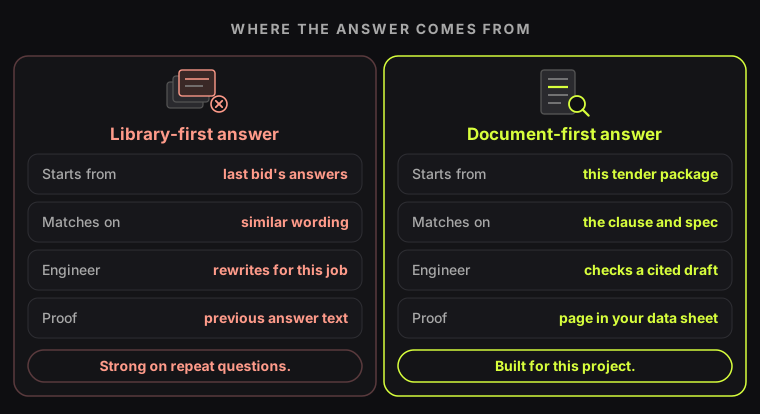
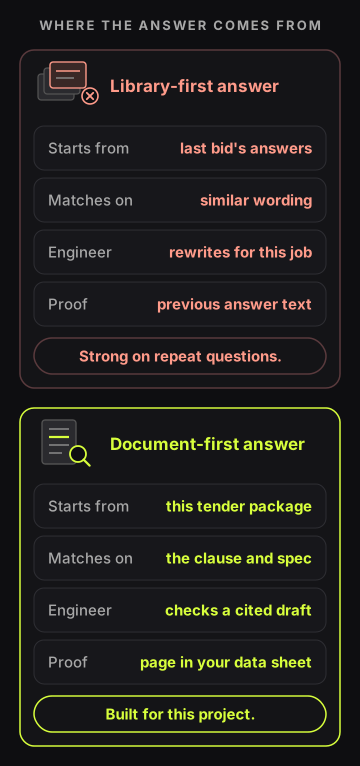
A tool that starts from the buyer's documents and ends at your evidence. Five tests separate the ones that do from the ones that only say so.
- It reads the tender package first. Requirements come out of the instructions to bidders, the specifications and the data sheets as single lines you can comply with, deviate from or query. If the demo opens with uploading your past answers, you are looking at a library.
- Every answer cites a page you own. The draft should point to the data sheet, test report, drawing or procedure it came from, down to the page. Your reviewer then checks a source instead of rewriting from memory, and rewriting from memory is where most engineering hours on a bid go today.
- It knows which revision is current. Specs change mid-bid. A tool that retrieves by similarity will quote a superseded revision without blinking, the failure described in ghost specs and stale revisions.
- Clarifications update the baseline. A technical query answered in round two can change a requirement you have already priced. The tool should carry that change through every answer that depends on it, which is the propagation problem in the technical query spiral.
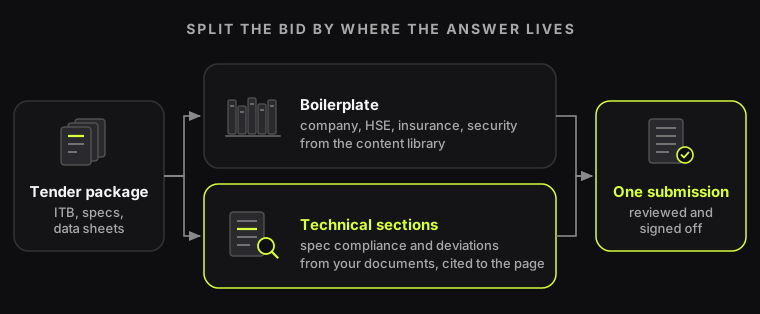
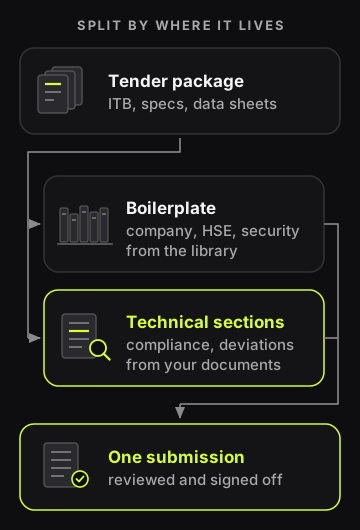
- The library keeps the boilerplate. Company profile, HSE policies, insurance, quality certificates and security answers repeat across every bid. Keep them in a library, whichever one you already own. Paying a second tool to do the same job is how bid teams end up maintaining two sources of truth.
How do the main Loopio alternatives compare for engineering bids?
Most alternatives are a better or cheaper library. One is a co-authoring tool. A newer category reads the project documents. The table puts them side by side on the points an engineering or industrial bid team should weigh.
| Tool | Built around | Fits best | Watch on an engineering bid | Price signal |
|---|---|---|---|---|
| Loopio | Library of approved answers, AI drafts from it | SaaS, financial services, healthcare, business services | Technical sections still start from the project documents | Median $23,915 a year (Vendr) |
| Responsive (formerly RFPIO) | Content library with AI agents | Large sales, proposal and InfoSec teams | Same library model as Loopio | Median $14,750 a year (Vendr) |
| Upland Qvidian | Content library, templates, AI Assist | Financial services proposals | Built around finance and enterprise sales content | Ask the vendor |
| Arphie, Inventive AI, AutoRFP.ai | AI drafting from synced documents | Sales teams on RFPs, security questionnaires and DDQs | Test on a scanned data sheet and a revised spec | Ask the vendor |
| XaitPorter | Co-authoring of large documents | Energy companies with many contributors per submission | Solves assembly; tracing requirements is a separate job | Ask the vendor |
| Document-grounded industrial AI | Reading the tender package and your engineering documents | EPC contractors, equipment OEMs, technical bid teams | Newer category: check security and deployment fit | Ask the vendor |
If co-authoring is your real problem, start with XaitPorter alternatives instead.
Price is the easy part to compare. Vendr puts the median Responsive contract at $14,750 a year across 133 purchases, against $23,915 for Loopio, so moving between the two incumbents changes the invoice more than the workflow. Fit is the hard part. Loopio's own 2026 trends research found that 43% of response teams now use AI-driven RFP software, up from 33% a year earlier. Adoption is no longer the question. What the AI reads is.
See a technical tender answered from your own documents
We'll show you how it works: requirements pulled from the package, and each answer linked to the page of the spec or data sheet it came from.
Where is RFP software heading in 2026 and 2027?
Toward assistants in every app, which makes drafting cheap and sourcing decisive.
Loopio's Copilot agent, released in July, puts library answers inside Word, Teams and PowerPoint, and its portal extension maps questions into a project from more than 170 portal providers, SAP Ariba and Coupa among them. Responsive and the AI-first vendors are shipping agents of their own. Within a year, every serious tool will draft a first answer in seconds. The difference will sit upstream: what the draft was built from, and whether the engineer who signs the bid can open the source and check it.
For an engineering or industrial bid team that points to two purchases, not one. Keep a library for the boilerplate if you already own one. Buy for the technical sections, where the answers live in your specifications and data sheets. Ranger builds in that second category, cited comprehension of industrial documents, on the view that a technical answer you cannot trace to a page is not one you should submit.
Key Takeaways
- Loopio is a strong content library, and its own site lists SaaS, financial services, healthcare and business services as the industries where it is used most.
- A library works when bids overlap, and the technical sections of an engineering tender, written around one project, mostly do not.
- The best Loopio alternative for an engineering team starts from the tender package and cites your own engineering documents to the page.
- Responsive, Upland Qvidian and the AI-first tools share the library model closely enough that switching among them changes price more than workflow.
- Vendr's data puts the median Loopio contract at $23,915 a year and the median Responsive contract at $14,750.
- Keep a library for boilerplate and buy for the technical sections, rather than forcing one tool to do both jobs.
If your bids lean on the specification, read how EPC teams answer a 400-page RFP without losing technical accuracy, then see what RFP response software for engineering documents has to do. Equipment makers will find the OEM side on the precision manufacturing page.