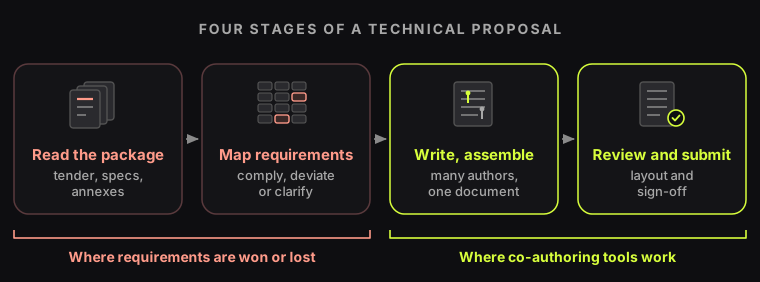
One Aker BP document had 34 writers and 41 reviewers working in it at the same time, according to Xait's customer story. That is what XaitPorter is for: many specialists, one controlled document, no late-night reformatting before a submission. In July 2025 Main Capital Partners took a majority stake in Xait with a stated plan to grow in the United States, so more North American teams will be weighing XaitPorter alternatives for technical proposals this year. The useful first question is which end of a technical proposal you are trying to fix.
What is XaitPorter built for?
XaitPorter is co-authoring software for large documents with many contributors: tenders, proposals, licensing applications, reports. Instead of a pile of Word files, it keeps one live document in a database, so dozens of people can write at once while layout, numbering and branding are enforced for them.
Its home ground is Norwegian energy. Xait calls XaitPorter the standard licensing round solution for energy companies in Norway, and the customer quotes on its product page come from Aker BP, Honeywell UOP and Sulmara Subsea. The AI layer, XaitAI, is a closed system that learns from your internal content to suggest material, analyse documents and keep the writing consistent. There is a Salesforce integration, and a sister product, XaitCPQ, for pricing.
Xait sells a second proposal product as well. XaitProposal began life as Proposal Studio at the French specialist Jack in the Box, which Xait acquired in January 2022 and renamed that September. It works differently: a writer answers a guided questionnaire and the software assembles the proposal from a knowledge base of CVs, equipment sheets and approved text.
On price there is little to compare. Xait does not publish prices, and TrustRadius lists no pricing plans for XaitPorter.
Where does XaitPorter stop on a technical tender?
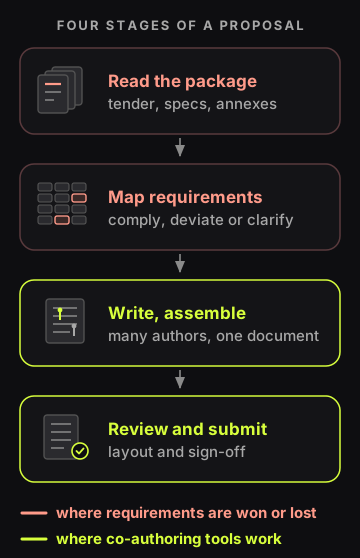
At the edge of your own document. XaitPorter manages what your team writes. The buyer's package, and the trace from each of its requirements to your answer and your evidence, is a separate job, and it is not the one Xait's product pages lead with.
Look at what an energy tender asks of the bidder. Under the EU rules for utilities procurement, Directive 2014/25/EU, the technical specifications are set out in the procurement documents (Article 60(1)). Where a specification refers to a standard, the contracting entity may not reject an offer that departs from it once the tenderer proves in its tender, by any appropriate means, that its solution meets the requirement in an equivalent manner (Article 60(5)). Read that as a bidder. The burden of proof sits with you, inside the tender, one requirement at a time.
Operators and EPC contractors outside public procurement run their tenders much the same way. A compliance matrix to fill in. A deviations list. A technical query log. Document requirements that run to a volume of their own.
None of that is a formatting problem. A co-authoring platform gives your 34 writers a better place to write. It does not tell them which clause of the client's technical requirements each paragraph has to satisfy, or flag that the clause changed in the second round of clarifications. Most teams run that part on a spreadsheet next to the document, which is exactly where requirements slip through.
If co-authoring is the only pain, the cheapest alternative may already be on your laptop: Microsoft 365 supports real-time co-authoring in Word. What a shared Word file lacks is the layout discipline XaitPorter enforces once 75 people are inside it. That trade is real, and for a five-person bid team it often goes Word's way.
What should a technical proposal team look for in an XaitPorter alternative?
Decide which end of the proposal hurts, then test for that end. Six checks cover both, and each can be run in a normal vendor demo.
| Check | Why it matters on a technical tender | How to test it in a demo |
|---|---|---|
| Reads the buyer's package | Requirements live in the tender documents, annexes and referenced standards, not in your library | Load a closed tender you already submitted and compare what it extracts with what your team found |
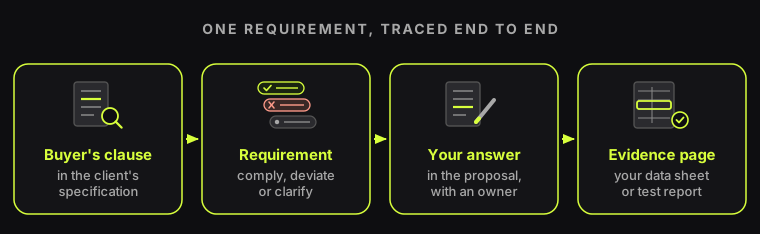
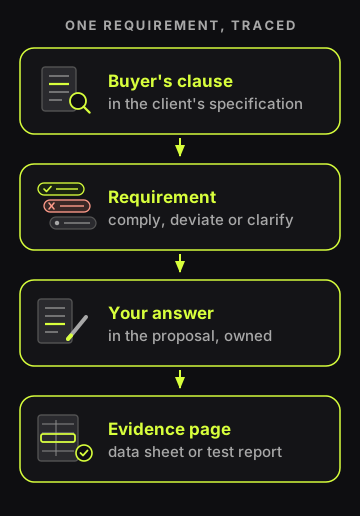
| Gives every requirement a status | Each clause needs comply, deviate or clarify, and an owner | Ask for the compliance matrix it produces, not a summary of the tender |
| Cites your evidence to the page | Evaluators and your own engineers need proof, not prose | Open three answers and check that each lands on the source page |
| Tracks revisions and clarifications | Specs and answers change while the bid is open | Swap in a revised specification and see what it flags |
| Keeps co-authoring and layout | Dozens of contributors still write the final document | Keep the tool that already does this, XaitPorter or Microsoft 365 |
| Fits your security model | Energy tender documents are usually confidential by contract | Ask where documents are processed and stored, and who can see them |
The first four checks are about the left half of the proposal. The fifth is the one XaitPorter already passes. Teams that skip straight to the fifth tend to buy a better pen when the problem was reading.
Which XaitPorter alternatives fit which job?
Pick by the job, not by the category label on a review site.
For writing and assembly, stay close. XaitProposal, Xait's own second product, suits a higher volume of standard offers built from a knowledge base. Microsoft 365 co-authoring suits small teams that can live without enforced layout. Moving between these changes how your team writes, not what it answers.
For repeat questions, use a content library. Loopio, Responsive and Upland Qvidian are built for questions that come back in every bid, and Vendr's medians put Loopio at $23,915 and Responsive at $14,750 a year. They are covered in more detail in Loopio alternatives for engineering bid teams.
For requirements and evidence, add a reading layer. A document-grounded tool reads the buyer's package, builds the requirement list, and links each answer to the page of your own data sheet, procedure or test report that proves it. It sits upstream of whichever tool your team writes in. Ranger builds in this category.
See a tender package turned into a cited requirement list
We'll show you how it works: every requirement pulled from the buyer's documents and mapped to your evidence, with a link to the page it came from.
Where is technical proposal software going in 2026 and 2027?
Toward suites assembled by acquisition, with AI added to every authoring tool.
Xait made three acquisitions in just over a year up to January 2022, and Main's announcement describes a selective buy-and-build strategy from here, with the United States and Continental Europe as the growth markets. Microsoft is building Copilot into Word. Drafting and assembly of technical proposals are being attacked from every direction at once, and both will keep getting cheaper.
The open problem sits upstream. Tenders in energy and infrastructure can arrive as packages of thousands of pages, and the work that decides the award is knowing what each clause demands and proving the answer from your own documents. That part does not get easier when the editor gets smarter. Ranger builds in that layer, cited comprehension of industrial documents, on the view that a technical proposal should start from a traced requirement list rather than end with one assembled under deadline.
Key Takeaways
- XaitPorter is co-authoring software for large, multi-author documents, and Xait calls it the standard licensing round solution for energy companies in Norway.
- Its strength is the end of a proposal: many writers in one live document with layout enforced for them.
- The hours that decide a technical award sit at the start, in reading the buyer's package and proving each requirement.
- EU utilities procurement rules put the burden of proving equivalence on the tenderer, inside the tender (Directive 2014/25/EU, Article 60(5)).
- Choose the alternative by job: XaitProposal or Microsoft 365 for writing, a content library for repeat questions, a document-grounded tool for requirements and evidence.
- Since July 2025 Xait has been majority-owned by Main Capital Partners, which plans to grow it in the United States.
Energy teams will find the sector view on the energy and oil and gas page, and the requirement-by-requirement approach on tender evaluation. For speed on large EPC packages, see how to answer a 400-page EPC RFP in under 72 hours.