Upload a 3D model to Xometry and a price and a lead time come back in seconds. The instant quoting engine reads the geometry, selects a process, and commits to a number with nobody in the loop. That problem is solved, and it is solved because the part arrived already defined. An industrial enquiry does not arrive defined. It arrives as a material requisition of dozens of lines of text, and before any of them can be priced, somebody has to decide what kind of line each one is.
Why is the first decision on an RFQ line the expensive one?
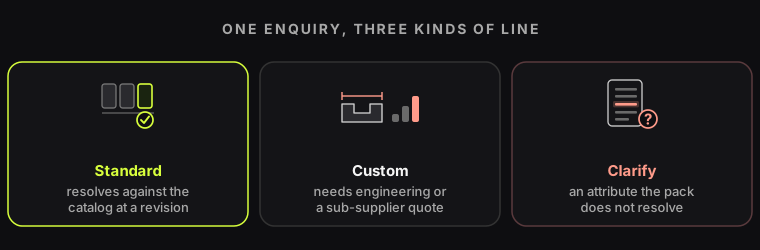
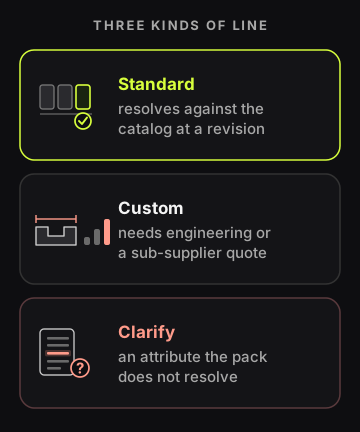
Because it decides who touches the line, and a routing mistake is close to impossible to undo once the quote has gone out. Every line in an industrial enquiry belongs to one of three classes, and the class is a commitment about cost, risk and schedule rather than an administrative tag.
A standard line resolves against a catalog item or a valid configuration at a known revision. The price is a lookup, and in most enquiries most lines are this. A custom line is special construction: a non-standard material, a duty point outside the published envelope, an interface that has to be designed. It needs applications engineering, a cost build-up, often a sub-supplier quote, and it absorbs most of the hours in the bid. A clarify line cannot be classed as written at all. It references a standard the enquiry does not attach, names a make with no equivalence wording, calls for a certificate grade that changes who inspects the part, or specifies an operating condition the datasheet does not cover. It is not a hard line. It is a line that is not yet priceable.
The arithmetic is unforgiving in both directions. A standard line misrouted to custom spends engineering hours answering a question the catalog already answered. A custom line misrouted to standard gets a catalog price attached to special construction, which is the error that surfaces after award rather than before it. A clarify line misrouted to either gets a confident number resting on an assumption nobody wrote down.
Why doesn't RFQ automation software make this call?
Because nearly all of it starts after the classification rather than before it. The category is built to price a line once you have told it what the line is.
Look at what each tool actually does. Configurators and quoting engines (Tacton, Configit, Salesforce CPQ, Intelliquip) are strong inside a defined product model: they solve constraints, reject invalid combinations, and hold pricing consistent across a sales force. A line that falls outside the model is not a configuration error, it is out of scope, and refusing it is the correct behaviour. Whether it falls outside is decided somewhere else. ERP quoting modules (SAP, Infor, Epicor) price against item master records, so a line with no matching item returns a blank, and the blank goes to a person. Instant-quote engines solve for geometry, which works because the input is a model with bounded processes behind it, not a paragraph of tender prose. Response platforms (Loopio, Responsive, AutoRFP.ai) assemble narrative from a content library, and an enquiry's line list is not narrative.
So the real incumbent is a spreadsheet, and the real classifier is whichever applications engineer opened the enquiry, working from what they remember about the catalog. That works, and it is genuinely skilled work. It is also undocumented, unevenly applied across a team, and invisible to anyone auditing the quote afterwards.
What does line-level triage have to do to be trusted?
Five things, and only one of them is about speed.
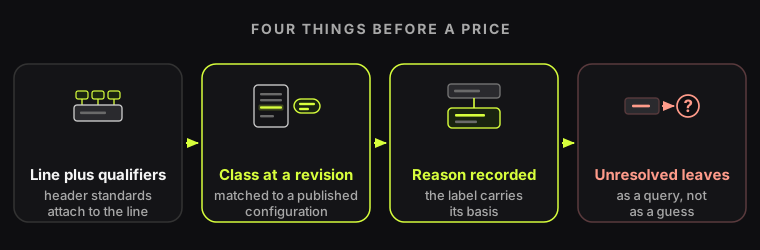
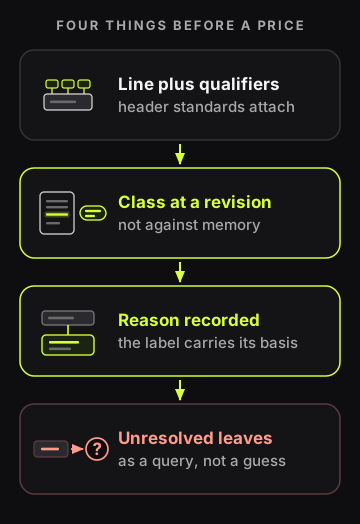
- Read the line with its qualifiers attached. The material grade, certificate type, test scope, painting specification and delivery term that govern a line usually sit in the enquiry header or a referenced standard, not on the line. A classifier that reads the line list alone will class a modified item as a catalog item.
- Class against a catalog revision, not against memory. A standard-class decision is a claim that this line matches a published configuration. The revision that claim was made against has to be part of the record, because configurations are withdrawn and superseded between enquiries.
- Emit a reason, not just a label. "Standard" is not useful on its own. "Standard, matches configuration at revision F, all specified attributes within published range" can be checked by a reviewer and challenged by an estimator.
- Promote ambiguity to a query rather than resolving it quietly. When an attribute cannot be resolved from the documents supplied, the correct output is a technical query naming that attribute, not a best guess with a margin added. Default to clarify, and make the default visible.
- Survive the reissue. When the enquiry is revised during the clarification rounds, every open classification has to be re-tested against the new text rather than carried forward. A class is a statement about a specific revision, and it expires when that revision does.
What do the rules already require of this decision?
More than most quoting teams treat it as, and the obligation sits on the bidder.
ISO 9001:2015 clause 8.2.2 requires an organisation, when determining the requirements for the products and services it offers, to ensure those requirements are defined, that applicable statutory and regulatory requirements are included, and that it can meet the claims it makes. Clause 8.2.3.1 goes further and requires a review before committing to supply, covering requirements the customer did not state but which are necessary for the specified or intended use, and requiring that differences between the order and anything previously expressed are resolved. Line triage is that review. Performing it from memory does not stop it being a conformity obligation; it only stops it being evidenced.
Regulated procurement adds a harder constraint on one specific class of line. Under Directive 2014/24/EU Article 42, technical specifications must not refer to a specific make, source or process unless the subject matter of the contract justifies it, and where such a reference is permitted on an exceptional basis it has to be accompanied by the words "or equivalent". In DYKA Plastics (C-424/23), decided on 16 January 2025, the Court of Justice read those drafting methods as an exhaustive list and held that a material requirement is only permissible where it necessarily arises from the subject matter of the contract or where the authority cannot otherwise describe that subject matter precisely enough. For a bidder, that makes a branded or material-specific line something other than a catalog lookup. It is a question about whether the requirement binds and whether an equivalent may be offered, which is a clarify line as a matter of law rather than preference.
Certificates behave the same way and are easier to miss, because the line itself looks ordinary. Under EN 10204, a type 3.1 inspection certificate is validated by the manufacturer's own authorised inspection representative, independent of the manufacturing department. A type 3.2 certificate has to be validated by that representative and by the purchaser's authorised representative or an inspector designated by official regulations. The part number does not change between the two. The supply chain, the lead time and the cost all do.
Know which RFQ lines need an engineer before you price them
See how cited, line-level comprehension classifies an enquiry against your own catalog and revisions.
Where this is going
Structured procurement data is moving down the document stack, one layer at a time. The notice layer went first: under Implementing Regulation (EU) 2019/1780, eForms became mandatory for contract notices published in the EU from 25 October 2023, turning what used to be free text into fields. Award criteria followed, since they already had to be published in advance. The line item is the obvious next layer, and it is the one that matters most to a bidder, because it is where the money is.
At the same time, buyer expectations about response speed are migrating upward from the components that instant quoting solved first. A buyer who gets a price for a machined bracket in seconds begins asking why a packaged pump skid still takes weeks, and the honest answer is that most of that time is not pricing. They are classification, clarification, and waiting for a sub-supplier. A team that already holds a class, a reason and a revision for every line can answer the fast lines immediately and defend the slow ones with a reason, which is a considerably better position than quoting everything at the same cautious pace.
How should you choose RFQ automation software?
Judge candidates on what they do with a line they cannot handle, not on how quickly they price the easy ones. Six questions separate the two:
- What does the system return for a line it cannot classify: a blank, a guess, or a query naming the attribute that stopped it?
- Does each classification carry a reason and a source, or only a label?
- Which catalog revision was a standard-class decision made against, and is that recorded on the line?
- Are the qualifiers in the enquiry header (referenced standards, certificate grade, test scope, delivery term) applied to every line, or read once and forgotten?
- When the enquiry is reissued, are open classifications re-tested against the new text or carried forward unchanged?
- Can the people who do special construction see the custom-class lines without reading the whole enquiry first?
A tool that answers the first and the last of those well will usually answer the others. A tool that answers none of them is a pricing calculator, which is a reasonable thing to own as long as nobody mistakes it for an intake process.
Key Takeaways
- Every line in an industrial enquiry is standard, custom, or not yet priceable, and the class decides who touches it.
- Misrouting costs differently in each direction: wasted engineering hours one way, a catalog price on special construction the other, and an undocumented assumption in the third case.
- Most RFQ automation software begins after the classification, because configurators, ERP quoting modules and instant-quote engines all need to be told what the line is first.
- ISO 9001:2015 clauses 8.2.2 and 8.2.3.1 already require a documented review of requirements before committing to supply, which is what line triage is.
- A branded or material-specific line is a legal question rather than a lookup: EU procurement rules restrict such references and usually require the words "or equivalent", a position the Court of Justice narrowed further in DYKA Plastics in January 2025.
- An EN 10204 3.2 certificate requirement changes who has to inspect the part without changing the part number, which is how a clarify line hides inside an ordinary-looking one.
Triage is the cheapest decision in a bid and the one most often made by accident. For what happens to the lines that come back as questions, see surviving clarification rounds on industrial tenders, or read how Ranger approaches this class of work in precision manufacturing.