Through 2025 and 2026 the RFP-response tools converged on the same feature: an agent that drafts your answers to the buyer's questions. Almost none of them touch the traffic moving the other way. On an engineered tender it is the questions the bidder asks the buyer, the technical queries, that move the deadline, and every answer that comes back quietly rewrites the document set the bid is being priced against.
Why do technical queries decide an industrial tender's timeline?
Because a technical query is rarely a request for information. It is a request to change a requirement, and until it is answered the scope it touches cannot be priced, engineered or committed to.
A technical query (TQ), also called a clarification request, is a formal question a bidder raises against a named clause, drawing or datasheet during the bid period. They are generated by contradiction, not by curiosity. A package for fired heaters lands as a requisition, a set of datasheets, P&IDs, a stack of client project specifications, an inspection and test plan, general conditions of contract, and several hundred pages of referenced standards. Each discipline reads its slice and finds the seams. The rotating equipment engineer finds a seal plan on the datasheet that the referenced API standard does not recognize at that duty. Electrical finds a motor voltage that contradicts the single line diagram. The proposals manager finds a liquidated damages cap in the general conditions that the instructions to bidders contradicts. Every one of those is a query, and every one of them blocks a number.
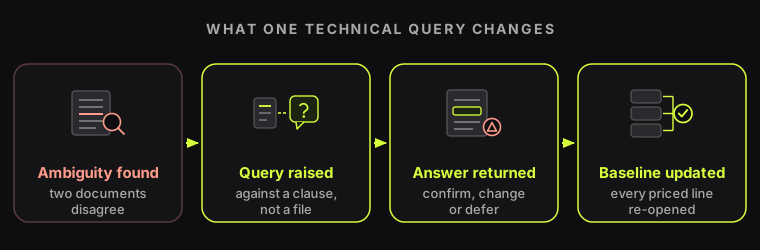
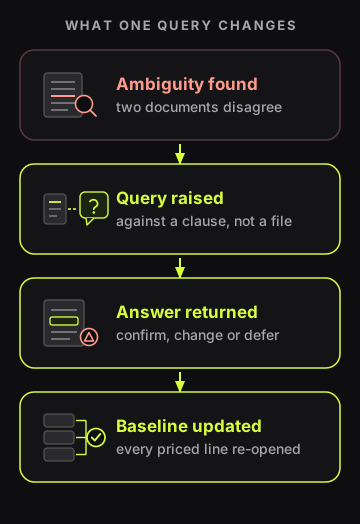
The spiral is what happens next. One answer moves a requirement, which invalidates an assumption another discipline already priced, which produces the next round of queries. A meaningful part of any bid window is spent waiting on answers to questions the bidder could not avoid asking.
Why don't e-tendering portals and RFP tools already solve this?
Because they are built to transport the question and prove it was asked, not to track what the answer changed.
Look at what each part of the stack actually does. The sourcing and e-tendering platforms (SAP Ariba, Jaggaer, Coupa, Ivalua, and the public sector portals) are genuinely good at the transport and audit layer: a timestamped Q&A channel, a published cut-off for questions, answers distributed to every bidder as a numbered addendum, and a defensible record of who asked what and when. What they do not do is connect the answer to the clause it modified. The portal knows query 47 was answered. It does not know that the inspection and test plan now carries an extra hold point.
RFP-response tools and answer libraries (Loopio, Responsive, AutoRFP.ai and the agentic entrants) model the questionnaire as the unit of work and retrieve prior approved answers to fill it. A technical query runs in the opposite direction, and its unit of work is a clause in a document somebody else wrote. An answer library has nothing to say about it.
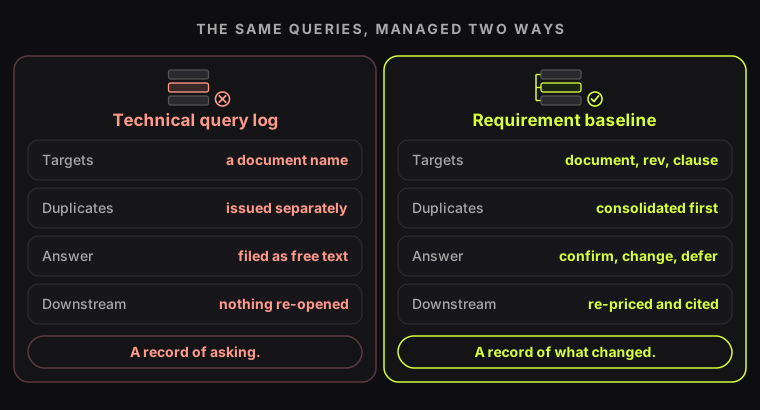
The actual incumbent is a TQ register in Excel: number, date raised, discipline, question, status, response, date closed. It has the virtue of existing, and everybody on the bid can read it. Its limit is that it is a list of strings. Nothing in it connects TQ-047 to clause 6.4.2 of specification SP-3021 revision C, and nothing connects that clause to the eleven places in the cost model, the compliance matrix and the sub-supplier enquiries that assumed the old wording. In private industrial tenders, where there is often no portal at all, the register competes with a mailbox and usually loses.
What does a clarification system have to track?
Five things, and only the first is about the question itself. The rest are about what the answer does to everything downstream.
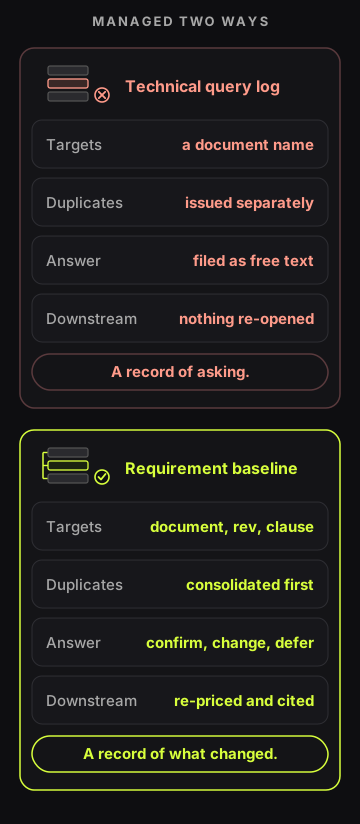
- Bind every query to a coordinate, not a document name. Document number, revision, section and page. "Clarification on the spec" is not addressable; "SP-3021 rev C, clause 6.4.2" is. A query whose target cannot be named precisely is usually a sign that the ambiguity is wider than the person asking thinks.
- Consolidate near-duplicates before they are issued. The same contradiction gets found independently by three disciplines and leaves as three separate queries. Issuers answer near-duplicate questions in slightly different words, and the bid team ends up holding three answers that do not quite agree, each cited by a different engineer. Reconciling on the way out is far cheaper than reconciling on the way back.
- Classify the answer instead of just filing it. There are three materially different outcomes. A confirmation leaves the requirement intact and removes an ambiguity. A change means the requirement now differs from the issued document. A deferral ("to be advised at order stage") is not an answer at all, it is a risk that has to be priced, qualified in the deviation list, or both. Only the second triggers rework, and only the third belongs in the assumptions register.
- Propagate to the artifacts that consumed the old wording. An answer that changes a requirement invalidates specific downstream items: a compliance matrix row, a costed line, an enquiry already sitting with a sub-supplier carrying the superseded datasheet, a deviation list entry, a delivery assumption. A clarification process that ends when the TQ log is updated has relocated the problem rather than closed it.
- Maintain one current requirement baseline, with precedence. The live requirement is the base document plus addenda plus answered queries, applied in the order of precedence the instructions to bidders themselves state (contract conditions over specifications over datasheets, later addenda over earlier). Most tenders publish that order. Very few bid teams maintain the resulting composite anywhere a person can read it.
What do the standards already require during a bid?
More than most bid teams realize, and the requirement is about the record rather than the response time.
ISO 9001:2015 clause 8.2.3 requires an organization to review the requirements for products and services before committing to supply them, to ensure that requirements differing from those previously defined are resolved, and to retain documented information on the results of that review and on any new requirements. A bid is exactly that commitment, and a technical query is exactly a requirement differing from the one previously defined. Clause 8.2.4 goes further and states the propagation duty directly: when requirements change, the relevant documented information must be amended and the relevant people made aware. That is the fifth item on the list above, already written into the standard most industrial suppliers are certified against.
Public procurement shows the compulsory version of the schedule link. Under the EU public procurement directive (Directive 2014/24/EU, Article 47), where additional information relating to the specifications has been requested in good time but is not supplied at least six days before the deadline for receipt of tenders, the contracting authority must extend that deadline. Clarification traffic is treated in law as an input to the programme, not an administrative side channel. The same directive has required electronic communication in public procurement since 2018, which is why public Q&A is at least channelled, numbered and published to all bidders at once.
Private industrial tenders carry neither obligation. Answers arrive per bidder, with no numbering and no guarantee that two bidders received the same interpretation. The asymmetry is worth naming: the strictest clarification discipline sits where it was made mandatory, not where the packages are most technically complex.
See every clarification traced back to the clause it changed
Bring one tender package, its addenda and the query log that came with it. See which requirements moved, and which priced lines and compliance rows still sit on the superseded wording.
Where is tender clarification management going in 2026 and 2027?
Toward a volume problem that the current tooling is not built to absorb. Two movements are converging on the same weak point.
The first is agentic drafting on both sides of the channel. Bidders get assistants that generate well-formed queries from a document set, and issuers get assistants that draft responses. When writing a query costs almost nothing, query counts rise. The bottleneck moves to the issuer's ability to answer consistently and to the bidder's ability to absorb what comes back, and the six-day extension rule turns a productivity gain into schedule slip. The scarce resource stops being the writing and becomes the reconciliation.
The second is that document comprehension layers are moving up from extraction toward maintaining the composite. Reading a 400-page package and a numbered addendum, and reporting which clause the addendum superseded, is now tractable in a way it was not three years ago. What is not standardized is the artifact at the end: a current, cited requirement baseline that a cost engineer and a proposals manager can both work from. Ranger builds in that category, cited comprehension of engineered inquiry and bid documents, on the view that a requirement you cannot trace to its latest answer is not a requirement you can price.
Key Takeaways
- A technical query on an engineered tender is a change request, not a request for information: until it is answered, the scope it touches cannot be priced or committed to.
- The spiral is caused by propagation, not by volume. One answer invalidates an assumption another discipline already priced, which generates the next round of queries.
- E-tendering portals are strong at transporting and auditing the question and weak at connecting the answer to the clause it modified, which is where the cost actually sits.
- A TQ register in Excel is a list of strings: nothing links a query to the document, revision and clause it targets, or to the costed lines and compliance rows that assumed the old wording.
- Answers should be classified as confirmations, changes or deferrals, because only changes trigger rework and only deferrals belong in the assumptions register and the deviation list.
- ISO 9001 clause 8.2.3 already requires differing requirements to be resolved and the results retained, and clause 8.2.4 requires changed requirements to be propagated into the documented information and communicated.
The bid that gets submitted is priced against whatever the team believed the requirement was on the last day, and on most tenders nobody can reconstruct where that belief came from. For how the same problem shows up in revision control across a document estate, see ghost specs and stale revisions, and for what happens when the whole bid conversation lives in a mailbox, see why industrial bids die in email threads. For how this lands on EPC packages and compliance-heavy scope, see our infrastructure page.