AI arrived in the inbox in force over the past two years. Microsoft 365 Copilot drafts and summarizes inside Outlook, Gemini does the same inside Gmail, and both are sold on the promise of taming the thread. For industrial bid teams that is an upgrade aimed at the wrong layer. On a large tender the inbox is not a communication channel that happens to get busy. It is the system of record, by default rather than by decision, and no amount of summarization turns a mailbox into one.
Why do industrial bids end up living in email?
Because a tender needs more participants than any single system covers, and email is the only tool all of them already have. It is the lowest common denominator, so it wins by default.
Count the people touching one significant bid. Inside the company: proposals, applications engineering, cost estimating, supply chain, quality, legal, logistics, and whoever owns the commercial sign-off. Outside it: the client's package engineer, two or three sub-suppliers quoting bought-out components, sometimes a licensor, a freight forwarder pricing the delivery term, and a bank issuing the bid bond. No quoting system spans that list, and half of it sits outside your network entirely.
So the material requisition arrives as an attachment and gets forwarded. The technical query goes out as a reply and the answer comes back in the same thread, three levels deep, from an address nobody recognizes. The revised price for the bought-out gearbox is an attachment called Quote_rev3_FINAL. The decision to accept a narrowed performance guarantee is one line in a reply: "agreed, go with it." Ask where the current answer to any of those lives, and the honest answer is a thread.
Why doesn't bid management software fix it?
Because most of it models the artifact or the stage, not the exchange, and email keeps the exchange. Any tool that cannot take an inbound message as an input is competing with email, and it loses.
Look at what each category actually does. A CRM tracks opportunity stage and forecast, which it does well, but it was never built to hold a spec revision, a deviation register, or a comparison of three sub-supplier quotes. The stage field reads "Proposal" for eleven weeks and says nothing about what is open. E-procurement suites (SAP Ariba, Coupa, Jaggaer) digitized the buy-side transaction, so an engineered bid arrives as an attachment on a form and the coordination around it stays outside the tool. Configure-price systems (Tacton, Configit, Intelliquip) are strong where scope is configurable inside a defined product model, which a one-off engineered package with client specs and a deviation list is not. Response tools (Loopio, Responsive, AutoRFP.ai) build content libraries for repeat questionnaire prose, and the hard parts of a technical offer are spec compliance, exclusions, and cost structure rather than reusable paragraphs.
Which leaves the honest incumbent: a SharePoint folder tree and a spreadsheet bid tracker, updated by hand. That tracker is a report of the bid's state, produced by a person, always slightly stale. It is not the state.
What does a system of record for an industrial bid have to do?
It has to absorb the exchange instead of replacing it, and hold the bid at the level of requirements and decisions rather than messages and files. Five properties separate a record from a folder.
- Take email as an input, not a rival. A bid-addressed mailbox, forwarded threads, and attachments that land against the bid they belong to. Nobody is going to stop emailing a sub-supplier because a system prefers a form, so the system has to read what the sub-supplier sends.
- Make the requirement the unit of record, not the message. One row per scope line or specification clause, with an owner, a current answer, and a link to the exact document and page that answer came from. A thread is a transport for answers. It is a poor container for them.
- Keep revision authority explicit. Which revision of the client specification is current, which vendor quote supersedes which, and when the change landed.
Rev Candfinal_v2cannot both be authoritative, and in a folder tree they usually both are. - Record decisions with an owner, a date, and a basis. Accepting a deviation is a commercial position that shows up again at claim time. "Agreed, go with it" in a reply is evidence that a decision happened, not a record of why.
- Make status derivable, not reported. What is open, with whom, since when, answerable without a status call. When status has to be assembled by asking people, the reporting effort scales with the number of live bids and the answer is always yesterday's.
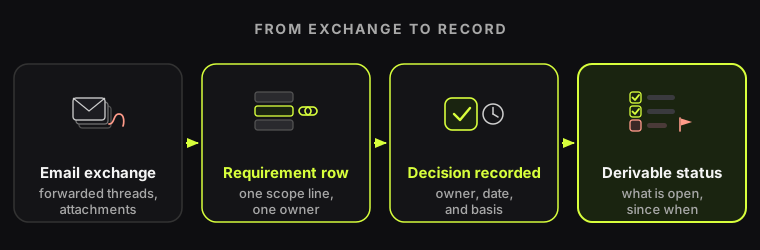
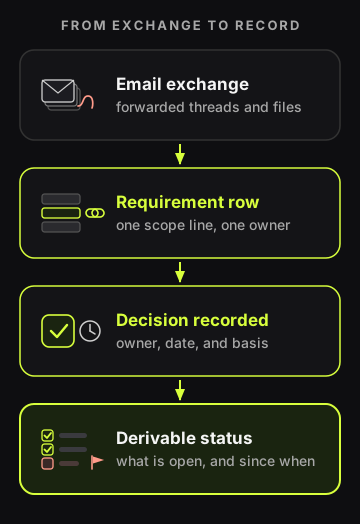
None of that removes email from the workflow. It removes email's role as the only place the bid's history exists.
What happens when a bid's audit trail is a mailbox?
The cost usually lands after the award, when somebody has to prove what was agreed. A client asserts that commissioning supervision was in scope. It was excluded, and the exclusion was accepted in a technical query response fourteen months ago, in a thread belonging to an engineer who has since left and whose mailbox was deprovisioned on schedule. The commercial position was real. The evidence is gone.
That is a documentation failure with a compliance shape, and the relevant regimes are explicit about it. ISO 9001:2015 requires documented information to be controlled under clause 7.5: available where needed, protected, with change control and defined retention. A personal mailbox satisfies almost none of those conditions. On the buy side the expectation is written down even harder. Directive 2014/24/EU obliges contracting authorities to document the progress of procurement procedures and keep documentation sufficient to justify their decisions (Article 84), and in US federal contracting FAR Subpart 4.8 requires a contract file that constitutes a complete history of the transaction. Suppliers inherit both: a prime contractor under those duties flows the same documentation demands down to the vendors who bid to it.
There is a quieter cost in the meantime. When the reasoning behind a price sits in one person's inbox, the next bid for the same client starts from scratch, and the estimator who knows why the number was what it was becomes a single point of failure the organization has no way to back up.
See what a bid of record looks like next to a mail thread
Bring one live inquiry, its specification, and the thread it is being run out of. See the same exchange as requirement rows, each cited to the page and message it came from.
Where is industrial bid management going in 2026 and 2027?
Toward a bid of record that sits underneath the inbox rather than another destination beside it. The collaboration-AI wave is making the inbox faster, which raises the value of the missing layer instead of supplying it.
Assistants inside email increase the volume and polish of messages. They do not establish which revision is authoritative, who accepted a deviation, or what is still open, because those are properties of a record and not of a conversation. Meanwhile agents are arriving on both sides of the table, with buyers reading responses using AI and bidders drafting with it, so the quantity of plausible text attached to every tender goes up and the traceability of any given claim becomes the scarce thing.
Regulation points the same way. The EU AI Act phases its obligations in across 2026 and 2027 with an emphasis on logging, documentation, and human oversight for consequential decisions, and the procurement documentation duties above have not loosened at all. The organizations that come out of this window ahead will be the ones whose bid history is a queryable asset rather than a set of personal archives. Ranger builds in that category, cited comprehension of engineered inquiry and bid documents, on the view that a bid you cannot reconstruct is a bid you cannot defend.
Key Takeaways
- A large industrial tender involves more internal functions and external parties than any single quoting system covers, so email wins the coordination by being the only tool all of them already have.
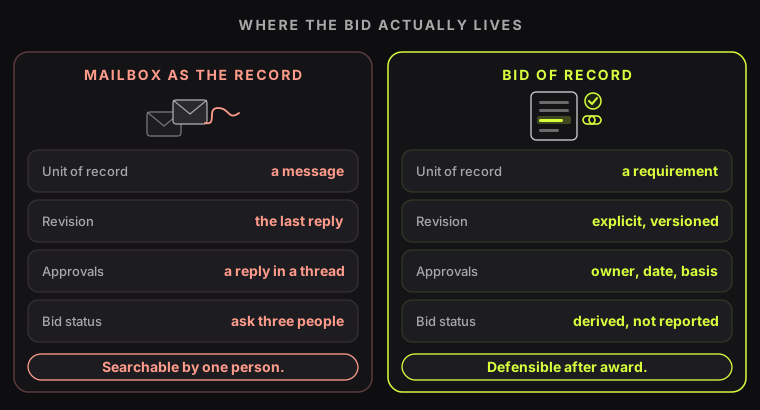
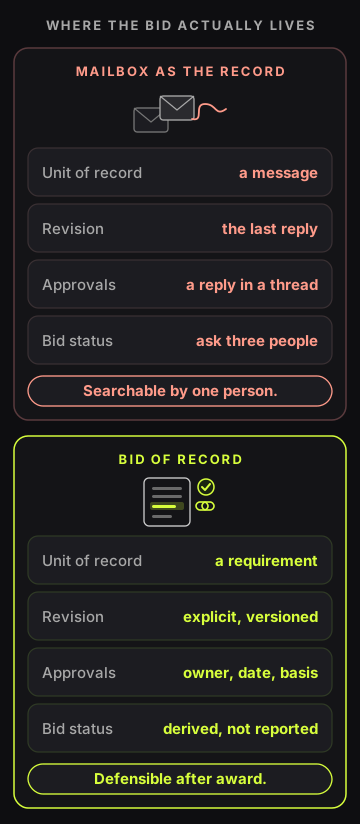
- When the exchange lives in email, the mailbox becomes the bid's system of record by default: searchable by one person, portable to nobody, and gone when they leave.
- Bid tools lose to email when they model the artifact or the pipeline stage instead of the exchange, because they ask people to re-enter what they have already sent.
- A spreadsheet bid tracker is a hand-made report of the bid's state rather than the state itself, which is why it is always slightly out of date.
- A bid of record holds requirements and decisions rather than files and messages: one owner per scope line, explicit revision authority, approvals with a date and a basis, and status that is derived instead of reported.
- Running a tender out of an inbox is a documented-information problem: ISO 9001 clause 7.5, EU Directive 2014/24/EU Article 84, and FAR Subpart 4.8 all expect controlled, retrievable evidence of how a decision was reached.
A bid you cannot reconstruct is a bid you cannot defend, and eighteen months after award that distinction stops being academic. For why this gap sits outside the CRM's remit, see ITO vs CRM, and for the revenue framing of the whole inquiry-to-order layer, see why inquiry-to-order is the revenue problem nobody is measuring. For how it lands on complex assembled scope, see our precision manufacturing page.