Search "ai proposal generator" today and the results are close to interchangeable: upload your past proposals, answer an RFP in minutes, win more deals. Nearly all of that software was built for proposals made of prose. An industrial offer is not prose. It is a priced, scoped, standards-referenced technical document that a customer will hold the supplier to for the life of the contract, and that difference decides whether AI in the proposal process is useful or quietly dangerous.
Can AI write an industrial proposal?
Partly, and the boundary matters more than the headline. AI can reliably do the retrieval and comprehension work inside a technical offer: locating the governing clause in a 400-page specification, pulling the correct datasheet revision, drafting standard commercial language, and checking that every requirement in the inquiry has a corresponding response. What it cannot do is make the engineering and commercial calls that give the offer its value, such as which frame size to propose, which clause to deviate from, and what the deviation is worth.
An industrial proposal (the technical offer, or bid) is not one document. For a pump OEM, a valve manufacturer, or an EPC contractor it is a package: a scope of supply, a clause-by-clause technical compliance matrix, a deviation and exception list, a priced bill of materials, a delivery schedule, and commercial terms. Each part has a different owner and a different failure mode. The compliance matrix is usually the first thing a buyer's engineering reviewer opens, and it is the part generic tools handle worst.
The reason is structural. Specification clauses reference standards (API 610 for centrifugal pumps in oil and gas service, the ASME Boiler and Pressure Vessel Code for pressure retaining parts, EN and ISO equivalents in Europe), and those references carry revisions, editions, and named exceptions. A sentence that is fluent and wrong about a revision is worse than a blank field, because a blank field gets asked about and a fluent wrong answer gets signed.
Why do generic AI proposal generators fail on engineered bids?
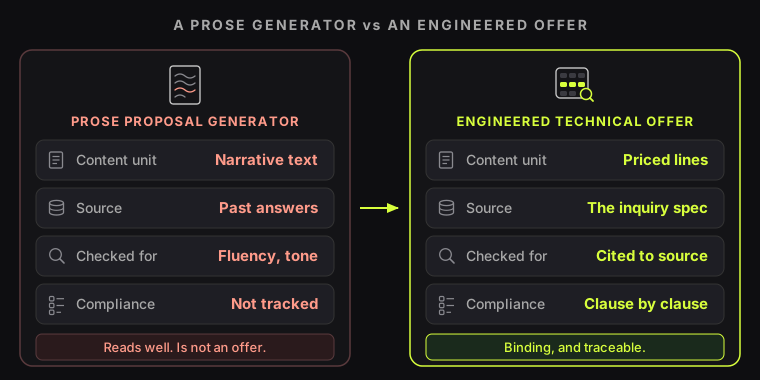
They fail because their unit of reuse is a past answer, while an engineered offer's unit is a configured scope tied to a specific specification revision. The content-library model is the industry standard for a reason, and it works well inside its lane.
Tools in the RFP response category, Loopio, Responsive (formerly RFPIO), Qvidian, and newer entrants like AutoRFP.ai, are built around a curated answer library: subject matter experts approve responses once, and the system suggests them against future questions. For security questionnaires, professional services proposals, and repeated corporate due diligence, that is genuinely the right architecture. The questions repeat almost verbatim, and a good answer stays good.
Engineered bids break all three assumptions behind that model. The questions do not repeat, because each customer writes its own specification in its own numbering scheme. The answers age, because a datasheet revision or a superseded standard silently invalidates last year's response. And the scoring is not about persuasion, because a buyer's technical evaluator is checking conformity against a requirement list, not reading for quality of writing.
The configuration side of the stack has the opposite problem. Product configurators, Tacton and Configit among them, and quoting layers like Salesforce CPQ model the product rules properly, but they assume the inquiry arrives already structured. Real industrial inquiries arrive as a PDF bundle with attached specs, a datasheet in a spreadsheet, drawings in whatever the customer's document control system exported, and half the requirements in an email. And beneath all of it sits the tool most bids actually run on: an Excel compliance matrix that someone maintains by hand.
What does industrial proposal automation actually need to do?
It needs to treat the inquiry as a requirement set and the offer as a structured, traceable response to it. Five requirements follow from that, and they are testable during an evaluation.
- Parse the inquiry as requirements, not as a document. Every "shall" in the specification, every referenced standard, and every attachment (including the specs listed in the material requisition but never actually sent) has to be resolved into a numbered requirement list before any drafting happens.
- Resolve external references to internal identifiers. Customer tag numbers, item codes, and terminology map onto the supplier's own catalog, product families, and standard scope. This mapping, not extraction accuracy, is where most industrial document AI actually stalls.
- Produce a compliance matrix, not a narrative. The primary output is a clause-by-clause table: comply, comply with deviation, or not applicable, with the response written at the level of the clause. Narrative sections are assembled from that table, not the other way around.
- Treat the deviation list as a first-class output. Deviations are simultaneously an engineering statement and commercial armor against post-award change orders and back-charges. They deserve to be generated, reviewed, and versioned deliberately, not buried at the end of a Word file.
- Cite every answer back to its source. Each populated cell should open to the exact page and clause it came from, in the customer's spec or the supplier's own datasheet, so an engineer can verify it rather than trust it. Verification is what makes machine-drafted content usable in a binding document.
Nothing in that list removes the estimator or the proposal engineer. It removes the eight hours of locating, transcribing, and cross-checking that sit in front of every decision they make.
What do the market signals say about proposal AI in 2026?
The market is moving toward autonomy faster than it is moving toward verifiability, and industrial bidding is where that gap gets expensive. Gartner has projected that a third of enterprise software will embed agentic AI by 2028, and has separately introduced the idea of guardian agents whose job is to check other agents' output. That is an admission worth reading plainly: an unverified generated answer is a liability wherever the document is binding, and a technical offer is binding.
The regulatory direction points the same way. The EU's Machinery Regulation (EU) 2023/1230 replaces the 2006 Machinery Directive and applies from January 2027, tightening what technical documentation has to state and how it is kept. Suppliers selling into Europe will be asked to be more precise, in their offers and afterwards, about conformity claims they used to make loosely. Precision at that level is a document problem before it is a legal one.
See what proposal automation looks like on an engineered offer
Watch a comprehension layer read a full inquiry package, build the compliance matrix clause by clause, and cite every answer back to the source document.
Where is industrial proposal automation going?
The category is splitting into tools that generate and tools that comprehend, and industrial bidding is going to buy the second kind. Three currents are pushing that split in 2026 and 2027. Quoting stacks are being reconsidered as vendors retire long-standing products and consolidation continues in the configure, price and quote market that Gartner tracks. Agentic tooling is arriving in procurement on both sides of the table, which means offers will increasingly be read by machines as well as written with them. And documentation obligations like the EU Machinery Regulation are raising the cost of an imprecise conformity claim.
What survives that is not the fastest generator. It is the layer that can read an inquiry package the way a proposal engineer reads it, resolve the customer's language onto the supplier's own catalog, and show its work at the clause level. Ranger builds in that category, cited comprehension of engineered inquiry and bid documents, on the view that in industrial revenue work an answer is only worth what you can trace it back to.
Key Takeaways
- An industrial proposal is a package (scope of supply, compliance matrix, deviation list, priced bill of materials, schedule, terms), not a narrative document.
- AI handles the retrieval and comprehension layer of a technical offer well, while the engineering and commercial decisions stay with the bid team.
- Generic AI proposal generators are built on a library of past answers, which fails when every customer writes its own specification and revisions silently invalidate old responses.
- Product configurators model the product correctly but assume a structured inquiry, while real industrial inquiries arrive as PDF bundles, spreadsheets, drawings, and email.
- The primary output of industrial proposal automation should be a clause-by-clause compliance matrix with a first-class deviation list, not assembled prose.
- Every generated answer needs a citation that opens to the exact page and clause, because a technical offer is a binding document and a confident wrong sentence is worse than a blank field.
The proposal is where industrial revenue is actually won or lost, which is why it deserves better than a text generator. We go deeper on the speed-versus-accuracy tradeoff in responding to a 400-page EPC RFP and on the gap between vendor claims and shipped capability in AI RFP automation in 2026. For how this plays out on complex assemblies, see our precision manufacturing page.