For spec-driven engineering tenders, the Responsive alternatives worth shortlisting are the tools that read the tender package and your own engineering documents, and cite the page for every answer. Responsive, formerly RFPIO, is a good content library, and a library answers from what your team wrote before. A tender built on a specification, datasheets and a deviation list asks about documents that library has never seen. Responsive's Spring 2026 release shows where the product is going: it adds automation for the portals where buyers collect third-party questionnaires, and most of the portals it names are vendor-risk and security review platforms.
What is Responsive built for in 2026?
Responsive, formerly RFPIO, is a response management platform for sales, proposal and security teams that answer RFPs, RFIs, DDQs and security questionnaires from a shared content library. Capterra's vendor profile calls it best suited to mid-size and large businesses in technology, finance and healthcare, and lists a 4.5 rating across 190 reviews. Responsive itself says it serves 450,000+ users and 25% of the Fortune 100.
The last two product releases show where it is heading. The Fall 2025 release added a Fit Analysis Agent that "reviews RFPs to surface key requirements, risks, and red flags" and returns a fit score for the go/no-go call. It also added an Executive Summary Agent and a Content Health Dashboard that measures the accuracy, freshness, duplication and compliance of the knowledge base, and it announced the acquisition of the Australian bid management company Bidhive.
The Spring 2026 release, dated 13 May 2026, did two things. An MCP server now puts Responsive inside ChatGPT, Microsoft Copilot and Claude. A Portal Automation beta, for Chrome and Edge, completes questionnaires in portals such as Whistic, OneTrust, Coupa, Venminder, BitSight, Hologic, ProcessUnity and UpGuard.
Responsive describes the output in both releases as grounded in approved sources and traceable. For a sales team that is a sensible promise, because the approved source is a library someone curates. In both releases the agents read the incoming request, and the answers come from content the team has already written. Neither release describes reading a specification, a datasheet or a drawing set.
Where does a library-first tool stall on spec-driven engineering tenders?
It stalls when the question is about a document the library has never seen. An engineering tender asks whether this equipment meets this specification, and no earlier answer can settle that. Responsive's pages cover answer reuse, go/no-go analysis and portals. They do not mention checking an offer against a specification or building a deviation list. Responsive does not say it cannot do either, so treat this as a description of what its pages cover, and test the rest.
Picture a bid engineer at a valve manufacturer opening a new package: instructions to bidders, a project specification, datasheets in Excel, a list of referenced standards, a scanned vendor document list and a set of drawings. Halfway through the bid an addendum changes the design pressure. Three jobs follow, and each one starts from the package.
The engineer checks the offered valve against each clause of the specification. Every point where the offer departs from the text goes onto the deviation list, which becomes part of the contract if you win. And the new pressure has to reach every answer that depended on the old one.
Reviewers describe the library side of this. A commenter on r/salesengineers who started on RFPIO wrote in January 2025 that "the library is horrible to maintain". A senior presales director on Capterra wrote in March 2026 that "the AI capabilities are still immature, and the generated answers always need to be reviewed", while calling the core functionality solid. A December 2024 reviewer asked for custom fields because "it is really important the AI doesn't give wrong info based on wrong product version". On a tender, the wrong product version is a superseded datasheet revision.
These reviewers mostly work in sales and proposal teams, and the same pages carry plenty of praise. The common thread is upkeep, and upkeep gets heavier when every answer depends on a document that keeps changing.
What should you test before choosing among Responsive alternatives?
Run your last tender through each tool and score it on five points. A demo on the vendor's sample package proves little, because your package has the scans, the odd file formats and the addendum.
- It reads the whole package. Requirements come out of the instructions to bidders, the specification and the datasheets as separate lines, and scanned pages and drawings are read too, not skipped.
- It cites the page. Every answer names the document, the revision and the page, so a reviewer opens the source and checks it instead of rewriting from memory.
- It lists deviations against your own standard. Give it your standard terms and your datasheet, and see whether it flags each point where the buyer's text differs, with a proposed position per clause.
- It follows revisions. Swap in a revised datasheet midway through the test and see whether the affected answers change and say why.
- Your data stays in your environment. Ask where documents are stored, whether any model trains on them, and which deployment options exist, since engineering files often carry NDA terms.
How do Responsive alternatives compare on an engineering bid?
The table sets five tools side by side on the points an engineering bid team weighs. Three are content libraries, one is a co-authoring tool, and one reads the documents.
| Tool | Built around | Fits best | Watch on an engineering bid | Price signal |
|---|---|---|---|---|
| Responsive (formerly RFPIO) | Content library with AI agents for RFPs, DDQs and security questionnaires | Sales, proposal and InfoSec teams at mid-size and large companies | Agents read the RFP; its pages do not mention specifications or datasheets | Median $14,750 a year (Vendr) |
| Loopio | Library of approved answers with connectors to company content sources | SaaS, financial services, healthcare, business services | Technical sections still start from the project documents | Median $24,318 a year (Vendr) |
| XaitPorter | Co-authoring of large tender documents with a content library | Energy teams with many contributors per submission | Solves assembly and version control; tracing each requirement is a separate job | Ask the vendor |
| Upland Qvidian | Approved content library, AutoFill and generative AI Assist | Sales teams producing proposals, RFPs and questionnaires | AI Assist drafts from library content; test its RFP queries on a datasheet | Ask the vendor |
| Ranger | Reads the tender package and your engineering documents, cites the page for every answer | EPC contractors, equipment OEMs, technical bid teams | Newer category: check security and deployment fit | Ask the vendor |
Price is the easy column. Vendr's data puts the median Responsive contract at $14,750 a year across 133 purchases, in a range of $5,518 to $40,303. The median Loopio contract is $24,318 across 269 purchases, between $11,770 and $59,147. Neither vendor publishes list prices, and Capterra marks Responsive's starting price as not provided by the vendor.
Fit is the hard column. Upland describes Qvidian AI Assist as drafting new answers from existing library content, with queries that extract key information from RFPs, sold as an optional add-on at an extra fee. Xait calls XaitPorter "tailor-made for writing large RFP documents, tenders, proposals, contracts, and bids". If many contributors assembling one document is your real problem, start with the XaitPorter alternatives comparison.
See a technical tender answered from your own documents
We'll show you how it works: requirements read from the package, and each answer linked to the page of the specification or datasheet it came from.
Responsive or Loopio on an engineering tender?
Neither has a structural edge on a spec-driven tender, because both answer from a library, so decide on price, interface and team size. In Vendr's data the Responsive median sits about $9,600 a year below Loopio's.
The products lean differently. Responsive pushes agents for fit analysis and executive summaries, and now reaches outward into ChatGPT, Copilot and Claude. Loopio's own site stresses content connectors to SharePoint, Google Drive and websites, and collaboration through Salesforce and Copilot 365. Both help a team find what it has already written faster. Run the revision test on both: swap in a revised datasheet and see whether the answer changes. The longer read on that product is in Loopio alternatives for engineering and industrial bid teams.
When should you stay on Responsive?
Stay when most of your volume is sales RFPs, DDQs and security questionnaires, because that is the work the library was built for. A UK reviewer wrote on Capterra in April 2026 that Responsive "required some upkeep to get the most value out of it" and still reduced manual effort. A library pays back when someone owns its content.
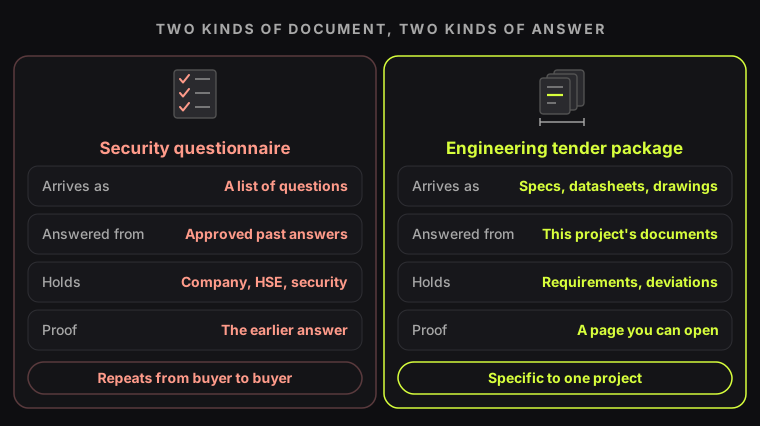
Most engineering companies answer both kinds of request. Company profile, HSE policy, insurance, quality certificates and security answers repeat across every bid, and a library holds them well. The technical sections, spec compliance, deviations and datasheet values, come from the project documents. Splitting the bid by where the answer lives lets you keep the library you pay for and add a document-grounded tool for the sections that decide the award.
A full switch makes sense only when engineering tenders are the bulk of your volume. Otherwise you pay for a second tool to do the library's job.
Key Takeaways
- Responsive, formerly RFPIO, is a library-first platform for sales, proposal and security teams, and its 2025 and 2026 releases add agents, an MCP server and portal automation around that library.
- Responsive's pages do not mention reading specifications, datasheets or drawings, so test that step on your own tender package.
- Five tests separate the tools: it reads the whole package, cites the page, lists deviations against your standard, follows revisions and keeps your data in your environment.
- Vendr's median contracts are $14,750 a year for Responsive and $24,318 for Loopio, and both libraries share the same model on a technical tender.
- Keep a library for company, HSE and security answers, and add a document-grounded tool for the technical sections.
- Stay on Responsive when most of your volume is questionnaires and an owner keeps the library current.
Ranger builds in the document-grounded category, and the RFP response page shows what that looks like for engineering teams. For the other two common starting points, see the Loopio and XaitPorter comparisons.