EPC companies automate the reading and the comparing in technical bid evaluation and commercial bid evaluation: the completeness check against the specification and datasheets, the deviation list, the technical query log, and the work of putting commercial offers on one basis. Teams that automate this keep technical acceptance and the recommendation of award with the engineer.
The reading is where the clerical effort sits. A pump package arrives as a bundle per bidder: datasheets, a deviation list, an exclusions page, a quality plan and a price schedule laid out differently by every vendor.
What are TBE, CBE and bid tabulation?
Technical bid evaluation (TBE) is the review of each bidder's technical offer against the specification, the material requisition and the datasheets, line by line, before prices are discussed. imHORA's procurement guide puts it the same way: every offer is checked against the data sheets and deviations are cleared first. A TBE template is usually a compliance matrix with one row per requirement and one column per bidder. The output is a list of technically acceptable bids.
Commercial bid evaluation (CBE) compares the commercial offers of those bids: price, currency, delivery basis, payment terms, delay damages, warranty, and the cost of whatever a bidder left out.
Bid tabulation is the table CBE produces, bidders in columns and price plus adjustments in rows. Teams call it the bid tab. The work of making offers comparable is bid levelling, which iSpec's EPC procurement guide describes as adding the cost of scope gaps to each bid to produce a comparable "should cost". In many firms the bid tab is still the system of record.
What is the sequence of an EPC technical and commercial bid evaluation?
Bids arrive in two envelopes, pass a completeness check, go through TBE and a clarification loop, reach a technically acceptable list, and only then are priced, levelled and, where the process calls for it, put through a best and final offer round before the recommendation of award.
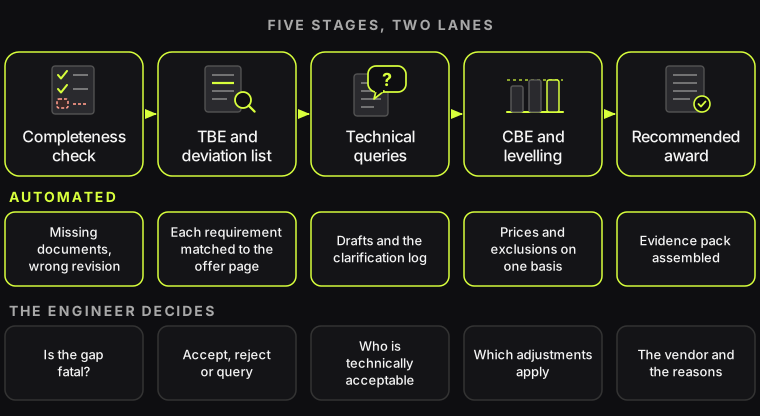
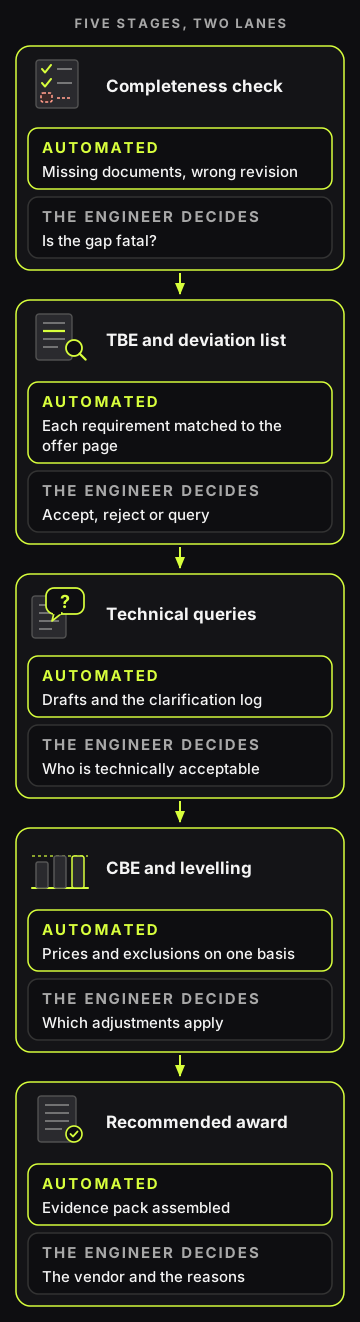
| Step | What gets automated | What the engineer decides | Output |
|---|---|---|---|
| Bids received | Intake and filing of each bidder's files by envelope | Who is invited and when envelopes open | Register of received bids |
| Completeness check | Missing documents, wrong revision, validity period | Whether a gap is fatal or can be cured | Responsive list |
| TBE | Each requirement matched to the offer with its source page | Whether an offer meets the intent of a clause | Compliance matrix |
| Deviation list | Deviations and exclusions extracted and numbered | Accept, reject or query each one | Deviation list with status |
| Technical queries | Drafts, log and tracking of answers | What to ask and whether the answer closes it | Clarification log |
| Technically acceptable list | Compiled from the matrix and the log | Which bidders qualify | Technical recommendation |
| Price opening and levelling | Prices, currency, exclusions and terms put on one basis | Which adjustments apply and how to price a gap | Bid tab |
| Abnormally low bid check | Bids far below peers or the estimate flagged | Whether the bidder can deliver at that price | Written clarification record |
| BAFO | Revised offers compared with the first round | Whether to run the round and with whom | Updated bid tab |
| Recommendation of award | Evidence pack assembled | The vendor and the reasons | Award recommendation |
Technical side: from sealed bids to the acceptable list
Major packages usually run on two envelopes. iSpec calls two-envelope tendering best practice for major EPC packages: the commercial envelope stays closed until technical evaluation is complete. The World Bank's Procurement Regulations for IPF Borrowers (7th edition, September 2025) write the same rule down: financial proposals are kept unopened at the first opening (para 5.45), and only bidders that met the technical requirements have their financial proposals opened (para 5.46). imHORA lists the opposite habit as a common mistake: opening prices before the TBE, so the technical review bends toward the cheapest offer.
The completeness check comes first, so no engineer spends a day on a bid that cannot be accepted. It asks whether the required documents are there and whether the bid rests on the right revision of the requisition. Red Bag's technical evaluation procedure, a published EPC procedure, tells the evaluator to check exactly that, down to the issue number. Validity belongs here too. The World Bank text requires the validity period in the request to cover evaluation, approvals and award (para 5.39), so a bid that expires earlier has a problem before anyone reads its datasheets.
TBE proper takes each requirement from the specification, the material requisition and the datasheets and finds the answer in the offer. Red Bag lists what the evaluator watches: technical details, the vendor's QA and QC manual, deviations and exclusions. By hand, the slow part is locating the answer. It can sit in a datasheet cell, a footnote, a covering letter or a scanned vendor drawing.
The deviation list collects every departure from the requirement, whether the bidder declared it or the evaluator found it. The Red Bag procedure has the evaluator list each unacceptable deviation and exception and has the deviation list discussed at the pre-award meeting. The deviation list is a contract document once it is agreed, which is why its status column matters.
Technical queries close what the matrix cannot. Per the same procedure, the buyer issues the evaluator's clarification requests and asks for revised bids from vendors whose deviations are unacceptable. iSpec adds a limit: post-bid clarifications must not let a vendor modify its bid. Every round goes into the technical query log, the record that shows whether a round-two answer changed a requirement already priced. The technically acceptable list is what is left when the matrix, the deviations and the queries are closed.
Procedures differ on order: the Red Bag text has Purchasing preselect quotations commercially before the engineer evaluates them, while iSpec and imHORA put technical evaluation first.
Commercial side: from price opening to the recommendation
With technically acceptable bids in hand, prices open. Levelling then turns each bidder's offer into a comparable cost. imHORA's adjustments for equipment: currency at the rate in the award plan, a delivery basis brought to landed at site, the delivery date priced as weeks late times the weekly cost of delay less recoverable delay damages, the finance cost of advance payments, and witnessed factory acceptance tests and spares if excluded. Scope gaps go on the same list. If the scope in the bid tab departs from the scope in the client contract, the Red Bag procedure calls for a change order.
A bid far below the rest gets a separate check. The World Bank defines an abnormally low bid as one whose price, with other elements of the bid, raises material concerns about the bidder's capability to perform at that price (para 5.65). The buyer seeks written clarification with a detailed price analysis (5.66) and rejects the bid if the bidder cannot demonstrate capability (5.67). Software can flag the outlier; the buyer decides.
The best and final offer (BAFO) round invites the remaining bidders to improve their commercial terms once, after levelling. Not every process has one: the World Bank's two-envelope paragraphs quoted above apply to processes with no BAFO or negotiations.
The recommendation of award closes the sequence. When risk-adjusted totals are close, imHORA notes, the decision moves to non-price factors written into the award plan. Red Bag requires the reasons for the recommended vendor to be stated and the bid analysis to be approved by the personnel the procedure lists.
How does the evaluation run on a pump package? (Illustrative example)
This is an illustrative example, not a customer case, and every figure in it is invented and rounded. Three bidders, A, B and C, quote two API 610 centrifugal pumps for a hydrocarbon transfer service.
Reading each offer against the datasheet produces the compliance matrix, and one line stands out. The datasheet caps required NPSH at 4.0 m at rated flow. Bidder B quotes 4.6 m on its curve and lists "standard design" in its deviation list. The engineer does not reject B on the spot. Whether 4.6 m works depends on the NPSH available at site, a number that lives in the process data and not in B's bid. A technical query asks B for the curve at the guaranteed point. Until the answer arrives, B stays on the list as conditional.
Prices come out of the second envelope. Headline totals for the two pumps, on the same delivery basis, are 170,000 for C, 183,000 for B and 190,000 for A. C looks lowest by a wide margin. Its exclusions page leaves out commissioning spares, which A and B include at 12,000 and 14,000. The evaluator adds a spares line to C and uses the higher figure until C prices it, so that an exclusion cannot win the comparison. C moves to 184,000.
The order is now B at 183,000, C at 184,000 and A at 190,000, which differs from the headline order. The gap between first and second is 1,000, smaller than the uncertainty in the spares adjustment, so the tab does not settle the choice. B's open NPSH query does, and an engineer writes the reasons down.
Where does automation stop in bid evaluation?
Automation stops at the decisions that carry accountability: accepting a deviation, taking a commercial risk, and weighing a vendor's history. Each depends on information outside the bid, or on a judgement someone has to sign.
Accepting a deviation is a design decision. B's NPSH figure is a number anyone can extract, but only the process and mechanical engineers can say whether the margin at site is enough. The same holds for a different seal arrangement or a substituted material. Autonomous scoring is the wrong frame for this reason.
Commercial risk depends on the project. The cost of a week of late delivery comes from the project programme. Whether a large advance payment or a cap on delay damages is tolerable is a call for the people who carry the exposure.
Vendor history sits outside the documents. The Red Bag procedure says the company's experience with a vendor's QA and QC system shall be considered, and that experience lives in project files and in people's memories. A tool can surface what was written down.
What should you check in a bid evaluation tool?
Test whether it shows its work, copes with real bid files and leaves decisions to people. Six checks apply to any tool:
- Pick a compliance result and ask for the offer page and the specification clause it was read against. If you cannot open both, the result is a claim.
- Give it a bid with a deviation buried in a datasheet footnote or an exclusions page, plus a scanned page and a drawing, and see what it finds.
- Change the requisition revision mid-evaluation and ask which bids were read against which revision.
- Look for the levelling arithmetic. Each adjustment should be its own line, with a stated basis that an engineer can edit.
- Check who sets status. Accept, reject and query should be recorded as a named person's decision with a date.
- Ask where bid documents are stored, who can read them and whether they are used to train models.
How does Ranger handle technical and commercial bid evaluation?
Ranger reads each supplier's offer against the specification and contract terms and flags deviations and exclusions, each with a citation to the source page. It compares sub-vendor offers and costs line by line and brings the offers onto one basis. It reads PDFs, Word files, Excel sheets, scans and drawings. Scoring and the award stay with the evaluation team. The tender evaluation page describes the workflow.
See a bid evaluation worked through from the offers
We'll show you how it works: each offer read against the specification, and every flagged deviation linked to the page it came from.
Key Takeaways
- EPC companies automate the reading and comparing in technical and commercial bid evaluation, and keep technical acceptance and the recommendation of award with the engineer.
- Bid levelling brings each offer onto one basis by pricing scope gaps, exclusions, currency, delivery basis, payment terms and delay damages, and the result is the bid tab.
- A two-envelope process keeps prices closed until technical evaluation (TBE) is done, and commercial bid evaluation (CBE) then compares the technically acceptable bids.
- An abnormally low bid needs a written clarification with a price analysis before the buyer accepts or rejects it.
- Automate the reading, and leave the decisions to accept a deviation, take a commercial risk and weigh vendor history with named people.
For what an issuer's committee scores once the technical list is closed, read inside the bid evaluation room. EPC teams will find the wider workflow on the infrastructure page.